The story
Wrapped around a shimmering lake high in the Cardamom Hills of the Western Ghats, Periyar Tiger Reserve at Thekkady is one of India’s most-loved wildlife destinations — a place where you glide silently past herds of elephants, watch the drowned forest’s leafless stumps rise from the water, and step into misty jungle trails guided by former poachers turned protectors.
The story of Periyar Tiger Reserve
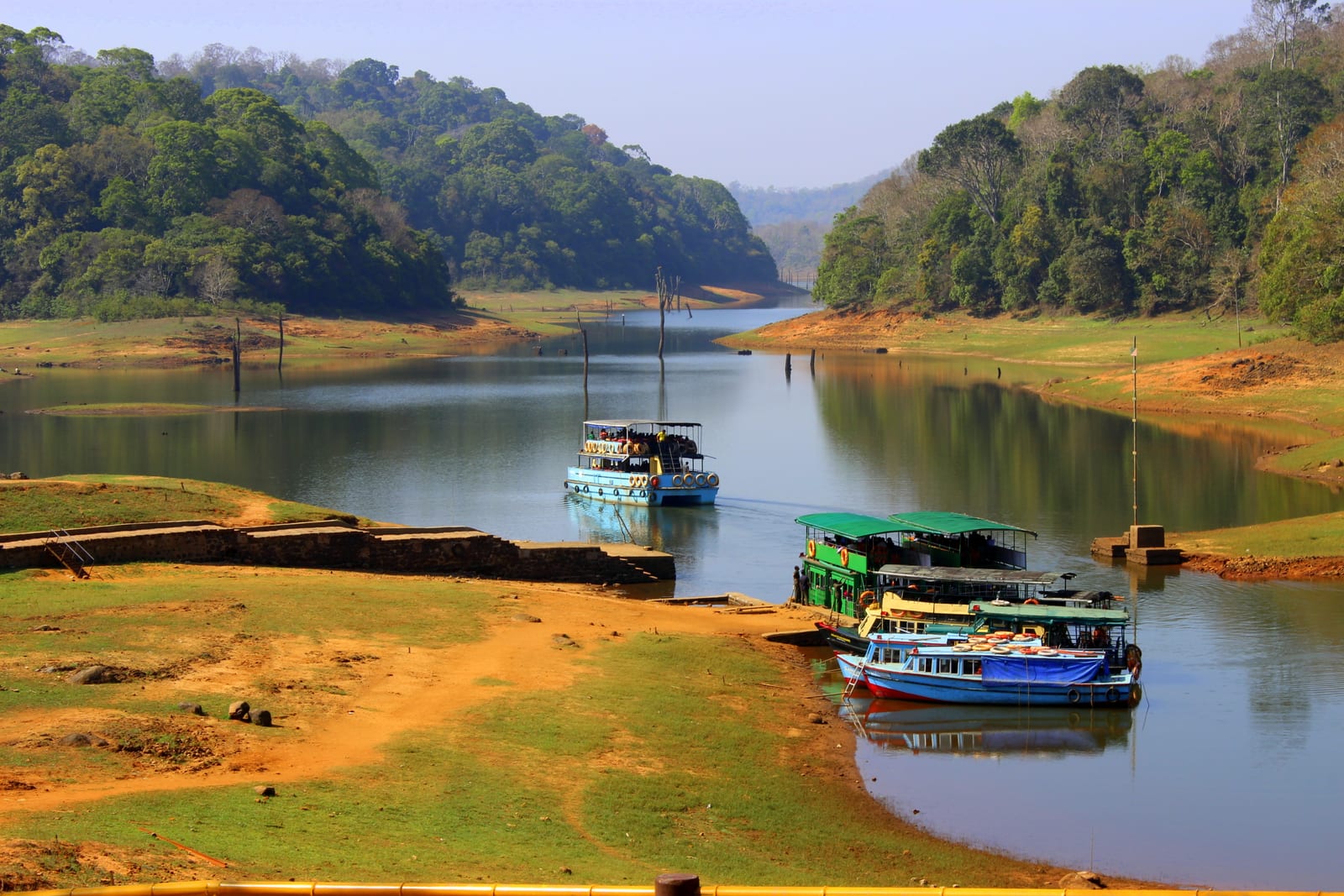
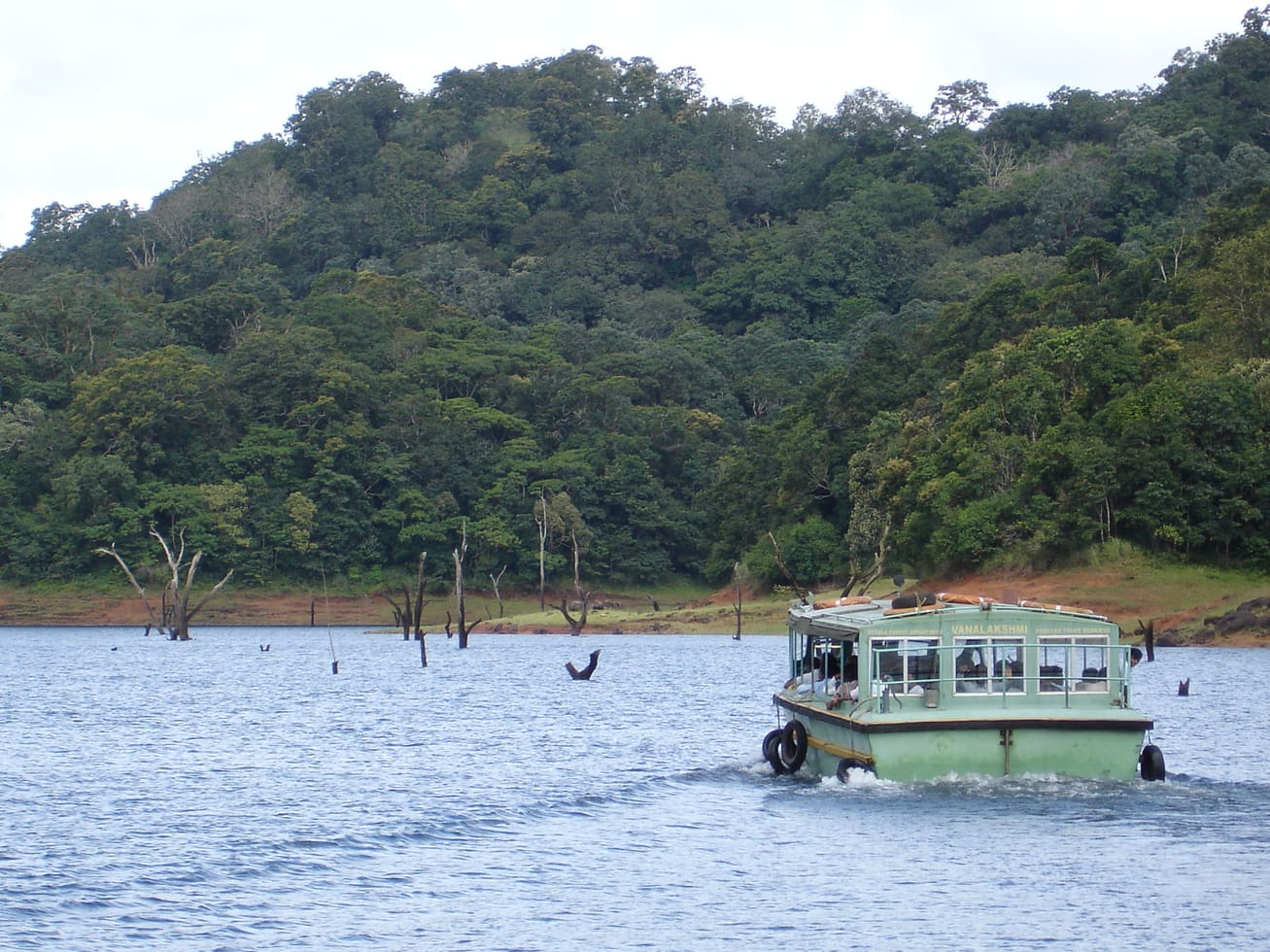
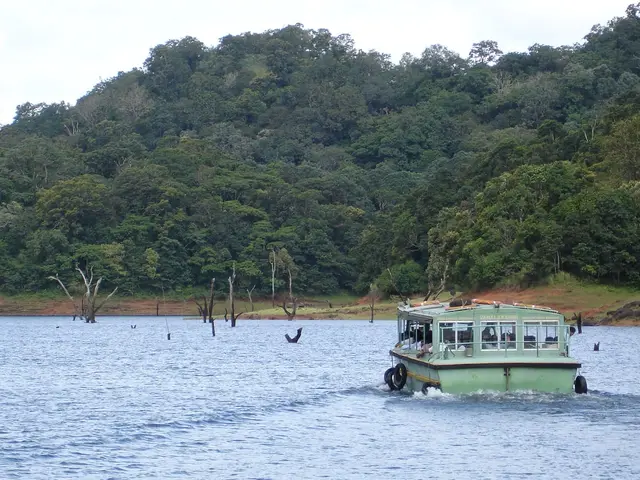
The heart of Periyar is its lake, and the lake itself is a beautiful accident of engineering. It did not exist until 1895, when British engineers dammed the west-flowing Periyar river to divert its waters east into the rain-shadowed plains of Tamil Nadu. As the reservoir filled behind the Mullaperiyar Dam, it drowned a swathe of forested valley — and the tallest trees never fully vanished. Their bleached, skeletal trunks still stand in the shallows today, a ghostly drowned forest that gives the lake its haunting, unmistakable character and doubles as favourite perches for cormorants and darters.
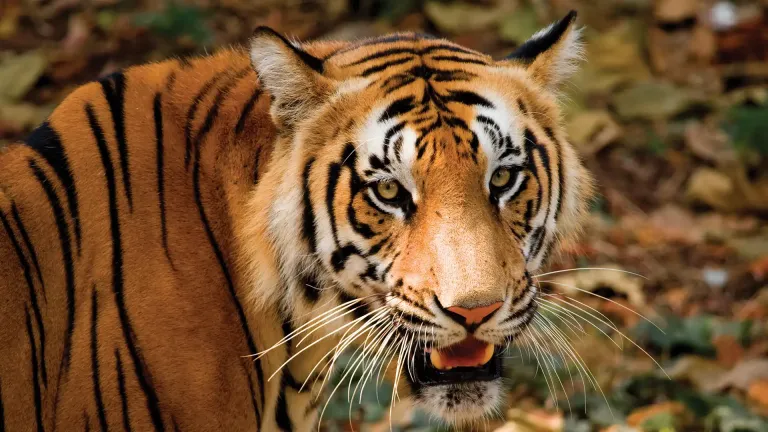
The classic Periyar experience is the boat cruise. For roughly ninety minutes a launch tracks the fingers and inlets of the lake, and the show is the shoreline: elephants padding down to drink and bathe, gaur grazing on open grass banks, sambar deer stepping warily to the water, wild boar rooting in the mud, and otters slipping between the stumps. Tigers give the reserve its name but are famously elusive — Periyar is far more reliably an elephant sanctuary than a big-cat safari, and most visitors treasure it for that quieter, water-level intimacy with wildlife rather than a guaranteed roar.
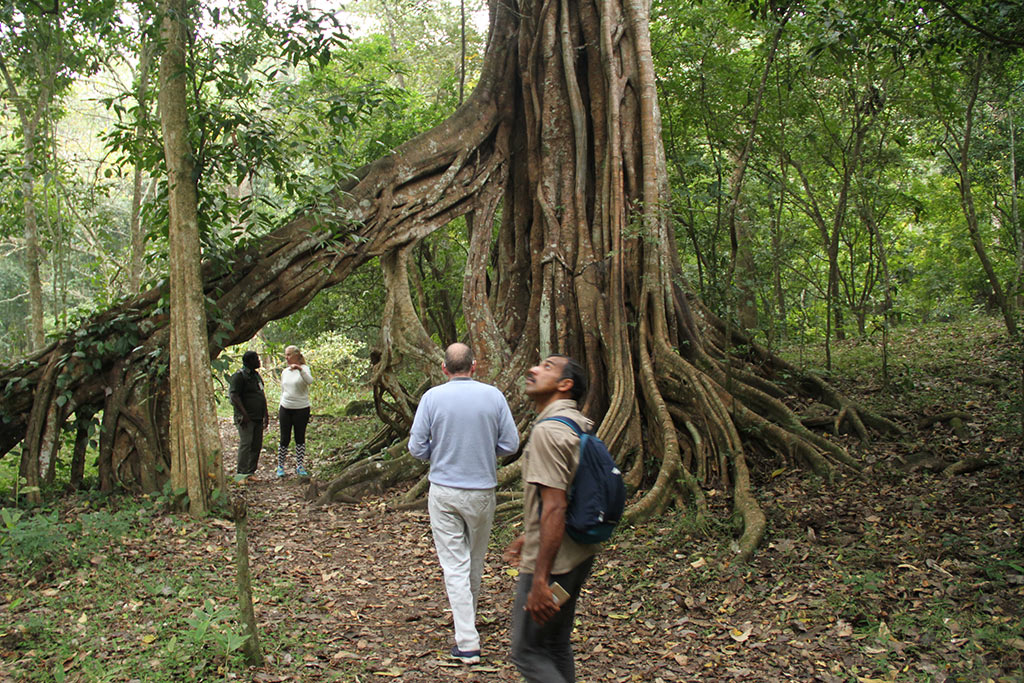
Away from the boats, Periyar has quietly become a model for community-based ecotourism. Some of its most memorable programmes — dawn border hikes, the Tiger Trail trek, jungle patrols and the celebrated bamboo rafting — are led by guides drawn from the reserve’s own tribal communities, and many were once poachers and sandalwood smugglers who now earn their living protecting the forest they once plundered. Walking a jungle path behind an armed forest guard and a guide who can read every track and alarm call is a very different thrill from the deck of a boat.
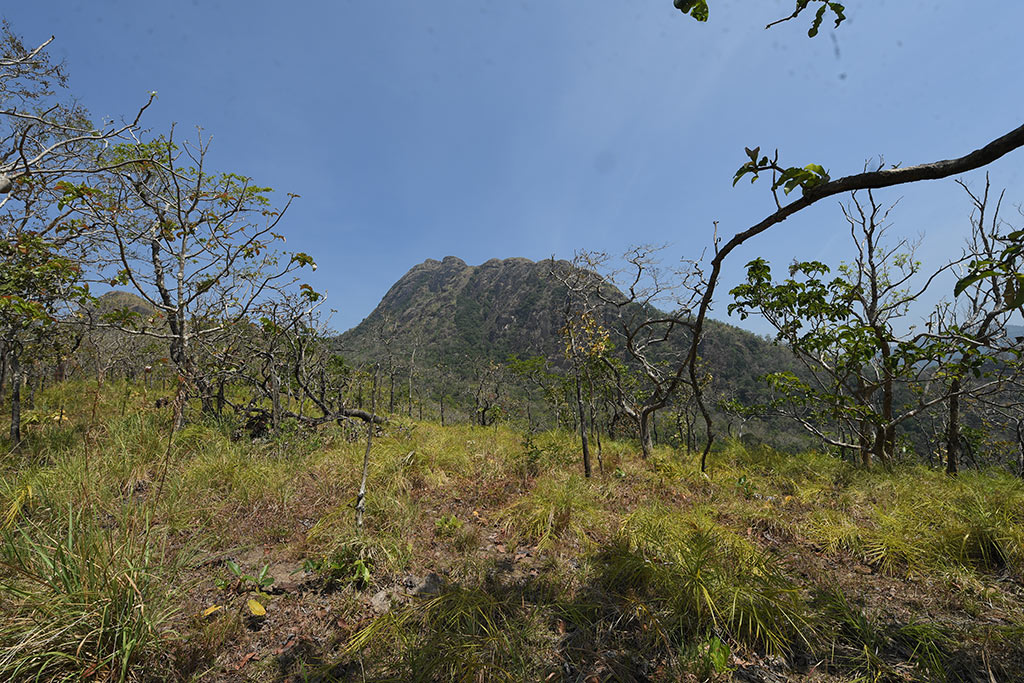
The forest around the water is classic Western Ghats country — moist evergreen and semi-evergreen jungle threaded with grasslands, laced with the scent of the cardamom, pepper and coffee plantations that ring the reserve. This is prime habitat for rarities: the lion-tailed macaque with its silver mane, the glossy black Nilgiri langur, the Malabar giant squirrel, and more than 260 species of bird from the great hornbill to kingfishers and the endemic Nilgiri wood pigeon.
The gateway to it all is Kumily, a lively spice-market town just outside the reserve boundary, with Thekkady — the lake and jungle zone — lying a few kilometres inside. Between the boat landing, the plantation walks, the ayurvedic spas, the Kathakali and Kalari shows and the pepper-scented shops of Kumily, Periyar rewards a stay of a couple of days rather than a rushed day trip.
Legend & myth
High in the reserve, near the Tamil Nadu border, sits the remote hilltop shrine of Mangala Devi (Mangaladevi Kannagi Temple), and it carries one of South India’s most powerful legends. The goddess here is identified with Kannagi, the wronged heroine of the ancient Tamil epic Silappadikaram. When her husband Kovalan was falsely accused of theft and executed by the king of Madurai, Kannagi — so the legend runs — tore off her breast and flung it at the city, cursing it to burn, before wandering into these very hills where she was deified as Mangala Devi.
The ancient granite temple is said to date back many centuries and lies deep inside the tiger reserve, so it opens to pilgrims only once a year, on the full-moon day of Chithra Pournami (April–May), when devotees from both Kerala and Tamil Nadu climb up for worship. Visiting at other times requires special permission from the forest authorities.
History
The story of the modern reserve begins with water. In 1895 the Mullaperiyar Dam was completed across the Periyar river as a British-era irrigation project, and the reservoir it created — the Periyar Lake — flooded the valley floor and became, unexpectedly, the nucleus of what is now one of India’s finest wildlife landscapes.
Formal protection followed the water. The forests around the new lake were declared a reserve forest in 1899, and in the 1930s the tract was set aside as a game sanctuary (the Nellikkampatty Game Sanctuary) under the Maharaja of Travancore, chiefly as a private shooting and hunting preserve for the ruling house and its guests.
In 1950, after Indian independence, the area was reconstituted and enlarged as the Periyar Wildlife Sanctuary, shifting the emphasis decisively from hunting to conservation. The lake, the drowned forest and the surrounding evergreen jungle were now managed to protect their wildlife rather than provide sport.
The reserve’s defining moment came in 1978, when Periyar was brought under the Central Government’s Project Tiger scheme and declared a Tiger Reserve — among the earliest in the country. A core national-park zone was later notified in the early 1980s, and the reserve was also folded into Project Elephant, reflecting its outstanding importance as an elephant habitat within the Cardamom Hills of the Western Ghats.
Running through all of this is a human history often overlooked by visitors. Several indigenous communities — among them the Mannan, Paliyan, Malampandaram, Urali and Ulladan — have lived in and around these hills for generations, and in recent decades the reserve’s pioneering community-based ecotourism has turned local knowledge, and even former poachers, into the backbone of its protection and its guided programmes.
Why visit
The lake boat cruise is unlike any other Indian safari — you watch elephants, gaur, sambar and otters from the water rather than a jeep, drifting silently past a drowned forest of standing tree stumps that makes the scenery genuinely unforgettable.
It is one of the most reliable places in India to see wild elephants in a natural setting, with herds regularly coming down to the lake shore to drink and bathe, especially in the dry months.
Periyar is a birdwatcher’s paradise, home to more than 260 recorded species including the great hornbill, kingfishers, darters and Western Ghats endemics, all easily observed along the water’s edge.
Its community-based ecotourism is a rare feel-good story in wildlife tourism — hikes, jungle patrols and bamboo-rafting trips led by tribal guides, many of them reformed poachers now protecting the forest, offer a deeper, on-foot experience than the boat alone.
The reserve sits amid the fragrant spice country of the Cardamom Hills, so a visit pairs jungle and lake with plantation walks through cardamom, pepper and coffee, plus the buzzing spice bazaar of Kumily just outside the gate.
As a flagship Project Tiger and Project Elephant reserve in the Western Ghats — a UNESCO-recognised global biodiversity hotspot — Periyar lets you experience a landscape of real conservation significance while still being an easy, family-friendly destination.
_13072018164535.jpg)