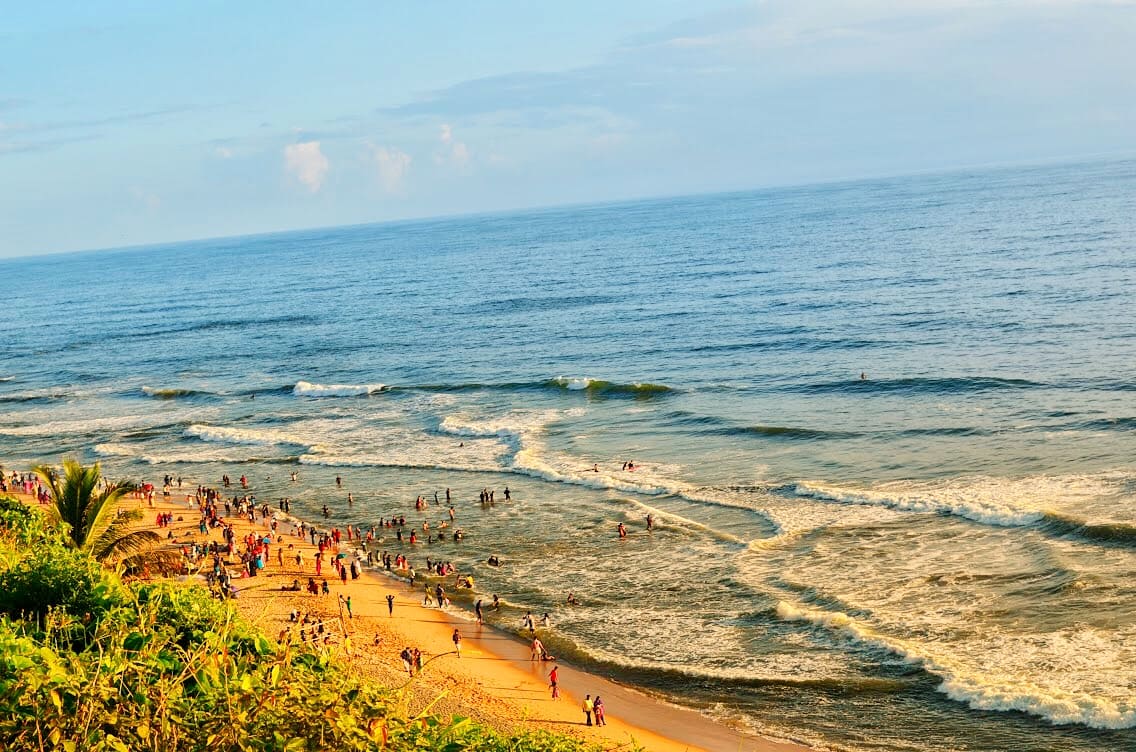
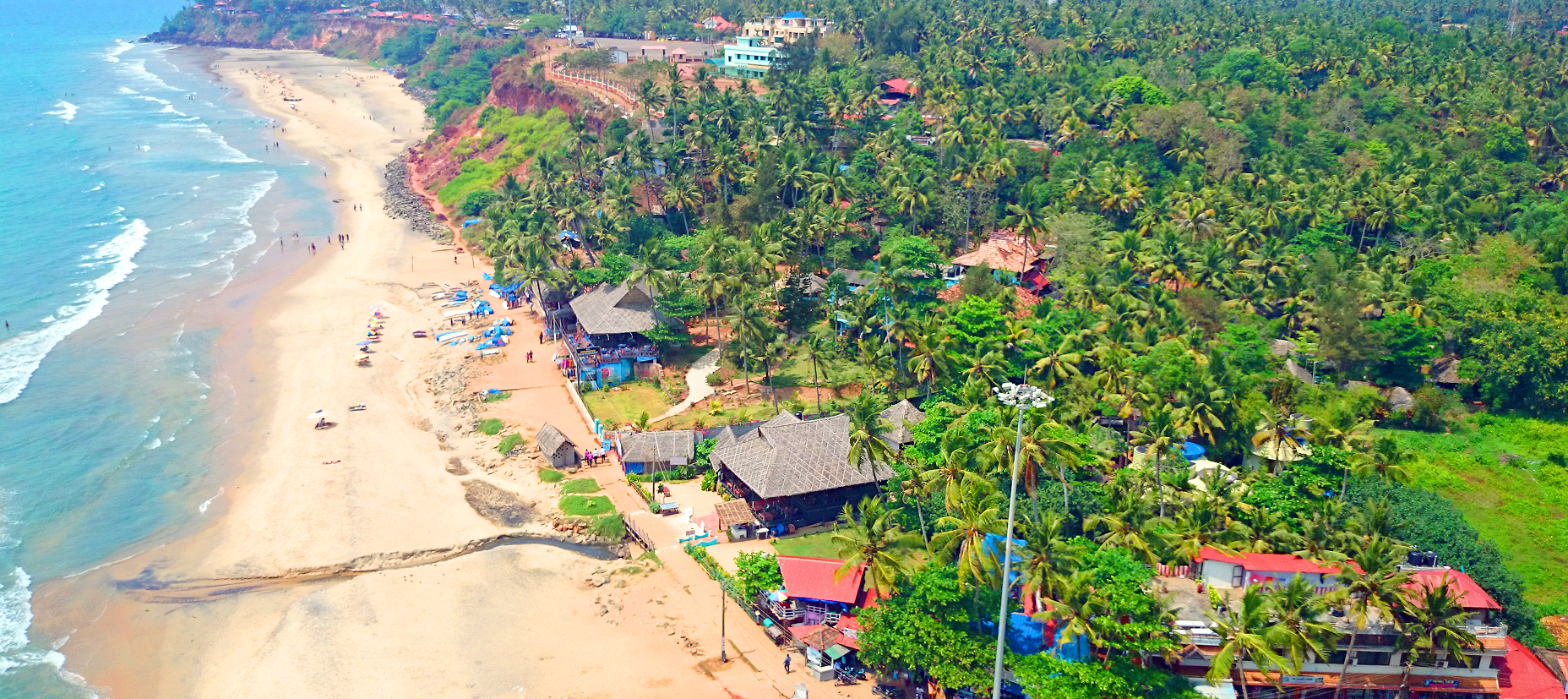
Perched on a hill above the Arabian Sea, where a red‑laterite cliff drops to the sin‑washing sands of Papanasam Beach, the Janardanaswamy Temple has drawn pilgrims to Varkala — the ‘Kashi of the South’ — for what tradition holds to be some two thousand years.
The story of Janardanaswamy Temple
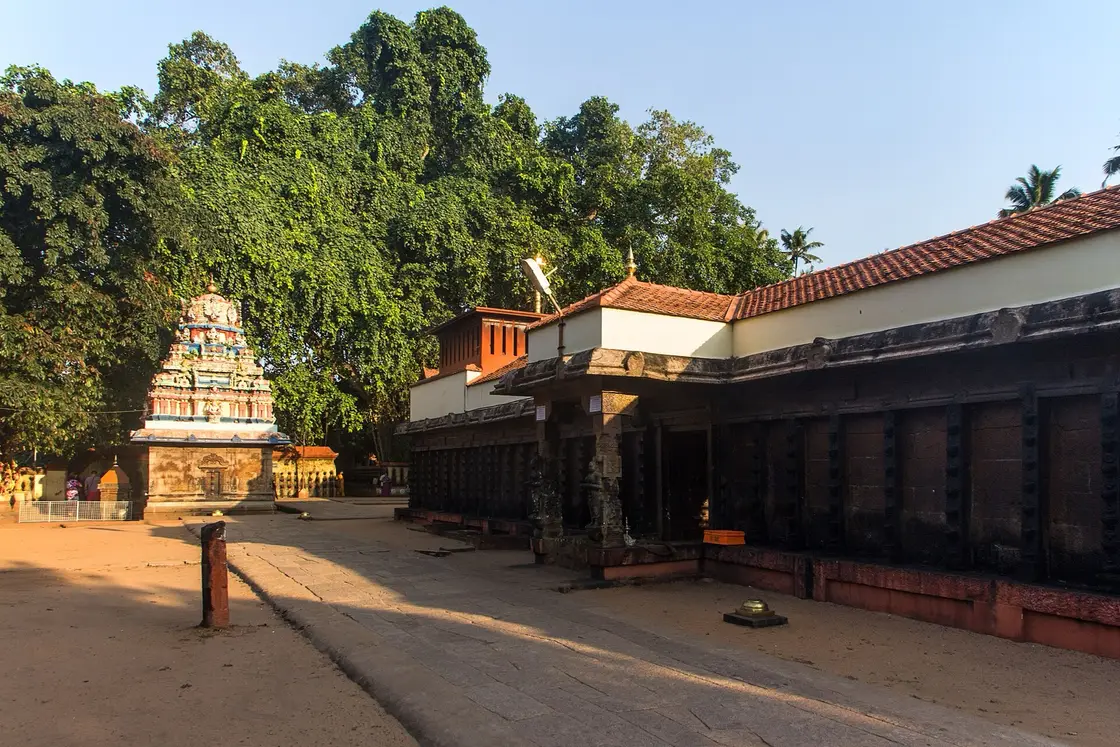
The Sri Janardanaswamy Temple stands on a low hill in the Janardhanapuram quarter of Varkala, a clifftop town on the coast of Thiruvananthapuram district. Its presiding deity is Vishnu worshipped in the aspect of Janardana Swami — literally ‘the one who is prayed to by people’, a form of the preserver revered here as protector and giver of liberation. Locally the deity is also called Varkaleswara, the lord of Varkala, and the town itself grew up around the sanctuary (indicative — confirm locally).
The idol in the old sanctum is described as a standing, east‑facing four‑armed form bearing the conch (shankhu), discus (chakra), mace (gada) and a pot or vessel, with the consorts Sridevi and Bhudevi at the deity’s side and figures of Hanuman and Garuda in attendance. Around the central shrine are smaller shrines to Shiva, Ganesha, Sastha (Ayyappa) and the Naga deities, so that a single visit takes in a small family of Kerala‑style sub‑shrines rather than one image alone (indicative — confirm on site).
What sets Varkala apart from ordinary Vishnu temples is its standing as a place of the dead as much as the divine. The town is called ‘Dakshina Kashi’, the Kashi of the South, and sometimes the ‘Gaya of the South’ — both names borrowed from the great pilgrimage cities of the north where Hindus perform rites for their ancestors. Devotees come to the temple and then descend to Papanasam Beach below to carry out pitru tarpanam and shraddha, the offerings made to departed parents and forebears, in the belief that the waters here carry those prayers and dissolve the sins of the living and the dead alike (framed as tradition — confirm locally).
The very name Papanasam means ‘destruction of sins’, and the mineral springs that seep from the cliff into the sea are held to be sacred. Families gather at the shoreline, often guided by priests, to bathe, to pour water and sesame in memory of the dead, and to seek peace for souls awaiting release. The rhythm of the temple above and the ancestral rites on the sand below has made this one of the most significant sites in Kerala for pitru karma, the duties owed to one’s ancestors (indicative — confirm locally).
The setting itself is part of the pilgrimage. The temple sits within a short walk of Varkala’s famous cliffs, its sea‑facing steps and old banyan shade catching the salt wind, while the wider Varkala hill carries other layers of sanctity — most famously the Sivagiri hill nearby, where the social reformer and sage Sree Narayana Guru established his ashram in the early twentieth century. Pilgrims often pair the ancient Vishnu temple with a visit to Sivagiri, so that Varkala holds together the very old and the comparatively recent in Kerala’s spiritual life (indicative — confirm locally).
Today the temple remains a living centre of worship rather than a monument, busiest at dawn and dusk and thronged during its annual festival, when the deity is carried in procession to the water for a ceremonial bath. For the visitor it offers a rare combination — an ancient hilltop sanctuary, a legend that explains a town’s name, a beach where the living tend to their dead, and an outlook over one of the most striking stretches of the Kerala coast.
Legend & myth
Tradition traces the name of Varkala to Sage Narada. In the best‑known telling, a group of penitents came to Narada confessing that they had sinned and asked how they might be cleansed. Narada is said to have flung his valkalam — the bark garment worn by forest ascetics — into the air, declaring that where it fell would be a place able to wash away wrongdoing. The cloth is said to have come to rest here, and the spot took the name Valkala, later Varkala; at that very place, the legend continues, a temple to Vishnu was consecrated (recounted as sacred legend, not documented history).
A related strand of the story has Narada asking the pilgrims to bathe in the waters below the fallen valkalam to be rid of their sins — the origin, in devotional belief, of Papanasam Beach as a ‘sin‑destroying’ shore and of Varkala’s enduring role as a place of ancestral rites. Sage Narada is himself remembered as having meditated on this hill. These accounts belong to the temple’s living oral and Puranic tradition and are cherished as such rather than offered as datable fact.
History
The Janardanaswamy Temple is popularly said to be around two thousand years old, and many pilgrim and tourism accounts repeat this figure. It should be treated as a devotional tradition of great antiquity rather than an established date — the temple is clearly very old, but no firm founding year can be verified, and the ‘2000‑year’ claim is best read as ‘time out of mind’ (traditional claim — not independently datable).
A recurring temple legend holds that the sanctuary was originally raised by the devas, fell into ruin, and was restored by a Pandya king. In that account the king, troubled by affliction and acting on a divine instruction, is said to have recovered the main idol from the sea, rebuilt the temple and laid down its rules of maintenance. As with much temple lore, this is preserved as sacred history and cannot be independently confirmed (recounted as tradition — confirm locally).
On firmer ground, inscriptions and records associate a phase of renovation with Umayamma Rani, the Attingal queen who ruled this region in the later seventeenth century (her regency is generally dated to roughly 1677–1684 CE — indicative). This ties the temple into the documented history of the Venad/Attingal country and shows it was an important, actively patronised shrine by that period.
One of the temple’s most talked‑about relics is an old bell said to have come from a wrecked European ship. Tradition holds that a Dutch vessel foundered off this coast without loss of life, and that its captain, in thanksgiving, presented the ship’s bell to the temple; the bell is popularly said to carry a date in the mid‑eighteenth century (a figure of 1757 is often quoted) and European names. The shipwreck‑bell story is widely told and is plausible for this trading coast, but the details should be treated as tradition unless confirmed on site (hedge — verify locally).
The temple’s principal annual event is the Arattu festival, held in the Malayalam month of Meenam (roughly March–April). ‘Arattu’ means ‘sacred bath’, and the festival — commonly described as running about ten days — culminates in the deity being carried in procession to a nearby water body for a ceremonial immersion, with elephants, temple music and, by many accounts, Kathakali and other classical performances. Alongside Arattu, the ancestral‑rite days, especially Karkidaka Vavu (the new‑moon of the Malayalam month of Karkidakam, usually July–August), draw very large crowds to the temple and to Papanasam Beach for tarpanam (all dates indicative — confirm locally each year).
Why visit
One of Kerala’s oldest and most revered Vishnu temples, wrapped in the tradition of ‘Dakshina Kashi’, the Kashi of the South.
A dramatic clifftop setting overlooking the Arabian Sea, minutes from Varkala’s celebrated cliffs and beaches.
The chance to witness one of Kerala’s most important sites for ancestral rites (pitru tarpanam) on the sin‑washing Papanasam Beach just below.
A living legend you can stand inside — the Narada valkalam story that gave the town of Varkala its very name.
Unusual heritage curiosities such as the ancient ship’s bell said to have been gifted by a Dutch sea captain.
Easy to pair with nearby Sivagiri, the ashram of Sree Narayana Guru, for a fuller picture of Varkala’s spiritual life.