The story
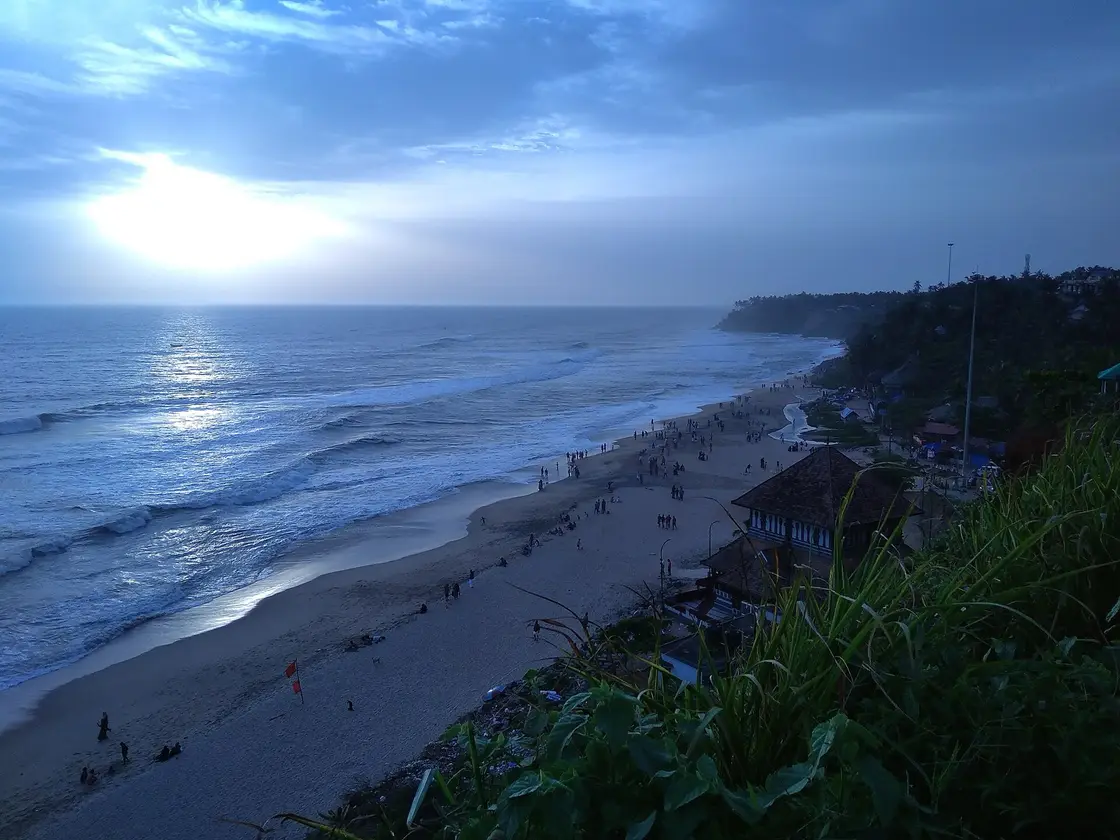
Varkala Cliff is a wall of rust-red laterite that rears straight up out of the Arabian Sea, a rare stretch of true sea-cliff on India’s otherwise low, sandy south-west coast. Along its crest runs a paved clifftop promenade strung with open-fronted cafés, their tables leaning out over a sheer drop to the surf and the golden crescent of Papanasam Beach far below. Come for the sunset — when the whole cliff-face glows amber and the sea turns to beaten copper — and you understand at once why travellers arrive for two nights and leave a fortnight later. This is not just a viewpoint; it is a slow, salt-scented way of life balanced on the edge of a geological wonder that took millions of years to form.
The story of Varkala Cliff
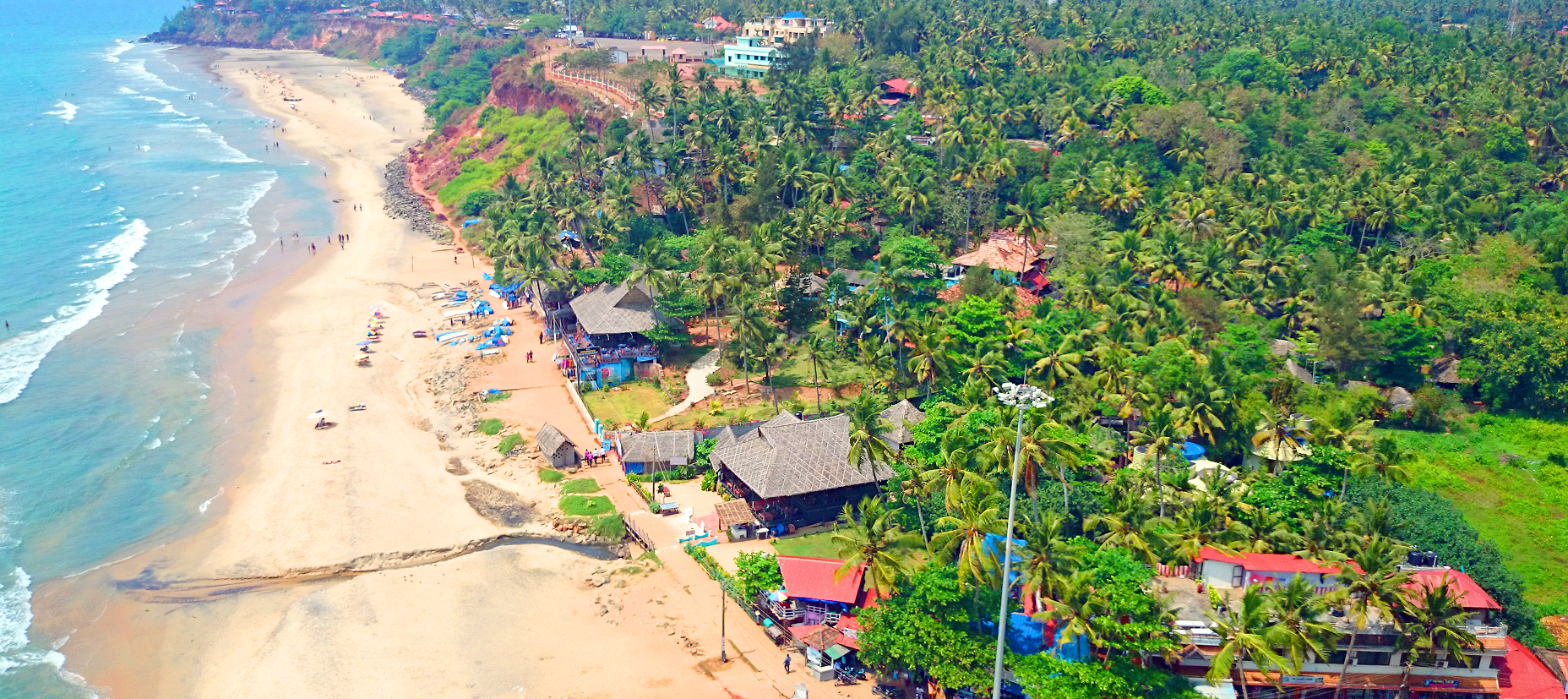
The cliff is the whole point of Varkala, and it is unlike anywhere else on the Kerala coast. For roughly two kilometres the land ends not in a gentle beach-slope but in a near-vertical bluff of red-and-white rock, thirty-odd metres high, plunging to a ribbon of sand and the open Arabian Sea. Stand at the railing and there is nothing between you and the horizon but sky and water — no harbour wall, no headland, just the long west-facing curve of the coast catching the full weight of the ocean. It is the sheer verticality, the sense of standing on the very lip of the subcontinent, that gives Varkala its particular drama.
Life on the cliff is arranged along a single pedestrian promenade, usually divided into North Cliff and the quieter South Cliff, linked by the Helipad flatland in between. There are no cars up here; the path is a slow river of barefoot travellers, yoga mats under arms, drifting between café verandas, Tibetan-run trinket stalls, tailor shops, spice sellers and Ayurvedic massage huts. The cafés hang their tables right at the cliff-edge so that every meal comes with the sea laid out beneath you, the surf a constant soft roar rising up the rock-face. It is a place engineered, almost by accident, for lingering.
Sunset is the daily headline act. As the afternoon cools, the crowd drifts west and the tables fill; the low sun sets the laterite ablaze, the sea flattens to hammered gold, and paragliders sometimes hang against the colour out over the water. When the disc finally sinks the whole promenade seems to exhale, and the cafés slide into their evening rhythm of candlelight, fresh seafood laid out on ice, live music and the long murmur of a hundred conversations. Few sunsets in India are watched by so many people from such a spectacular natural balcony.
The rock beneath your feet is the real marvel. The cliff exposes a layered sequence — a hard cap of iron-rich laterite three to four metres thick, and beneath it softer beds of red and white sandstone, pale clays and dark carbonaceous seams — the whole thing a cross-section through millions of years of ancient coastal deposits laid bare by the sea. Weathering paints the face in bands of ochre, rust, cream and grey, and in the monsoon rain streams down it in red rivulets. Geologists prize this exposure so highly that the cliff has been declared a National Geological Monument; for the visitor it simply reads as one of the most beautiful rock-faces in the country.
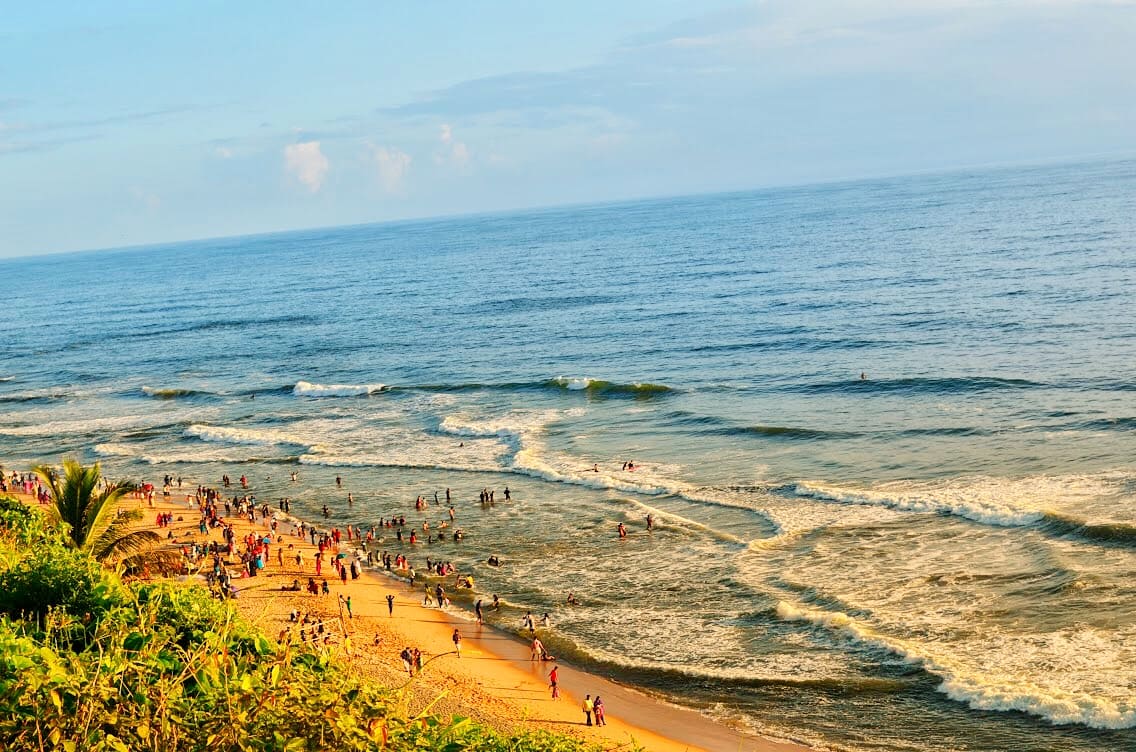
At several points fresh water seeps and springs emerge from the base and flanks of the cliff, filtered down through its porous sandstone layers. These mineral springs have long been considered therapeutic, and bathers still seek them out where they trickle onto the beach; together with the Ayurvedic clinics and yoga shalas strung along the clifftop, they give Varkala its enduring reputation as a place people come to heal as much as to holiday. Steep flights of steps and a couple of switchback paths connect the promenade above to Papanasam Beach below, where the springs, the surf and the pilgrims all meet.
The traveller scene is Varkala’s second nature, layered over its older sacred one. A short walk south, the cliff gives way to Papanasam Beach, a Hindu holy shore where families come to bathe and perform rites for departed ancestors, and where the ancient Janardanaswamy Temple and, inland, the Sivagiri hill of Sree Narayana Guru draw pilgrims through the year. So the cliff holds two worlds at once: on the clifftop, backpackers, surfers and long-stay yogis; at its foot, priests, offerings and ritual bathers. That easy overlap of the beach-bum and the sacred is exactly what makes Varkala feel like nowhere else.
Legend & myth
Legend gives the beach below the cliff its name and its aura. Papanasam means, roughly, ‘destruction of sins’, and tradition holds that a single dip in the waters here dissolves a lifetime of wrongdoing and cleanses the soul. Pilgrims combine the bathe with worship at the nearby Janardanaswamy Temple, so that prayer and sea together are said to leave body and conscience purified — the reason the shore has drawn the devout for centuries as much as the sunset-seekers draw to the cliff above today.
A second strand of the legend explains why Varkala became a place of ancestral rites. As the story is told, sages once complained to the divine of a burdensome request, and the god flung his cloth — his valkalam, or bark-garment — which fell to earth here, giving Varkala its name and marking the ground as sacred. Because of this the shore is held to be an especially auspicious place to perform ‘pitru karma’, the offerings made on behalf of departed souls, and on new-moon days the beach fills with families carrying out the ritual at the water’s edge.
These are beliefs carried down through tradition rather than matters of record, and they are best enjoyed as the living folklore of the place. Whatever one makes of the sin-cleansing power of the water, the sight of pilgrims bathing at dawn beneath the great red cliff, flowers drifting on the tide, is one of the most quietly moving scenes on the Kerala coast — myth and landscape doing their work together.
History
Long before it was a traveller haunt, Varkala was a place of pilgrimage anchored by the Janardanaswamy Temple — a shrine to Vishnu traditionally reckoned among the oldest in Kerala, with a history said to reach back some two thousand years — and by the holy shore of Papanasam directly beneath the cliff. For centuries the cliff simply formed the dramatic backdrop to this sacred coast, its springs valued for healing and its beach for ritual bathing, while the wider fame of the district was reinforced in the early twentieth century when the social reformer Sree Narayana Guru established his ashram on nearby Sivagiri hill.
The cliff’s scientific fame rests on its geology. It exposes the Warkalli Formation, a sequence of Mio-Pliocene sedimentary beds — very roughly the last several million years of Earth history — that outcrops along the coastal escarpment. The section reveals a hard lateritic cap over soft red and white sandstones, variegated clays and carbonaceous clays carrying seams of lignite, together with minerals such as marcasite and jarosite and preserved plant micro-fossils. This exposed ‘type section’ is the reference against which the formation is understood, which is precisely what gives the cliff its scientific value.
In recognition of that value the Geological Survey of India declared Varkala Cliff a National Geological Monument, one of a small national roster of protected geo-heritage sites — reportedly the 27th to be so listed, around 2014 — and Kerala Tourism has celebrated the designation as marking the cliff out as a geological marvel of national importance. The escarpment, extending several kilometres along the shore, has also been advanced as a candidate for wider geo-heritage and geopark recognition, with the ‘Natural Heritage of Varkala’ later entered on India’s UNESCO World Heritage tentative list (indicative — confirm current status locally).
The transformation of the clifftop into a traveller hub is a much more recent, largely late-twentieth-century story. Drawn first by the holy beach and the spectacle of the cliff, backpackers and long-stay travellers began arriving through the closing decades of the century, and small cafés, guesthouses, Ayurvedic clinics and yoga retreats gradually colonised the crest of North Cliff. Over a generation this grew into the walkable promenade of today, giving Varkala its reputation as one of Kerala’s most popular budget-traveller and backpacker beaches — a laid-back, café-lined counterpoint to the older pilgrim shore below.
That popularity now presses on the very cliff that created it. Because the protective laterite cap is thin and the sandstone beneath is soft, clifftop construction, drainage, heavy footfall, coastal erosion and intensifying monsoon weather have all been flagged as threats to the exposure, and slumping and edge-collapse have been reported in places. Conservationists, researchers and the National Green Tribunal have pressed for tighter protection of the geo-heritage site, and stretches of the cliff-edge are managed or fenced as a result — a reminder that this is a fragile, actively eroding landform, not a permanent balcony.
Why visit
Stand at the edge of one of the very few true sea-cliffs on India’s south-west coast, a sheer red-laterite wall dropping straight to the Arabian Sea.
Watch a west-facing sunset from a clifftop café table hung right over the surf — Varkala’s signature, unhurried evening ritual.
See a National Geological Monument up close: layered sandstones, lignite seams and a lateritic cap laid bare in bands of ochre and cream.
Walk the car-free North and South Cliff promenade of cafés, craft stalls, yoga shalas and Ayurvedic clinics strung along the crest.
Descend the cliff steps to Papanasam Beach for the mineral springs, the surf and the timeless scene of pilgrims bathing beneath the rock.
Feel the rare overlap of a backpacker beach-town and an ancient sacred shore, with the Janardanaswamy Temple and Sivagiri close at hand.