A modest whitewashed mansion the Portuguese built to buy a king’s goodwill — and inside, some of the finest temple murals in all of India glow across its walls like a painted scripture.
The story of Mattancherry Palace
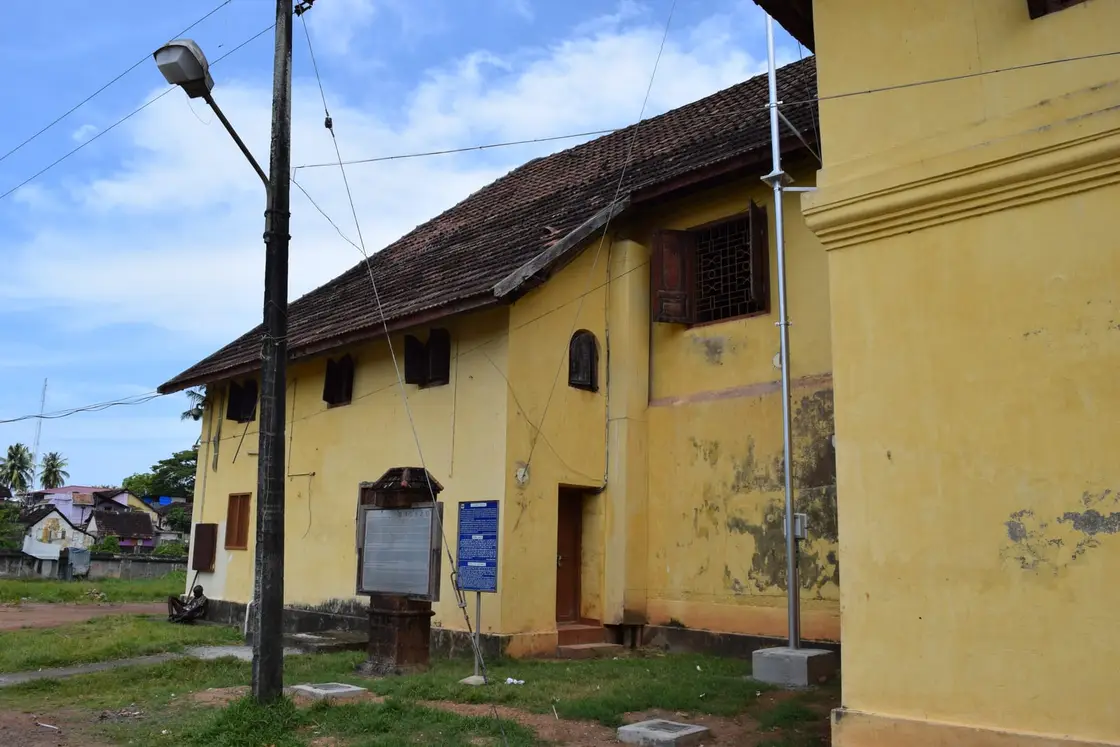
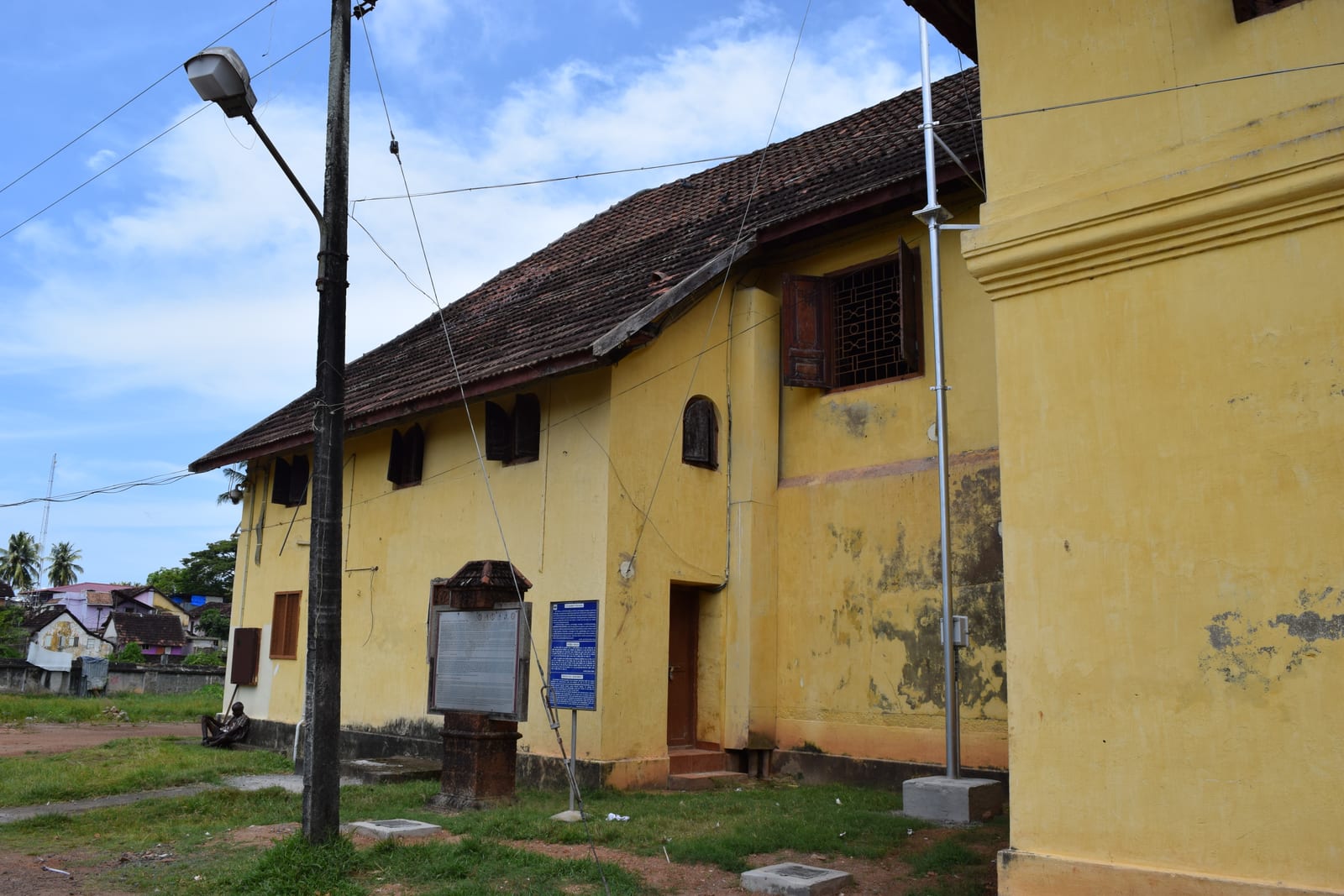
From the outside, Mattancherry Palace almost hides itself. Set among the spice godowns and antique shops of old Mattancherry, it is a low, unassuming two-storeyed building, its plastered walls a plain off-white, its sloping tiled roofs unremarkable against the Kochi sky. Nothing about the exterior warns you that within lies one of the greatest surviving treasuries of Kerala mural art — a place where the entire Ramayana unfolds across the walls of a royal bedchamber, and gods and goddesses shimmer in vegetable-dye ochres and greens.
The building follows the classic Kerala naalukettu plan — a quadrangular mansion of four wings folding around a central courtyard — but its arches, proportions and airy halls carry the quiet imprint of the Europeans who built and later remodelled it. In the courtyard stands a small shrine to Pazhayannur Bhagavathi, the tutelary deity of the Kochi royal family, while two further temples flanking the palace honour Lord Krishna and Lord Shiva. This was never a fortress or a pleasure palace; it was a ceremonial house, the place where the Rajas of Kochi were crowned and where the rituals of kingship were performed.
Walk the wooden-floored halls and the drama reveals itself room by room. The floors themselves are a marvel — a lustrous, near-black surface said to be made from burnt coconut shells, charcoal, lime, plant juices and egg-white, polished until it mimics dark marble. The coronation hall carries life-size portraits of the Kochi kings in their robes and headgear, some of the actual costumes displayed alongside. Elsewhere sit royal palanquins carved with floral motifs, silk-and-brass ceremonial parasols, sequined gowns, sheathed swords, daggers, feathered spears and old maps of the harbour town.
But it is the murals that stop visitors in their tracks. In the royal bedchamber, the whole of the Ramayana is told across roughly a hundred square metres of wall in tightly packed, jewel-toned panels — Rama’s exile, the abduction of Sita, the war at Lanka, all rendered in the distinctive Kerala style with its warm palette and rhythmic, crowded compositions. Other chambers carry scenes of Krishna Leela, Shiva Leela and episodes drawn from the Kumarasambhavam, with Krishna lifting Mount Govardhana, Vishnu reclining on the cosmic serpent, and Lakshmi seated upon her lotus.
These paintings, believed to date largely from the 17th and 18th centuries, use natural mineral and vegetable pigments and the exacting Kerala fresco technique, layered onto lime-plaster walls. Their survival across four centuries — through humidity, colonial upheaval and the slow decay that claims most such art — is what makes the palace so precious. Photography is banned in the mural rooms precisely to protect them, and the dim, hushed interiors give the whole visit the air of stepping inside a living manuscript.
Today the palace is protected and run as a museum by the Archaeological Survey of India, a compact but astonishingly rich stop on any tour of old Kochi. It sits within easy walking reach of the Paradesi Synagogue, Jew Town’s antique lanes and the spice markets, so most travellers fold it into a half-day wander through Mattancherry and Fort Kochi — arriving expecting a quick photo of a colonial building, and leaving having met the painted gods of Kerala face to face.
Legend & myth
The palace’s spiritual heart is the courtyard shrine of Pazhayannur Bhagavathi, the guardian goddess of the Kochi royal house, whom the Rajas revered as the protector of their lineage and their throne. Legend holds that the family carried their devotion to this Bhagavathi from Pazhayannur, and that her presence at the very centre of the coronation house was what sanctified a new king’s rule — the courtyard temple binding the mortal ruler to the divine mother who watched over his dynasty.
Around the murals themselves has grown a quieter lore. The Ramayana panels of the bedchamber and the Krishna scenes are read by many not merely as decoration but as devotional acts — the walls of a sleeping king wrapped in the deeds of gods so that royal dreams themselves might be steeped in dharma. Some of the Krishna murals, painted with a frank sensuous tenderness, have long drawn whispered commentary; guides tell visitors these were meant to invoke the amorous, life-giving play of the god rather than to shock, a reminder that in Kerala’s temple art the sacred and the sensual were never strangers.
History
The palace was built by the Portuguese around 1555 and presented as a gift to Veera Kerala Varma, the Raja of Kochi. It was an act of shrewd diplomacy as much as generosity — the Portuguese, then the dominant European trading power on the Malabar coast, wished to secure the goodwill of the Kochi ruler and safeguard their lucrative spice interests, and are said to have offered the mansion partly in recompense for damage done to a temple in the area.
In 1663 the Dutch captured Kochi from the Portuguese, and it was they who carried out extensive renovations and additions to the building. It is from these Dutch improvements that the palace earned its enduring popular name — the Dutch Palace — even though it was Portuguese hands that first raised it and neither colonial power ever actually lived in it.
For the Rajas of Kochi, the palace was never a colonial residence but a royal ceremonial house. Here successive rulers were crowned and important rituals of kingship performed, the coronation hall and the courtyard shrine of Pazhayannur Bhagavathi lying at the ceremonial centre of the dynasty. The life-size portraits displayed inside trace the line of Kochi kings, several of them shown in their coronation robes, and are generally identified as beginning with rulers from the mid-19th century onward.
The building itself blends Kerala tradition with colonial influence — the indigenous naalukettu layout of four wings around a central courtyard, married to European arches and proportions. Its greatest historical treasures, the murals, are attributed largely to the 17th and 18th centuries, executed in the classical Kerala fresco tradition using natural pigments, and rank among the finest and best-preserved examples of the school anywhere.
In the modern era the palace passed into the care of the Archaeological Survey of India, which protects it as a monument and operates it as a museum. Its collections — murals, coronation portraits, palanquins, ceremonial weapons, royal costumes, parasols and historic maps of Kochi — make it one of the most important repositories of the material and artistic heritage of the old Kingdom of Cochin.
Why visit
It holds some of the finest and best-preserved Kerala mural paintings in existence — including a near-complete Ramayana across roughly a hundred square metres of a royal bedchamber wall — a rare chance to see this classical fresco tradition outside a working temple.
The history is irresistibly layered: a palace built by the Portuguese, renamed for the Dutch, and used by neither — a house that quietly tells the whole story of European trade rivalry on the Malabar coast in one building.
Beyond the murals, the museum displays life-size coronation portraits of the Kochi Rajas, their actual robes and headgear, royal palanquins, ceremonial swords, daggers, feathered spears, silk-and-brass parasols and old maps — a vivid, tangible picture of a vanished court.
The architecture itself rewards attention: the traditional Kerala naalukettu plan softened by colonial arches, and an extraordinary polished floor said to be made from burnt coconut shell, lime, plant juices and egg-white.
It is protected and curated by the Archaeological Survey of India, so what you see is a genuinely conserved heritage monument rather than a reconstruction — and the entry fee is nominal.
Its location is unbeatable for sightseeing: a short walk from the Paradesi Synagogue, Jew Town’s antique and spice lanes and the Mattancherry markets, letting you thread it into a single rich half-day of old-Kochi wandering.