The story
Ezhattumugham is a hushed riverside village on the Chalakudy River in Ernakulam district, where the water fans out around islets and boulders into a scatter of shallow streams — the very image that gives the place its name. Wrapped in forest quiet and best known for its swaying suspension bridge, the Prakriti Gramam nature park and long stretches of boulder-strewn river you can wade across in the dry season, it is one of central Kerala's gentlest offbeat escapes, a short drive downstream from the thunder of Athirappilly.
The story of Ezhattumugham
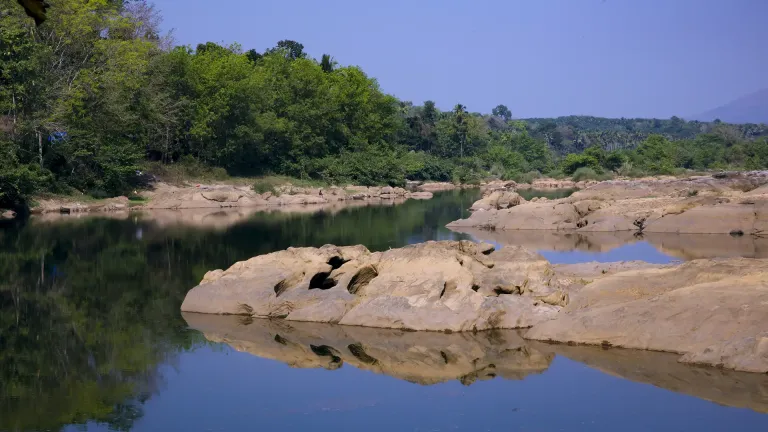
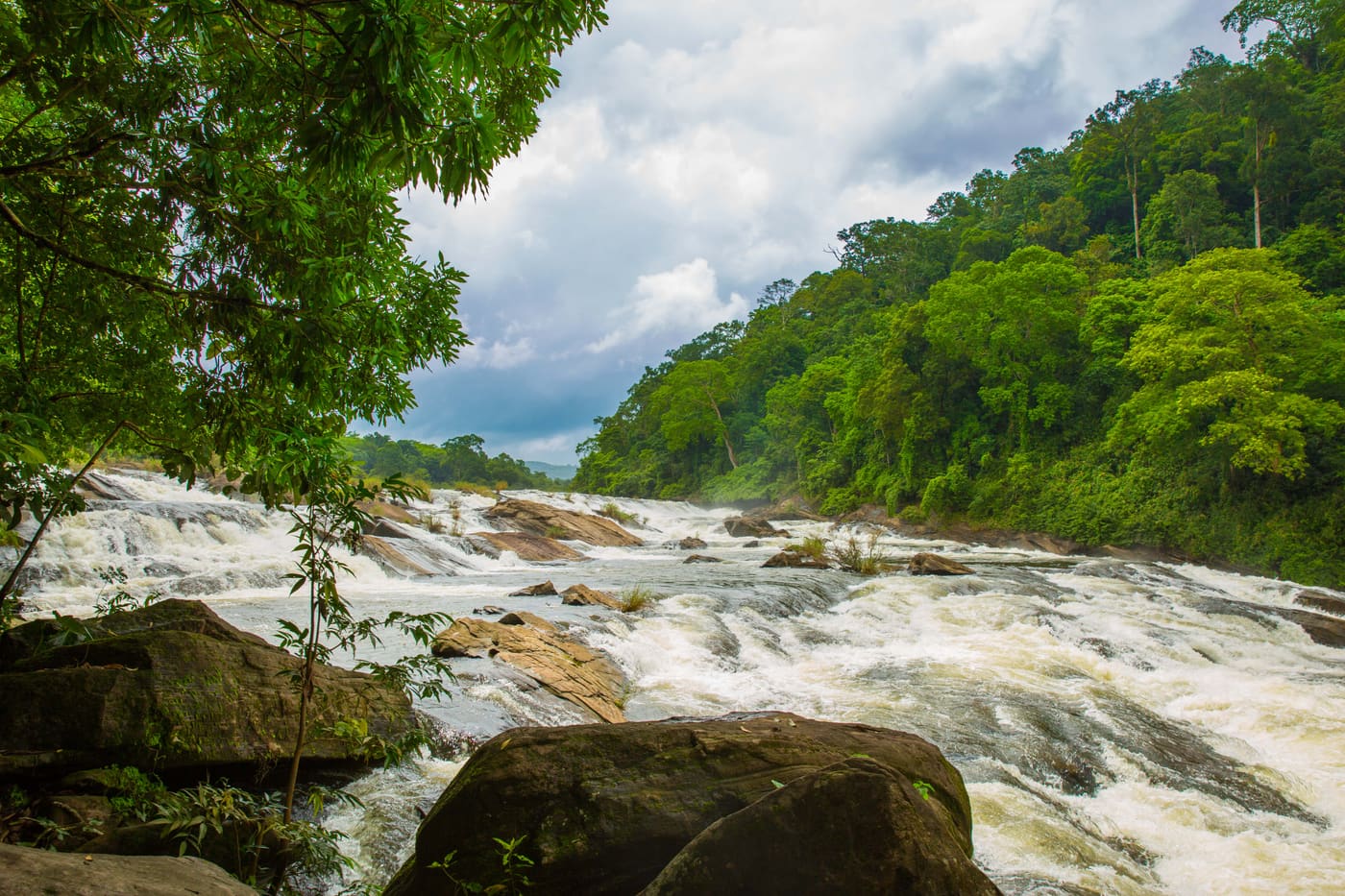
The name says almost everything. In Malayalam, ezhu (seven) and mugham (face) fold together into Ezhattumugham — the seven faces, or seven mouths, of the river. As the Chalakudy slides down from the Western Ghats and reaches this broad, rocky reach, it loses its single thread and splits around low islets and rounded boulders into a braid of channels. Stand on the bank in the dry months and you can count the shining streams peeling away from one another, then rejoining downstream, each one a separate face of the same water.
For most of the year the river here is more idle than fierce. Between roughly September and February the Chalakudy runs low and clear, baring its bed of sun-warmed granite, and villagers and visitors pick their way across the boulders and islets through ankle-deep water almost to the far bank. Children swim in the natural rock pools, families spread out for picnics on the flat stones, and the loudest sound is often birdsong from the surrounding canopy. It is the kind of place people come to do very little, deliberately.
The signature experience is the hanging bridge — a suspension footbridge strung across the Chalakudy, reported to be roughly 250 metres long and about 10 metres above the water (indicative — confirm locally). It sways and bounces underfoot, which is half the fun and half the fright, and it delivers you across to the Ezhattumugham–Prakriti Gramam side, with wide views up and down the braided river as you go.
Prakriti Gramam — literally Nature Village — is the organised heart of the visit: an eco-tourism park laid out beside a check-dam across the river. Within it are a butterfly garden said to host around 140 species (including the huge southern birdwing, the blue tiger and the common rose), a medicinal-herb garden explaining plants used in Ayurveda, a small tribal museum of indigenous artefacts and lifestyle objects, a children's park and beds of exotic flowering plants. It is compact and easily walked, and it turns a river stop into a half-day of pottering.
Beyond the park the landscape is working countryside — rubber, banana and sweeping oil-palm plantations line the approach roads, and the village keeps the unhurried rhythm of rural Kerala rather than the polish of a resort town. That authenticity is exactly the draw. Ezhattumugham has stayed low-key even as its neighbours grew famous, and it rewards travellers who want the smell of the river and the shade of the forest more than a checklist of attractions.
It is also quietly photogenic enough to have caught film-makers' eyes: the Chalakudy's boulders and light have appeared on screen, most notably in scenes tied to Mani Ratnam's 2010 film Raavan, shot around this river and the nearby falls. Come at dawn or in the low gold of late afternoon and it is easy to see why — the seven faces of the river each catch the light a little differently.
Legend & myth
The name itself carries a folk logic worth telling as story: local lore holds that the Chalakudy shows seven faces here because the river chose to divide and dance around the rocks rather than force its way through — seven streams, seven moods, one water. It is a poetic reading of a simple geological fact, and villagers repeat it as the village's own signature.
Ezhattumugham sits within a landscape steeped in Kerala's serpent-grove tradition. Across this part of the state, ancestral homesteads and riverside villages have long kept a sarpa kavu — a small, deliberately untouched patch of sacred forest set aside for the naga, or serpent deities. As legend has it, these groves are the abode of the snake gods, who guard the family and the land; to cut a tree or disturb the grove is said to invite the serpents' displeasure, so the kavu is left wild, its undergrowth, old trees and stone naga idols undisturbed for generations.
Whether or not you seek out a specific grove, it is worth carrying the belief with you as you walk the riverbanks: in the Kerala imagination the quiet, shaded, water-fed corners of a village like this are precisely where the serpents are thought to dwell, and the tradition of leaving them alone is credited — by folklore and, increasingly, by ecologists — with preserving pockets of native forest and the springs and soil they shelter. The reverence is legend; the surviving greenery is real.
History
Ezhattumugham owes its existence to the Chalakudy River, one of Kerala's major west-flowing rivers, which rises in the Anamalai hills of the Western Ghats and gathers the Sholayar, Parambikulam and other tributaries before spreading out over this broad rocky reach on its way to the sea. The braided channels and islets that give the village its name are the product of that geography — a wide, gently graded stretch where the river drops its energy and splits around resistant granite.
Water management has long shaped the spot. A check-dam across the Chalakudy here — associated with the Thumboormuzhi scheme upstream — steadies the flow and feeds irrigation for the surrounding farmland, and it is on the flank of this dam that the tourism park was later built. The steadier, pooled water is part of what makes the dry-season river so approachable.
The surrounding countryside has been farmed for generations, and the approach to the village runs through extensive oil-palm and other plantations; several sources describe the oil-palm estates of this belt as among the largest in the region (indicative — confirm locally). This is a productive agricultural landscape as much as a scenic one, and the village economy still leans on the land rather than on tourism alone.
The organised visitor attraction — Ezhattumugham–Prakriti Gramam — was developed as an eco-tourism project by the Thrissur District Tourism Promotion Council, on the district border where the Chalakudy separates Ernakulam from Thrissur. The suspension footbridge, butterfly garden, herbal garden, tribal museum and children's park were laid out to package the river's natural draw into a managed park while keeping its low-impact, nature-first character.
In recent years the reach gained wider fame as a filming location, its boulder-studded river and forest light drawing Malayalam and national productions; portions of the 2010 film Raavan were shot in this river country. That exposure, together with its easy distance from Kochi and Athirappilly, has slowly put the once-anonymous village on the offbeat-Kerala map.
Why visit
To see the river's seven faces — the rare, photogenic sight of the Chalakudy braiding into multiple shallow streams around islets and boulders, most visible in the dry post-monsoon months.
For the hanging bridge: a long, genuinely wobbly suspension footbridge that both thrills and gives the best wide views up and down the braided river.
For Prakriti Gramam, a compact eco-park bundling a butterfly garden (around 140 species), an Ayurvedic herb garden, a tribal museum and a children's park into an easy walk.
For a slow, safe river day — wading across sun-warmed boulders, swimming in natural rock pools and picnicking on the flat stones when the water is low.
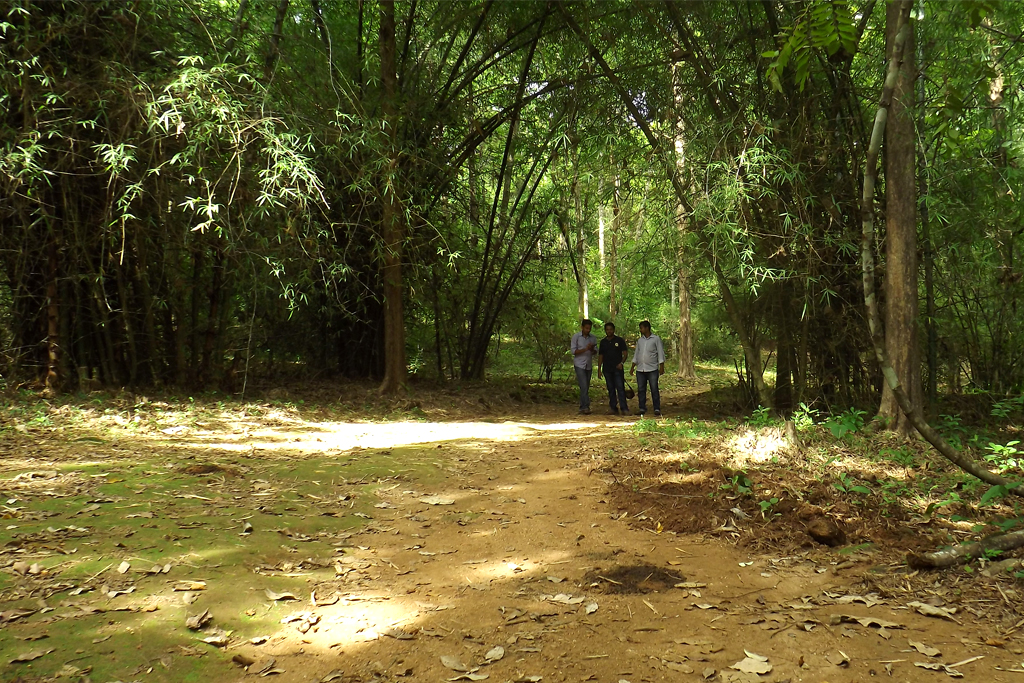
For the sheer calm: forest quiet, birdsong and working plantation countryside, a deliberate antidote to Kerala's busier honeypots.
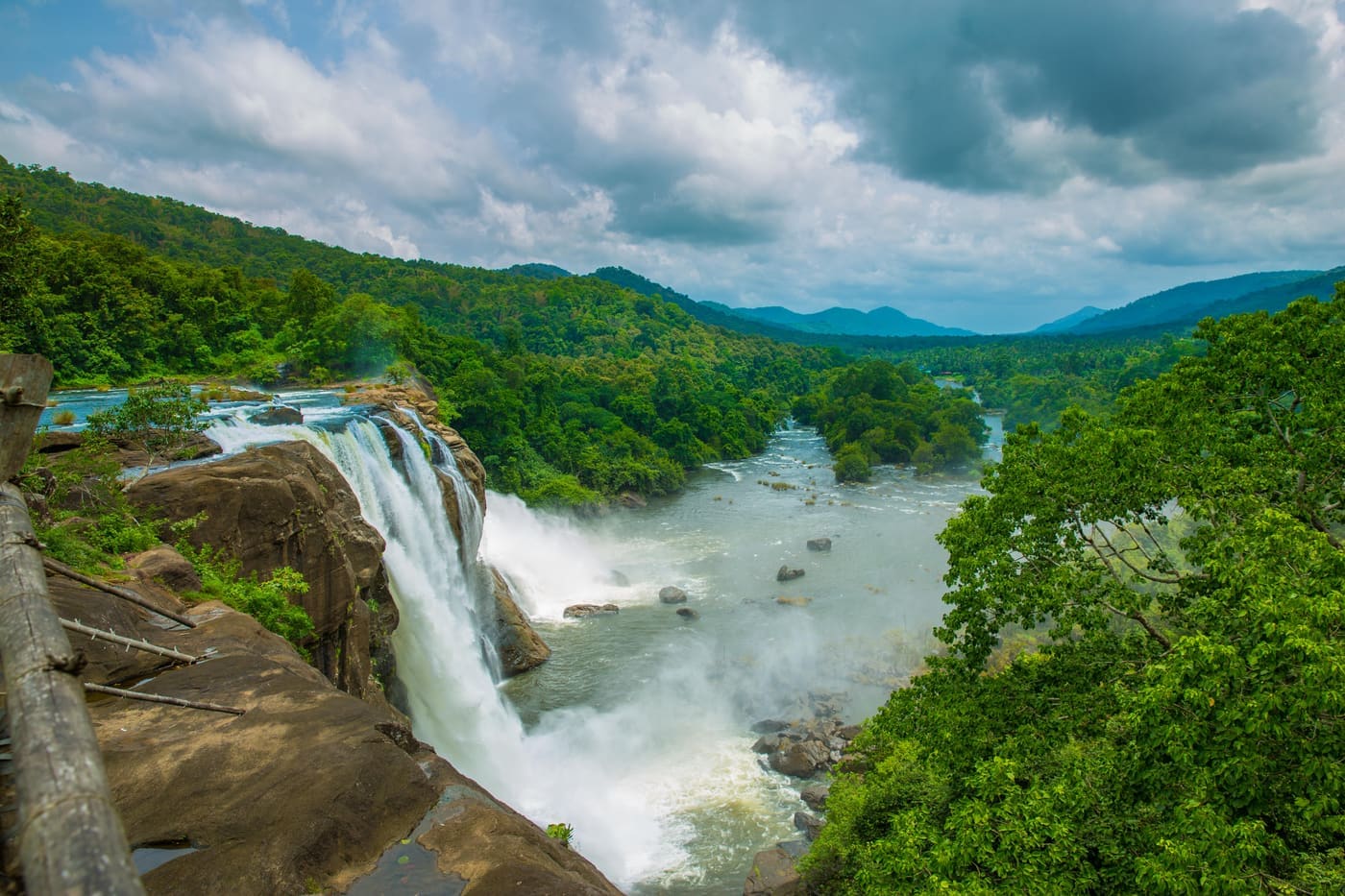
For its location — an easy pairing with the roaring Athirappilly and Vazhachal falls upstream and with the Thattekkad birding country, making it a natural add-on to a central-Kerala nature circuit.