In a green highland village on the Meenachil river, five kilometres east of Pala, stands the church that holds the tomb of St Alphonsa — India's first woman saint — and draws pilgrims from every corner of the globe.
The story of Bharananganam churches
Bharananganam sits in the rubber-and-spice highlands of Kottayam district, a quiet village of red-earth slopes and rain-washed greenery on the banks of the Meenachil river, roughly five kilometres east of the market town of Pala. For centuries it was known simply as an old Syro-Malabar Christian settlement in the Palai country. Today it is one of Kerala's most visited Christian pilgrimage centres, and the reason is a slight, gentle Franciscan Clarist nun named Alphonsa Muttathupadathy, whose earthly remains rest inside its parish church.
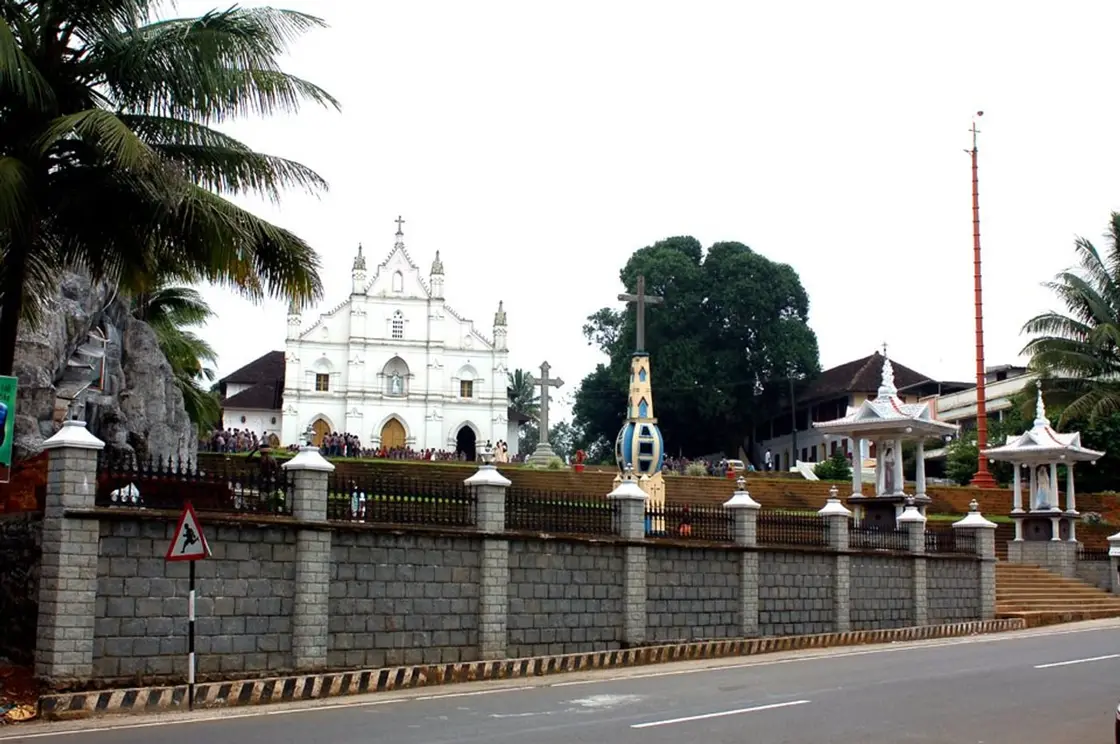
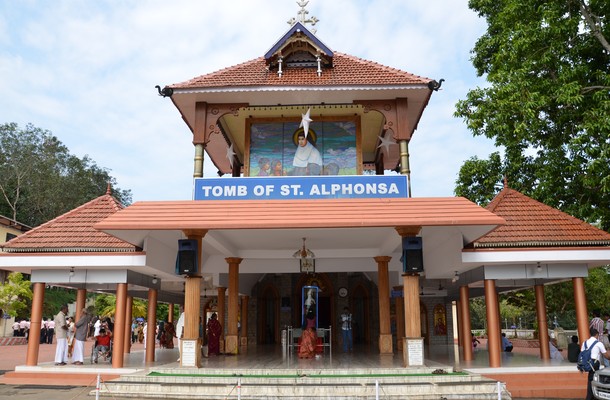
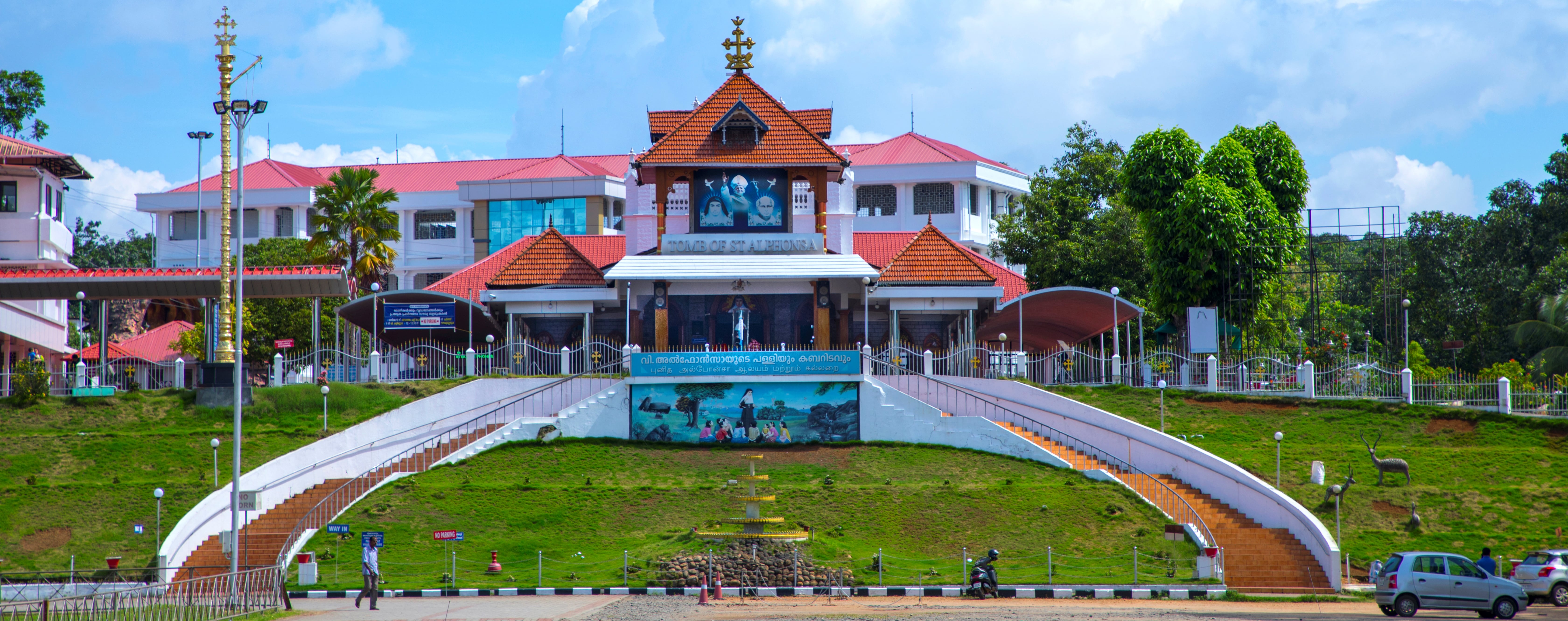
The heart of the village is St Mary's Forane Church, a Syro-Malabar Catholic parish whose origins are traced by tradition to around 1004 A.D., making it one of the more ancient Christian foundations in the region. The present church, white-walled and set among coconut palms and rubber trees, is the destination for the faithful — but the true magnet is the chapel beside it, where the tomb of St Alphonsa lies. Pilgrims file past in a slow, hushed line, some kneeling, some resting a palm on the marble, many pausing in silent prayer before the simple resting place of the woman they revere.
The atmosphere is unlike a museum or a monument; it is a living place of devotion. On ordinary days you will see nuns in white habits, families with children, students on the eve of exams and travellers who have come a long way, all moving quietly through the compound. Candles flicker, hymns drift from the church, and the air carries the damp, earthy smell of the highland monsoon. A small museum and the adjoining convent chapel display St Alphonsa's personal belongings — her spectacles, rosary, worn sandals and letters — offering an intimate window into a short life marked by illness and patient faith.
Once a year the whole village turns to the feast. Beginning in mid-July and building to 28 July, the anniversary of St Alphonsa's death, a nine-day novena and feast fills Bharananganam with tens of thousands of pilgrims. Candle-lit processions wind through the lanes, special Masses are offered, and by custom bishops from many dioceses gather to celebrate. Roadside stalls, streams of buses and the constant murmur of prayer transform the sleepy hill village into a great open-air shrine for the duration of the celebration.
Bharananganam is not a single-church village. As an old Christian settlement it holds several historic Syro-Malabar parishes and convent chapels scattered across its hills, along with the Franciscan Clarist convent connected with the saint. Wandering between them, a visitor gets a sense of the deep Catholic culture of the Palai highlands — where church bells set the rhythm of the day and faith is woven into ordinary village life.
Around it all stretches the classic mid-Travancore highland landscape: terraced rubber plantations, pepper vines climbing shade trees, small holdings of areca and banana, and the Meenachil river threading through the low hills on its way towards the backwaters. The combination of a world-famous shrine set in this gentle, unhurried countryside gives Bharananganam its particular character — a place that is at once an international pilgrimage centre and a small Kerala village that has never quite lost its calm.
Legend & myth
For the pilgrims who come here, Bharananganam is above all a place of intercession. Many believe that prayers offered at St Alphonsa's tomb are answered, and the walls of the shrine are lined with offerings and thanksgiving from those who feel their petitions — for healing, for children, for success in studies or for peace in troubled homes — have been granted through her prayers. Accounts of cures and answered prayers are cherished within the community of the faithful as signs of her closeness to God; the Church itself recognised such reported miracles in the formal process that led to her beatification and canonisation. These are matters of faith and devotion rather than claims a visitor need share, but they are inseparable from the meaning the place holds for those who journey here.
Devotion to St Alphonsa is often tender rather than grand. She is loved as a saint who understood suffering and small ordinary lives, and pilgrims speak of her almost as a companion — leaving handwritten notes, lighting candles and returning year after year to give thanks. That quiet, personal trust in her intercession, expressed by countless visitors, is the living heart of Bharananganam and should be approached with respect.
History
Alphonsa Muttathupadathy was born on 19 August 1910 at Kudamaloor near Kottayam and given the name Annakutty. Orphaned of her mother as an infant and raised amid hardship and ill health, she felt a strong religious calling from a young age. She joined the Franciscan Clarist Congregation, taking the name Alphonsa of the Immaculate Conception, and made her religious profession in 1936. Much of her adult life was spent at Bharananganam, where she taught and lived as a nun while enduring long and severe illness with a patience and cheerfulness that deeply impressed those around her.
She died at Bharananganam on 28 July 1946, at just thirty-five years of age, and was buried in the cemetery chapel attached to St Mary's Church. Reports of favours and cures attributed to her intercession spread soon after her death, and her tomb steadily became a place of local, then wider, devotion, drawing pilgrims and prompting the Church to open the formal cause for her sainthood.
Her cause advanced through the Catholic Church's careful process. On 8 February 1986 Pope John Paul II beatified her during his pastoral visit to Kottayam in Kerala, declaring her Blessed. Then on 12 October 2008 Pope Benedict XVI canonised her at St Peter's Square in the Vatican. With this she became the first woman of Indian origin to be declared a saint and the first canonised saint of the Syro-Malabar Catholic Church, a landmark moment for Christians across India.
St Mary's Forane Church itself is a much older foundation. Local tradition dates the parish to around 1004 A.D., placing it among the ancient Christian communities of the Palai highlands that trace their heritage to the St Thomas Christian tradition of Kerala. A forane church is a senior parish with pastoral oversight of surrounding parishes, and Bharananganam's status reflects its long standing in the region long before it became famous as a saint's shrine.
The parish and shrine belong to the Syro-Malabar Catholic Church, one of the Eastern Catholic churches in full communion with Rome, and fall under the Eparchy of Palai. Following the 2008 canonisation the tomb was developed as an international pilgrim centre, with facilities for the great crowds that now arrive for the annual feast, while the surrounding cluster of historic parishes and the Franciscan Clarist convent keep alive the older layers of Bharananganam's Christian heritage.
Why visit
Pay respects at the tomb of St Alphonsa, India's first woman saint and the first canonised saint of the Syro-Malabar Church — one of the most significant Christian pilgrimage sites in the country.
Experience a genuinely living shrine, where quiet daily devotion and the intimate story of a young nun's life move even non-religious visitors.
See St Mary's Forane Church, a parish whose roots reach back roughly a thousand years, and the small museum displaying the saint's personal belongings.
Time a visit with the great nine-day feast culminating on 28 July, when candle-lit processions and vast crowds transform the village into an open-air pilgrimage.
Explore the wider cluster of historic Syro-Malabar churches and the Franciscan Clarist convent that make Bharananganam a window into the deep Catholic culture of the Palai highlands.
Enjoy the setting itself — a calm highland village on the Meenachil river amid rubber plantations, pepper vines and spice gardens, an easy add-on to a Pala or central-Kerala itinerary.