The story
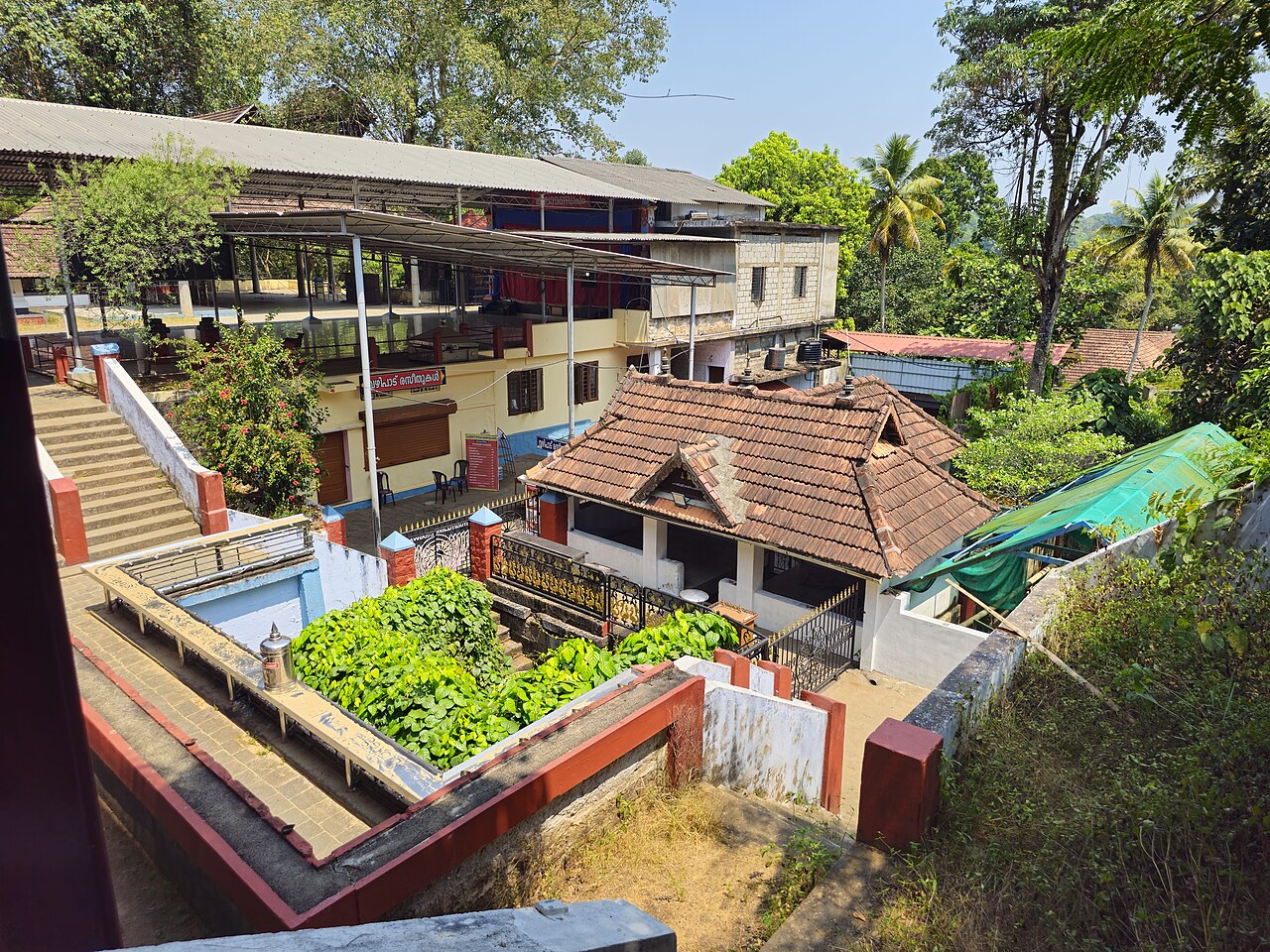
Tucked into the heart of Kottayam town, a short walk from its larger twin the Valiyapally, stands the church that Malayalis simply call Cheriapally — the ‘small church’, a name its soaring façade and mural-drenched interior cheerfully contradict. Consecrated in 1579 on land gifted by the Hindu Thekkumkur Raja, and today the St Mary’s Orthodox Syrian Church of the Malankara Orthodox tradition, it is celebrated across Kerala as one of the state’s oldest and best-preserved churches — a living gallery where Portuguese-influenced biblical frescoes, Kerala temple carpentry and the deep memory of the ancient St Thomas (Nasrani) Christians meet under one tiled roof.
The story of Cheriapally Church
The story of Cheriapally begins not with a new congregation but with a parting of ways. For generations the St Thomas Syrian Christians of Kottayam had worshipped together at the older Valiyapally, the ‘big church’, among them both the Knanaya community and the group known as the Vadakkumbhagar (the ‘northern side’ families). Tradition holds that a dispute between the two groups led the Vadakkumbhagar, under their vicar Fr Ouseph Kathanar, to seek land of their own — and so, rather than divide an existing sanctuary, they resolved to raise a second church a stone’s throw away. That daughter church became the Cheriapally, the little church that would in time outshine its parent in fame.
The land came from an unexpected patron. The Thekkumkur Raja — the Hindu king whose small kingdom then held sway over Kottayam — granted the Christians a plot on which to build, and by local account levied no tax upon it (indicative tradition — confirm locally). Construction was completed in 1579, during the reign attributed to Goda Varman Manikandan. In an age when religious lines could harden into walls, the sight of a Hindu monarch endowing a Christian church has been cherished ever since as one of Kerala’s quiet emblems of communal harmony, and the Raja’s generosity is woven through nearly every telling of the church’s origin.
What draws art historians and pilgrims alike, though, is what happened to the walls once the church stood. The interior — above all the sanctuary (madbaha) and altar screen — was covered over the following generations with an extraordinary programme of mural paintings: the Crucifixion, the Last Supper, the scourging and trial of Christ, and a crowd of biblical and non-biblical scenes rendered in the warm ochres, reds and greens of Kerala’s indigenous fresco tradition. Executed in vegetable and mineral pigments and blending Keralite temple-mural technique with Portuguese and European composition, the ensemble is often described as a landmark in the history of Christian mural art in India (dating estimates vary — many are held to be around 300 years old; confirm with the parish).
Among the murals runs one of the church’s most beloved traditions: that somewhere in the painted assembly the patron Thekkumkur Raja himself was depicted, a gesture of thanks for his gift of the land. Whether every figure can be firmly identified today is a matter for the guides and the parish, but the tale captures the spirit of the place — a Christian sanctuary that never forgot the Hindu king who made it possible, and that let his memory share wall-space with the saints (indicative tradition — confirm locally).
To place Cheriapally in its wider family is to touch the roots of one of the world’s oldest Christian communities. Kerala’s St Thomas Christians trace their faith to the Apostle Thomas, said to have landed on the Malabar coast in AD 52, while the Knanaya trace a further migration led by the merchant Knai Thoma (Thomas of Cana) around the fourth century. Kottayam sits at the historic heart of this heritage — and it is the neighbouring Valiyapally that is most closely bound to the Knanaya community and famed for its ancient Persian (St Thomas) granite crosses. Cheriapally, born of the same Nasrani world, today belongs to the Malankara Orthodox Syrian Church, and the two churches together tell the layered story of Kottayam’s Syrian Christian past.
For all its museum-grade art, Cheriapally remains first and foremost a working parish. Lamps are lit, the Holy Qurbana is offered, feast days fill the compound with the fragrance of incense and the sound of Syriac-rooted liturgy, and families who can name ancestors buried in its grounds still come to pray. Visitors who step in quietly find not a preserved relic but a sanctuary in continuous use for well over four centuries — which is precisely what makes standing beneath its painted ceiling feel less like sightseeing and more like time travel.
History
The deep background to Cheriapally is the arrival of Christianity in Kerala itself. The St Thomas (Nasrani) Christians hold that the Apostle Thomas evangelised the Malabar coast in the first century AD, and by the early medieval period a thriving Syriac-rite community was established along the backwaters and spice ports. The Knanaya, a distinct endogamous group within this fold, trace their descent to a migration from West Asia associated with the merchant Knai Thoma, conventionally dated to around AD 345. Kottayam became one of the enduring centres of this world, and its churches are among its most tangible monuments.
By the sixteenth century the St Thomas Christians of Kottayam worshipped together at the Valiyapally, then the community’s principal church. A dispute between the two groups sharing it — the Knanaya and the Vadakkumbhagar — prompted the latter, led by Fr Ouseph Kathanar, to petition the Thekkumkur Raja for land to build a church of their own. The Raja, ruling from Kottayam and identified in local record as Goda Varman Manikandan (reign given as 1579–1606 CE), granted the plot, and the new church — the Cheriapally — was completed in 1579 (dates per local and community record; confirm with the parish).
Architecturally the building is a study in fusion. Its plan and craftsmanship draw on Kerala’s temple-building tradition — thick laterite and brick walls, dressed granite pillars, a steep tiled roof and fine woodwork — while its gabled façade and interior detailing carry the imprint of the Portuguese, whose presence on the Malabar coast in the sixteenth century reshaped local church design. The result is frequently described as a Portuguese-Baroque-Keralite synthesis, and it is this hybrid vocabulary that makes Cheriapally a set text for students of Kerala’s ecclesiastical architecture.
The murals for which the church is world-famous belong to a later chapter of embellishment, painted in the indigenous Kerala fresco idiom using organic pigments derived from plants and minerals. Scholars regard the altar and sanctuary paintings as a major episode in the history of Indian Christian mural art; several of the works are held to be around three centuries old, and careful conservation has kept the sanctuary pieces remarkably legible (dating and restoration details vary by source — confirm on site).
In the long reshaping of Kerala’s Syrian Christianity into its modern denominations, Cheriapally came to belong to the Malankara Orthodox Syrian Church, under which it is administered today as St Mary’s Orthodox Syrian Church, Kottayam, and revered as a pilgrim centre. It should not be confused with its near neighbour the Valiyapally, the ‘big church’ most closely associated with the Knanaya community and celebrated for its Persian granite crosses bearing Pahlavi inscriptions — a distinct and equally historic monument a short distance away.
Why visit
You come, above all, for the murals. Few places in India let you stand this close to a continuous, centuries-old programme of Christian frescoes — the Crucifixion, the Last Supper, the passion scenes — painted in Kerala’s own earthy palette and technique. For anyone with an eye for art history, the altar and sanctuary walls alone justify the visit.
It is one of Kerala’s oldest and most intact churches, consecrated in 1579, so a visit is a direct encounter with the sixteenth-century world of the St Thomas Christians rather than a reconstruction or replica — the timber, the granite and the laterite are the real thing.
The architecture rewards slow looking: a rare, legible marriage of Kerala temple carpentry and Portuguese-European church form, gabled and steep-roofed outside, richly wooden and painted within — a single building that teaches how two very different traditions met on the Malabar coast.
The founding story is genuinely moving — a Hindu king, the Thekkumkur Raja, granting land (by tradition tax-free) so that a Christian community could build its church, and a tradition that his likeness was honoured among the murals. In a divided age, Cheriapally is a small, concrete monument to communal generosity.
It sits in the historic core of Kottayam’s Syrian Christian heritage, paired with the neighbouring Valiyapally and its famous Persian crosses — so a single short outing lets you read two chapters of the Knanaya and St Thomas Christian story side by side.
And it remains a living, praying parish rather than a ticketed monument. Entry is free, the doors open onto genuine worship, and the atmosphere — incense, lamplight, the hush beneath a painted ceiling — offers a quiet, unhurried counterpoint to Kottayam’s busy streets just outside.