The story
Tucked into a green fold of laterite hillside a short drive south of Kottayam town, Panachikkadu Saraswathi Temple is revered across Kerala as the Dakshina Mookambika — the ‘Mookambika of the South’. It is the state’s pre-eminent shrine to Saraswathi, goddess of learning, wisdom and the arts, and every autumn it fills with students and anxious parents who come to place their children’s first letters at her feet.
The story of Panachikkadu Temple
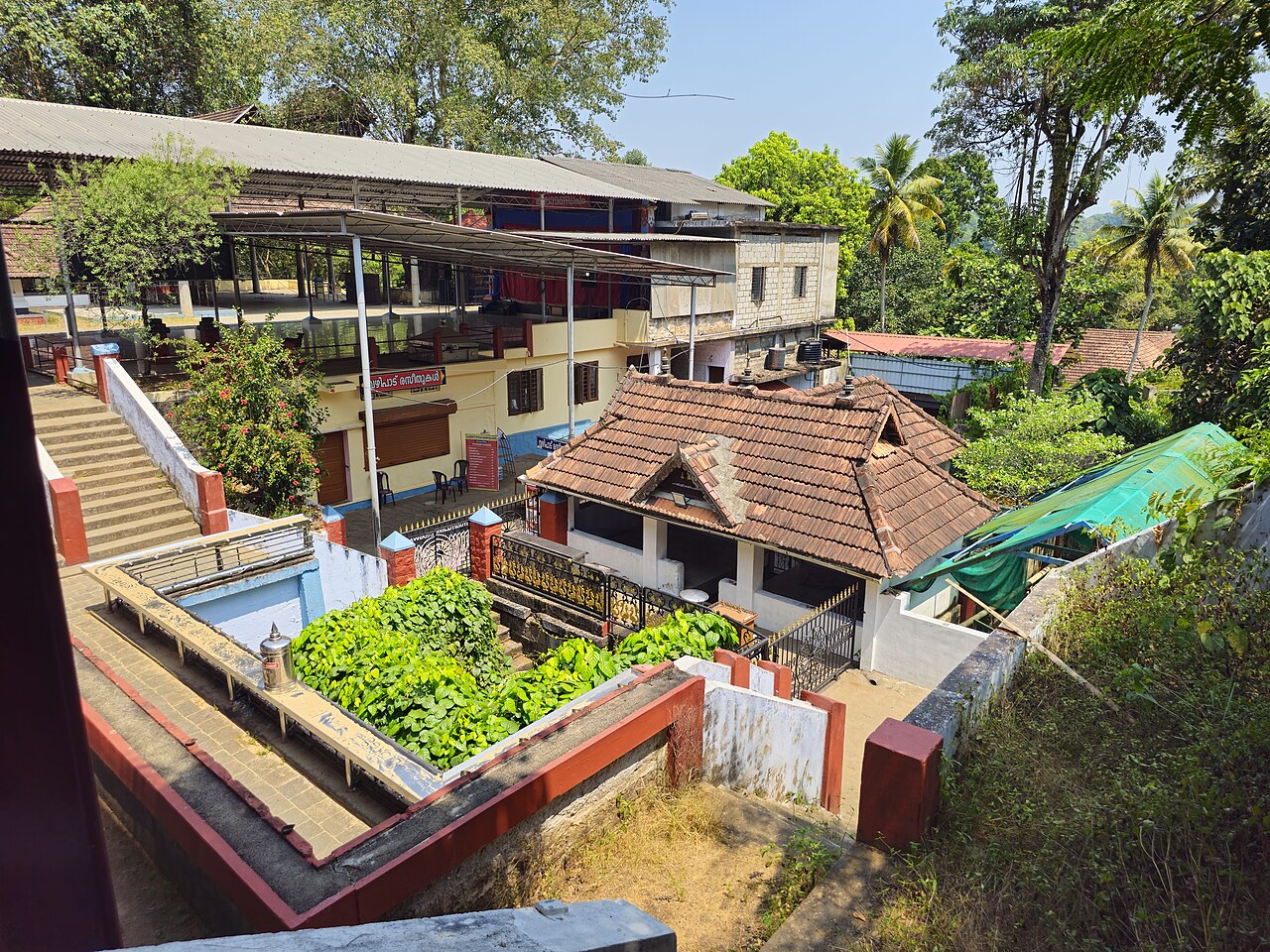
Most Kerala temples announce themselves with a tiled sanctum and a burnished lamp-lit doorway. Panachikkadu does something stranger and more moving. Its most famous deity, Saraswathi, is not enshrined under an elaborate roof at all but sits half-hidden in a wild, moss-blanketed nook of laterite rock on the southern side of the compound, where a thin thread of spring water trickles down over the stone and reaches the goddess’s feet. Creepers and shrubs — locally spoken of as ‘Saraswathi leaves’ — curtain the spot, and devotees say the little spring has never run dry, even at the peak of a Kerala summer.
The effect is deliberately, beautifully untamed. Where the main temple is orderly and roofed, the Saraswathi shrine feels like a piece of forest that the priests have chosen not to civilise — dark, damp, green and cool, the idol glistening under the constant drip of water. Many visitors describe the walk from the bright main sanctum to this shadowed, dripping grove as the emotional heart of the visit, a deliberate crossing from the ceremonial to the elemental.
For all its fame as a Saraswathi temple, Panachikkadu is, by consecration, a Vishnu temple. Lord Vishnu is the principal deity of the main sanctum, worshipped here long before the goddess’s presence is said to have settled in the grove, and it is his shrine that anchors the daily rhythm of poojas. The Saraswathi shrine sits apart, downhill and to the south, so that pilgrims typically pay their respects to Vishnu first and then descend to the goddess in her watery bower.
Around these two centres, the compound gathers the familiar family of Kerala sub-shrines. Devotees speak of upa-devatas including Ganapathy, Shiva, Dharmasastha (Ayyappan) and, importantly, the serpent gods — Nagaraja and the naga stones set among the trees, tended in the old Kerala way as guardians of grove, soil and lineage. Figures such as Brahmarakshas and Yakshi are also part of the local devotional landscape (traditions vary — worth asking the temple staff on the day).
What draws the crowds, though, is learning. Panachikkadu is the Saraswathi temple that Kerala families turn to at the great thresholds of study — the start of schooling, the eve of examinations, the beginning of music, dance or a new craft. The temple is especially associated with Vidyarambham, the ceremony in which a small child is guided to write his or her first letters in a tray of rice, and it is renowned for conducting the initiation not only on the festival day but through the year.
The name says it all: Keralites hold this shrine in the same affection they reserve for Kollur Mookambika across the border in Karnataka, and call it, simply and proudly, the Dakshina Mookambika — a Mookambika you can reach without leaving Kerala. For a devotee who cannot make the pilgrimage north, Panachikkadu is understood to carry the same grace, close to home, wrapped in moss and the sound of dripping water.
Legend & myth
As legend has it, the temple’s Saraswathi presence travelled here from Kollur itself. The story is told of a Namboodiri of an old illam who made the long pilgrimage to the Mookambika temple at Kollur in Karnataka and worshipped the goddess there with great devotion over many years. In one telling, he had gone praying for a son; in another, remembered more often at Panachikkadu, he had grown too old and frail to keep making the arduous journey north, and longed to carry a little of the goddess home with him.
The tradition holds that the goddess, pleased with his devotion, gave him leave to depart — and that her divine presence followed him southward. Nearing home, the Namboodiri stopped at a pond at Panachikkadu to bathe, resting his palm-leaf umbrella against the ground on the bank. When he finished, so the legend goes, the umbrella would not budge — it had rooted itself immovably to the earth. Astrologers, consulted in alarm, are said to have divined that the very spirit of Mookambika had settled in that spot and would go no further.
And so, the story concludes, the goddess was worshipped where she chose to stay — not moved into a grand roofed sanctum but honoured in the living rock and spring water of the grove, which is why her shrine at Panachikkadu remains to this day the wild, moss-covered, water-dripping nook rather than a conventional temple chamber. Devotees offer this as the reason the ‘Mookambika of the South’ feels less built than grown.
These accounts are devotional legend rather than documented history, and versions differ in their details from one telling to the next — the pilgrim’s purpose, the illam’s name, the sequence at the pond. What is constant, and what pilgrims cherish, is the underlying idea: that the grace of Kollur Mookambika chose this quiet Kottayam hillside for a second home.
History
Panachikkadu is generally described as an ancient foundation, with local tradition assigning the temple a history stretching back roughly a thousand years. As with many old Kerala shrines, firm dates are hard to fix; the temple’s antiquity lives more in oral and ritual tradition than in a securely dated inscription, so specific ages should be treated as tradition rather than established record.
By consecration the temple belongs to Vishnu, and the priestly and administrative traditions link it to old Namboodiri Brahmin families of the region — the same milieu from which the founding legend of the wandering pilgrim springs. The layering of a Saraswathi presence onto an established Vishnu temple is itself part of the story the community tells about how the shrine grew.
Over the centuries the site settled into the pattern that visitors see today: an orderly upper temple around the Vishnu sanctum, and the separate, deliberately naturalistic Saraswathi shrine downhill, set within a grove kept green by its perennial spring. The serpent shrines and sacred trees reflect the wider Kerala tradition of kavu — sacred groves — in which nagas are venerated and a patch of forest is left uncleared as holy ground.
In the modern era the temple has become one of Kottayam district’s best-known pilgrimage draws, particularly for education-related worship, and features consistently on regional lists of places to visit around Kottayam. Its Vidyarambham observances during Navaratri have given it a reputation well beyond the district, drawing families from across Kerala.
Today the temple is a living, actively-worshipped shrine rather than a monument — daily poojas at the Vishnu sanctum, a steady stream of students and parents at the Saraswathi grove, and a great annual surge at Navaratri. For up-to-date specifics on management, timings and ceremonies it is always best to confirm directly with the temple office.
Why visit
To see one of Kerala’s most unusual shrines: a Saraswathi idol set not in a roofed sanctum but in a wild, moss-covered laterite nook where spring water trickles ceaselessly over the stone — a shrine that feels grown rather than built.
Because it is the Dakshina Mookambika, the ‘Mookambika of the South’ — Kerala’s foremost temple to the goddess of learning, carrying for many devotees the same grace as distant Kollur but within easy reach of Kottayam.
For Vidyarambham: this is the temple Kerala families choose to initiate a child into letters, and it is renowned for conducting the ceremony through the year, not only on the festival day — a genuinely moving thing to witness even as a respectful visitor.
For the atmosphere of the grove — the cool, green, damp descent from the bright Vishnu sanctum to the dripping Saraswathi shrine, past serpent stones and sacred trees, is one of the most distinctive temple walks in the region.
For the Navaratri season, when the temple is at its most alive with music, learning and crowds of hopeful students, and the air of examinations-and-blessings gives the place a very particular emotional charge.
As an easy, rewarding half-hour trip from Kottayam town — a quiet, deeply local pilgrimage spot that most visitors to Kerala never hear about, rich in legend and unlike the grander coastal temples.