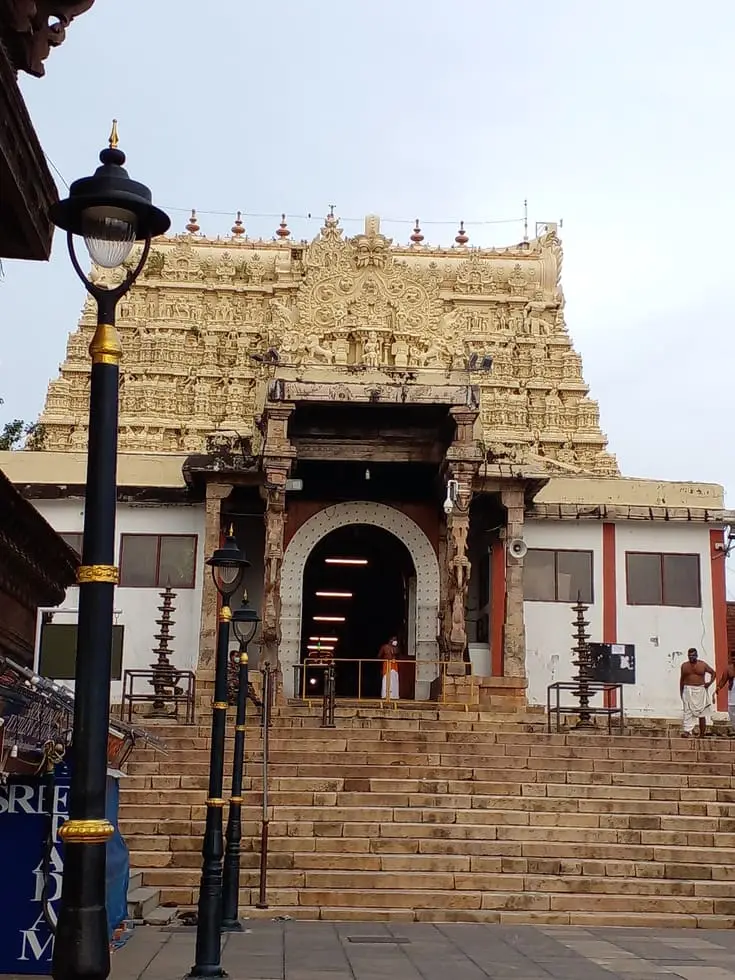
Behind a 100-foot, seven-tier gopuram in the heart of old Thiruvananthapuram lies a god who sleeps — and, beneath him, the richest treasure ever found in a single place of worship. Sree Padmanabhaswamy is Kerala’s most storied shrine: a temple so entwined with kings, serpents and sealed vaults that a visit feels less like sightseeing than like stepping into a living legend.
The story of Sree Padmanabhaswamy Temple
The presiding deity is Anantha Padmanabha — Lord Vishnu in yogic sleep (Anantha Shayanam), reclining on the thousand-hooded cosmic serpent Adi Shesha, his right hand resting over a Shiva lingam so that Vishnu and Shiva are worshipped in a single form. The idol is not carved from one block but built up from 12,008 saligrama stones said to have been brought from the Gandaki river in Nepal, coated in a special ayurvedic plaster.
The god is so vast that no single doorway can hold him. Devotees glimpse him through three separate doors: the first frames his serene face and the lotus rising from his navel bearing Brahma; the second, the ritual idols of gold and silver; the third, his feet. To take him in, you literally have to move — a piece of temple theatre that has awed pilgrims for centuries.
The temple is a masterpiece of Dravidian craft married to Kerala style: a corridor of 365-and-a-quarter granite pillars, and the celebrated Ottakkal Mandapam, a ceremonial platform hewn from a single enormous stone and set in place in 1731. Padmanabhaswamy is also counted among the 108 Divya Desams, the holiest Vishnu shrines sung by the Tamil Alvar saints as far back as the 7th–8th centuries.
Legend & myth
Temple legend tells of the sage Divakara Muni, who longed for a vision of Vishnu. The Lord is said to have appeared as a mischievous little boy who defiled the sage’s worship and then fled into the forest — before revealing himself as a reclining form so immense that it stretched for miles, from Thiruvallam to Trippadapuram. The sage begged him to shrink to a size the human eye could bear, and the god obliged, settling into the shape worshipped here today — which is why devotees still see him in three glimpses rather than one.
The temple’s greatest modern mystery is Vault B. Of six underground chambers (A to F), five were opened in 2011 under Supreme Court supervision and found to hold an almost unimaginable hoard — gold thrones, jewelled crowns, sacks of coins and precious stones, long kept as the Travancore rulers’ emergency reserve. Vault B, however, has stayed sealed. Its door carries the carved image of a serpent, which temple tradition reads as a warning against opening it, and a belief persists that misfortune would follow anyone who forced it. (Officials have since said the chamber was in fact accessed several times in the past without incident — so treat the "curse" as folklore, not fact.)
History
The shrine is ancient — praised in Alvar hymns over a thousand years old — but its modern character was set in 1750, when King Marthanda Varma performed the Thrippadidanam: he formally surrendered the entire kingdom of Travancore to Padmanabhaswamy and ruled thereafter merely as Padmanabhadasa, "servant of Padmanabha". Every Travancore king after him governed in the god’s name, a dedication that still shapes how the temple is run.
For most of its history the temple’s wealth was a matter of whispered legend. That changed on 27 June 2011, when the opening of the vaults revealed a treasure valued in the tens of billions of dollars, making Padmanabhaswamy the richest temple in the world and turning a quiet Kerala shrine into international news overnight.
Why visit
Few places pack so much into one visit: a genuinely awe-inspiring deity you must walk to see in three parts, some of the finest granite carving in South India, and the frisson of standing above the most famous sealed vault on earth. Come at dawn for the Nirmalya Darshan, when the god is seen in the previous night’s flowers, or during the Painkuni or Alpashy festivals to catch the Arattu procession sweep down to the sea.