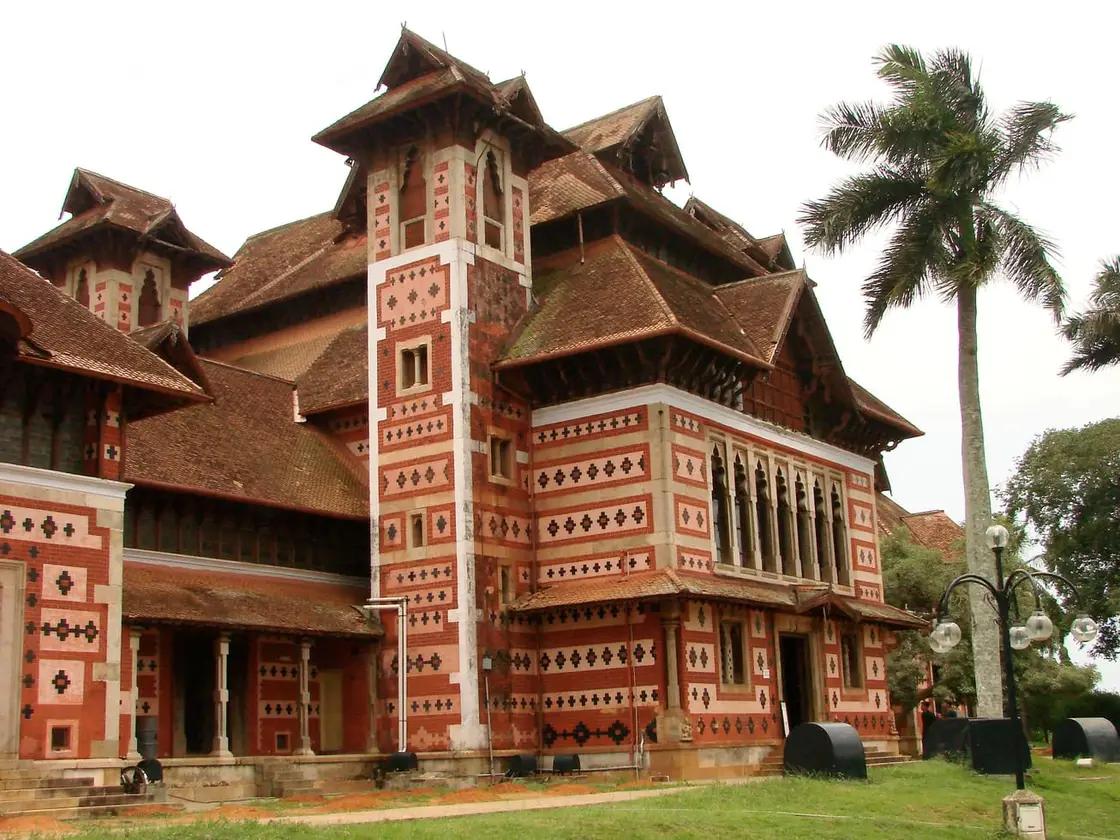
Rising like a painted casket of red, black and ochre amid the green lung of Thiruvananthapuram, the Napier Museum is one of India’s most flamboyant pieces of Victorian architecture — a 19th-century art and natural-history museum whose gabled, minaret-crowned silhouette is as much a treasure as the bronzes and ivories it shelters. Designed by the British architect Robert Fellowes Chisholm and named after Lord Napier, Governor of Madras, it anchors the leafy Museum & Zoo complex on the city’s northern high ground.
The story of Napier Museum
Approach the museum from the wide lawns of the complex and it looks less like a gallery than a jewel-box that has been magnified a hundred times. Bands of terracotta red, brick black, salmon and buttery yellow ripple across the walls; steeply pitched gables borrowed from Kerala’s temple roofs meet slender minarets that would not be out of place on a Mughal tomb; and the whole confection is stitched together with pointed arches, fretwork and finials. It is theatrical, and quite deliberately so — a building designed to be a spectacle before you have even stepped inside.
The genius of the place, though, is not only skin deep. Long before the age of air conditioning, Chisholm engineered the museum to breathe. The soaring, layered roof, the high ceilings and the strategically placed openings pull air through the halls so that the interior stays remarkably cool even in the coastal heat — a piece of climate-clever design that visitors still remark upon today. Look up and the underside of that roof reveals a riot of colour and joinery, a ceiling worth craning your neck for.
Inside, the collections read like a wander through southern India’s craft traditions. Glass cases and open plinths hold bronze idols of Nataraja, Surya, Parvati and Venugopala, ivory carvings of astonishing delicacy, wood sculpture, lamps, textiles, Kathakali figures, koftgari metalwork and old musical instruments. Among the bronzes is a Vishnu image said to be the oldest metal image in the state, gathered from a temple in the backwater country to the north — a reminder that these are not curios but survivors of living worship.
The museum does not stand alone. It is the centrepiece of a walled parkland shared with the Thiruvananthapuram Zoo — one of the oldest in the country — and with the Sree Chitra Art Gallery a short stroll away, where canvases by Raja Ravi Varma hang alongside Roerich, Tanjore and Mughal miniatures and works from Japan, China, Bali and Tibet. A single afternoon here can carry you from bronze deities to big cats to oil paintings.
The gardens themselves are part of the pleasure. Manicured lawns, flowering trees and shaded benches make the grounds a favourite of families, courting couples and photographers, and somewhere among the greenery grows what is claimed to be one of the oldest rubber trees in Kerala, raised from a sapling brought across from Ceylon in the 1870s. There is even an old bandstand where military bands once played to the strollers of colonial Trivandrum.
For all its grandeur, the Napier wears its history lightly. Come at golden hour, when the low sun sets the polychrome walls glowing and the minarets throw long shadows across the lawns, and you understand why locals treat this less as a museum to be ticked off than as a shared living room — a place to sit, to look, and to feel the layered past of Travancore all around you.
History
The museum’s story begins in 1855, when the reforming Maharaja of Travancore established a public museum in his capital — an early, ambitious act of civic culture in a princely state that prided itself on learning. An initial building went up in the late 1850s but proved unsatisfactory, and the search for something grander soon followed.
The turning point came in 1872, when Francis Napier, 10th Lord Napier and then Governor of Madras, visited Travancore. Struck by the region’s distinctive timber-and-tile temple architecture, he encouraged the building of a museum that would honour and promote native art, and the new institution was named in his honour. To design it, the commission went to Robert Fellowes Chisholm, the consulting architect to the Madras government and a pioneer of what became known as the Indo-Saracenic style.
Chisholm studied Kerala’s vernacular building traditions closely before drawing his plans, fusing local gabled roofs and joinery with Mughal arches, Chinese and Gothic touches and a bold polychrome skin. The foundation stone for this new building is recorded as having been laid in 1873; the earlier structure was cleared away, and after several years of work the museum was completed and opened to the public in 1880 under Ayilyam Thirunal, the reigning king of Travancore.
Over the following century the collections grew into one of South India’s richest holdings of religious and decorative art — bronzes, stone and wood sculpture, ivory, lamps, textiles and traditional instruments — and the surrounding parkland gathered further institutions around it. The Thiruvananthapuram Zoo shares the same historic grounds, and in 1935 the Sree Chitra Art Gallery was inaugurated nearby, adding a celebrated painting collection to the complex.
Today the Napier Museum is administered by Kerala’s Department of Cultural Affairs and is protected as a heritage landmark, its silhouette a much-loved emblem of the city. Chisholm’s naturally ventilated masterpiece remains, nearly a century and a half on, both the building people come to admire and the vessel that guards Travancore’s artistic memory.
Why visit
It is architecture as spectacle — a full-blooded Indo-Saracenic fantasy in red, black and ochre, with gabled roofs, minarets and pointed arches that make the exterior alone worth the trip, especially in the warm light of late afternoon.
The collection is a genuine treasure house of South Indian craft: bronze deities including Nataraja and Surya, exquisite ivory carvings, a temple chariot, wood sculpture, Kathakali figures, koftgari work and old musical instruments, including what is said to be the oldest metal image in Kerala.
You get three attractions in one gated complex — the museum, the historic Thiruvananthapuram Zoo and the Sree Chitra Art Gallery — so a single visit can span sculpture, wildlife and painting without leaving the grounds.
The Sree Chitra Art Gallery next door is a draw in its own right, hanging works by Raja Ravi Varma and Nicholas Roerich alongside Tanjore, Mughal and East Asian art.
The landscaped gardens, shaded benches, old bandstand and heritage trees make the grounds a relaxing green retreat in the middle of the city — as much a park as a museum.
Entry is inexpensive and the museum sits right in the heart of Thiruvananthapuram, close to the zoo and the PMG junction, making it one of the easiest and most rewarding half-day outings in the capital.