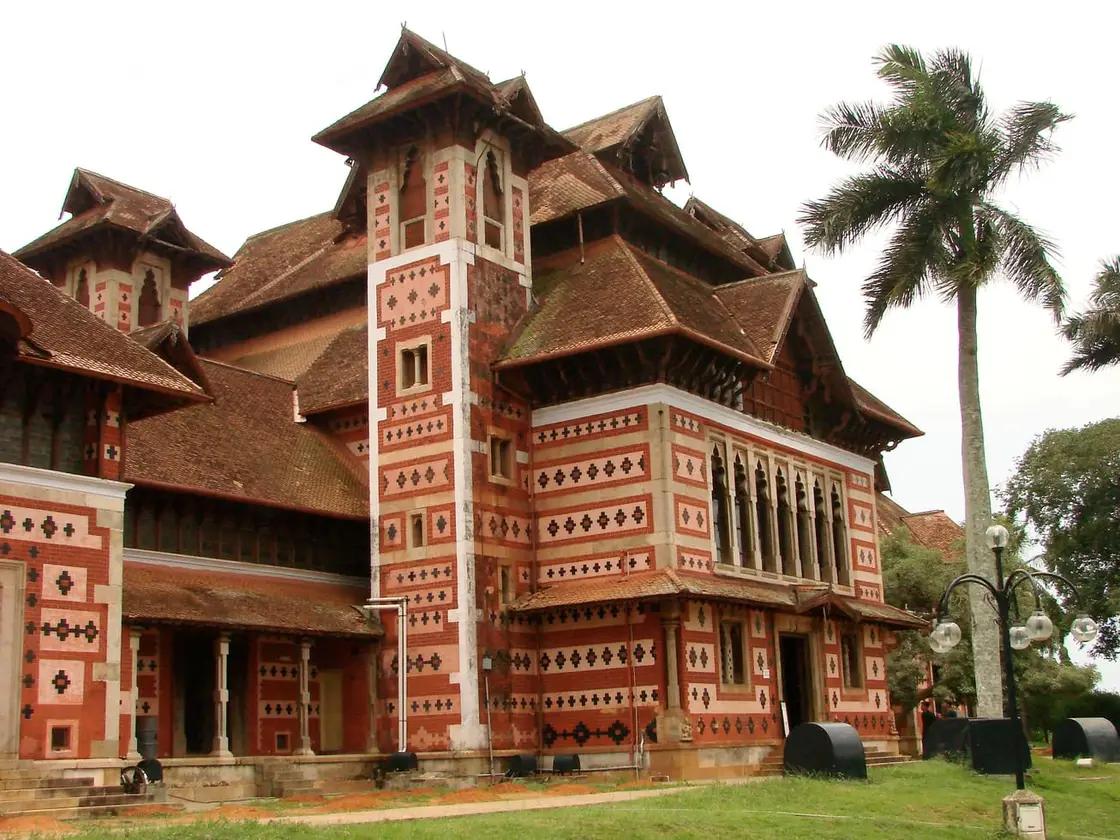
Set inside a leafy public park in the heart of Thiruvananthapuram, the Napier Museum is one of India’s most photographed 19th-century buildings — a riot of gabled roofs, striped brick and Indo-Saracenic colour designed by the British architect Robert Chisholm. Around it spread the Sri Chitra Art Gallery, home to Raja Ravi Varma’s luminous canvases, and one of the oldest zoos in the country, laid out among lakes and old trees since the 1850s.
The story of Napier Museum & Zoo
There are grander museums in India and older ones, but few announce themselves quite like the Napier. Approach it across the Museum Park and the building seems to unfold in layers — steep tiled roofs stacked like a Kerala temple, ochre-and-brick striping borrowed from Mughal and Rajput palaces, pointed arches, painted eaves and slender pinnacles that catch the light. It is a building that refuses to sit still in any one tradition, and that is precisely the point: it was conceived as an argument in brick and timber about what a distinctly Indian public architecture might look like.
Inside, the drama continues in a quieter register. Chisholm designed the interior to breathe. High ceilings, deep verandahs and a cross-ventilated plan keep the halls cool without any mechanical air-conditioning, and visitors still remark on how the temperature drops the moment they step in from the sun. The naturally ventilated interior is frequently described as air-conditioned by design — the flow of air, the shade and the height of the rooms doing the work that machines do elsewhere (indicative — confirm locally).
The collections reward slow looking. Ranked along the halls are South Indian bronzes — Natarajas, processional deities, lamps — alongside intricately worked ivory carvings, wood sculpture, ornaments and coins from Travancore and beyond. The showpiece for many is a grand carved temple chariot (rath), the sort once hauled through festival streets, now stilled under the museum’s painted ceiling where every joist and beam is picked out in colour.
Step out and cross to the Sri Chitra Art Gallery and the register shifts from craft to canvas. Here hang works by Raja Ravi Varma, the Travancore prince-painter who taught India to see its gods and heroines in oil, alongside paintings by the Russian mystic Nicholas Roerich and his son Svetoslav, and a spread of miniatures from the Tanjore, Mughal, Rajput and Bengal schools. It is a rare place to trace Indian painting from courtly miniature to the confident realism that made Ravi Varma a household name.
The third act of any visit is the park itself. The zoo that shares these grounds is among the oldest in India, and it was laid out from the start as a botanical garden as much as an animal collection — winding paths, a lake, and mature trees that shade tigers, elephants, primates and reptiles. Families come as much for the picnic lawns and the giant trees as for the enclosures, and the whole compound functions as the green civic lung of the capital.
Taken together — museum, gallery, zoo and garden on a single ticketed campus — the Napier complex is really a Victorian idea of a public institution made tropical: instruct, delight and improve, all under one enormous decorative roof. That the roof happens to be one of the most beautiful in the country is the bonus that keeps drawing camera-toting visitors back.
History
The museum’s origins reach back to the mid-19th century, when the Maharaja of Travancore, Uthram Thirunal Marthanda Varma, established a museum in Thiruvananthapuram — generally dated to around 1855 (indicative — confirm locally). It was named in honour of Lord Napier, then Governor of Madras, whose patronage lent the project weight within the wider Madras Presidency.
The building visitors admire today came later. Lord Napier is said to have entrusted the design to Robert Fellowes Chisholm, the consulting architect to the Government of Madras and a leading figure in the emerging Indo-Saracenic movement. The foundation stone for the new structure was laid in the early 1870s (often given as 1872–1873), and after years of construction the museum is generally said to have opened to the public around 1880 (indicative dates — confirm locally).
Chisholm’s brief was unusual for a colonial architect: rather than impose a Gothic or Neo-Classical box, he studied local Kerala building — its sloping tiled roofs, deep eaves and timber craft — and fused it with Mughal, Rajput and even Chinese decorative elements. The result introduced the Indo-Saracenic style to Kerala and became one of its most celebrated examples, blending native form with the ventilation logic of a tropical climate.
The complex grew over the following decades into a cultural precinct. The zoo occupying the same grounds dates to the 1850s (commonly cited as 1857), making it one of the earliest in the country, and it was conceived alongside a botanical garden. The Sri Chitra Art Gallery was added in 1935, inaugurated under Maharaja Chithira Thirunal Balarama Varma, to house the royal collection of paintings — anchored by the works of Raja Ravi Varma (indicative — confirm locally).
Through the 20th century and after Independence the museum, gallery and zoo passed into government stewardship, and the park became the shared civic heart of the capital. Today the campus is protected as heritage and remains under state administration, still drawing students, artists, families and travellers to a set of institutions that have shaped how the city sees its own past.
Why visit
The architecture alone justifies the trip: the Napier is a textbook Indo-Saracenic masterpiece and one of the most striking heritage buildings in South India, endlessly rewarding for photographers with its polychrome brickwork, stacked gables and painted interiors.
It is a genuine air-conditioning-free wonder — Chisholm’s naturally ventilated, high-ceilinged design keeps the halls cool through airflow and shade rather than machinery, a lesson in tropical building that still works today (indicative — confirm locally).
The museum collection is a compact tour of South Indian craft — bronzes, ivory carvings, wood sculpture, ornaments and a magnificent carved temple chariot — displayed in halls that are themselves works of art.
The adjacent Sri Chitra Art Gallery lets you stand before original Raja Ravi Varma paintings, plus Roerich canvases and Tanjore, Mughal and Rajput miniatures — one of Kerala’s finest painting collections in a single room.
The shared grounds hold one of India’s oldest zoos, set in a mature botanical park with a lake and huge old trees — a rare combination that turns a museum outing into a full, shaded day for families.
Everything sits together in the walkable Museum-PMG precinct at the centre of the city, so you can pair it easily with the nearby palaces, temples and the rest of Thiruvananthapuram’s heritage core.