The story
Rising in muscular green folds above the Padinjarathara valley near Kalpetta, the Banasura Hills carry the name of a Puranic asura king — and hold, at their feet, one of India’s most storied dams and a reservoir dotted with islands that appear only when the water is high. It is a place where legend, engineering and raw Western Ghats wilderness sit side by side: a strenuous peak trek for the fit, a speedboat skim across a sky-mirroring reservoir for everyone else, and a name that ties Wayanad to the age of gods and demons.
The story of Banasura Hills
The range takes its name from Banasura, the thousand-armed asura king of Sonitapura in Puranic legend, and Wayanad folklore holds that he performed a long and severe penance to Lord Shiva somewhere on these very heights. That thread of belief — an asura seeking the favour of the destroyer-god on a lonely summit — is what fixed his name to the hills, to the peak, and eventually to the reservoir that now pools beneath them.
Banasura Peak itself, the second-highest in Wayanad after Chembra, is the dramatic heart of the range. It is often quoted at around 2,073 metres, roughly 6,800 feet (indicative — confirm locally), and the ascent is a proper day’s work: grassy shola slopes, wind-combed ridgelines, patches of stunted montane forest and, near the top, a cave that local guides link to the Banasura legend. From the summit the whole Padinjarathara basin opens out, the reservoir a bright shard of blue far below.
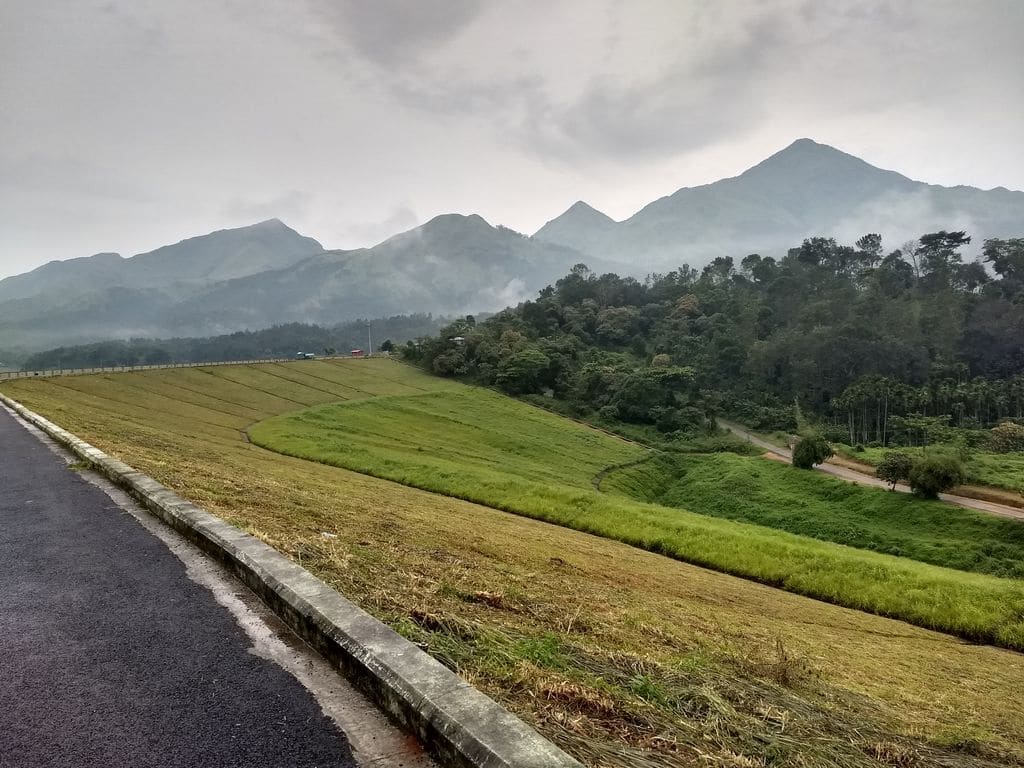
At the base of the hills lies Banasura Sagar Dam, thrown across the Karamanathodu — a tributary of the Kabini — and completed in 1979 (indicative — confirm locally). It is widely described as the largest earthen (earth-fill) dam in India and among the largest in Asia (often cited as such — confirm locally), a vast, grassed-over embankment of soil and rock rather than a wall of concrete. Its stated height is around 48–49 metres with a length of roughly 1.6 kilometres (indicative — confirm locally).
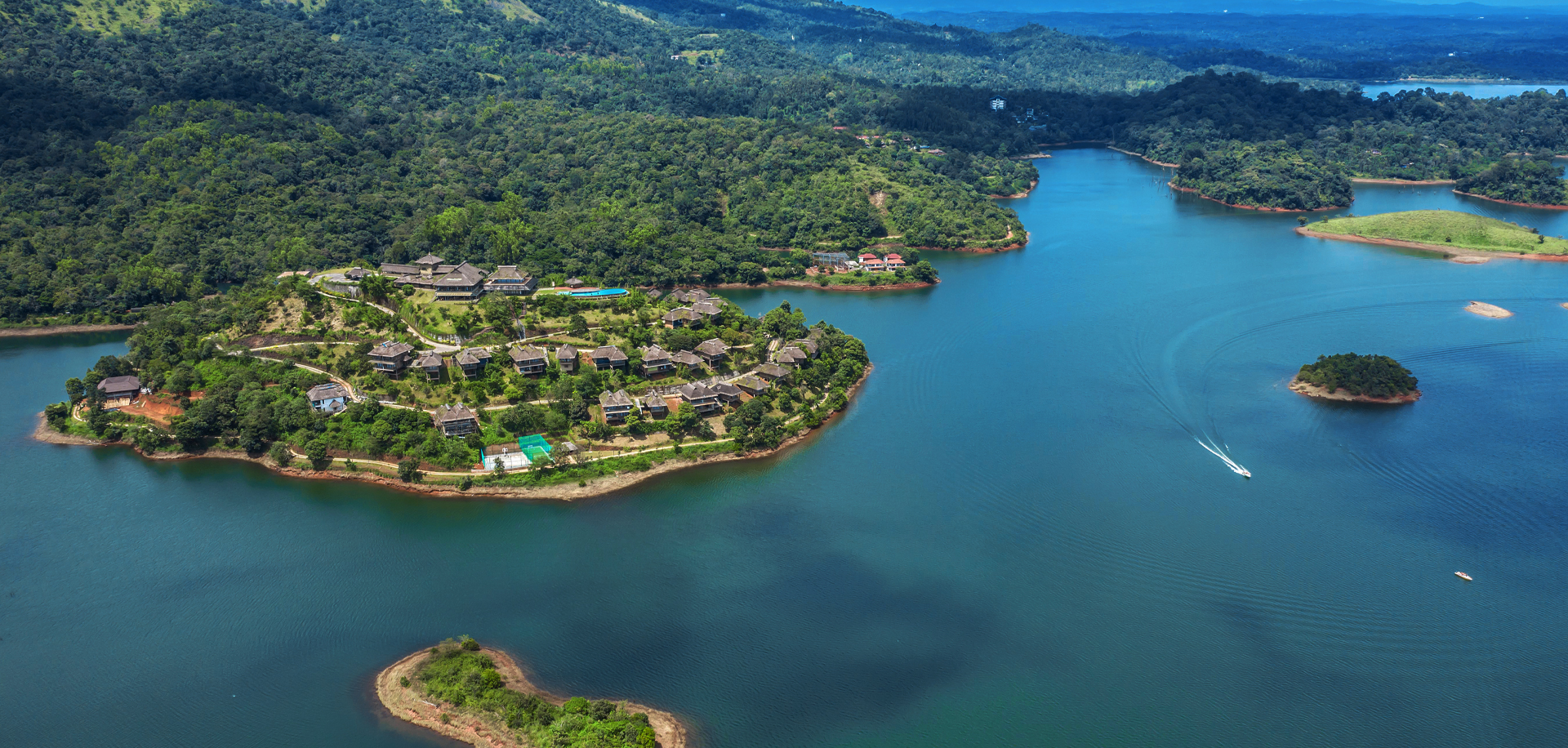
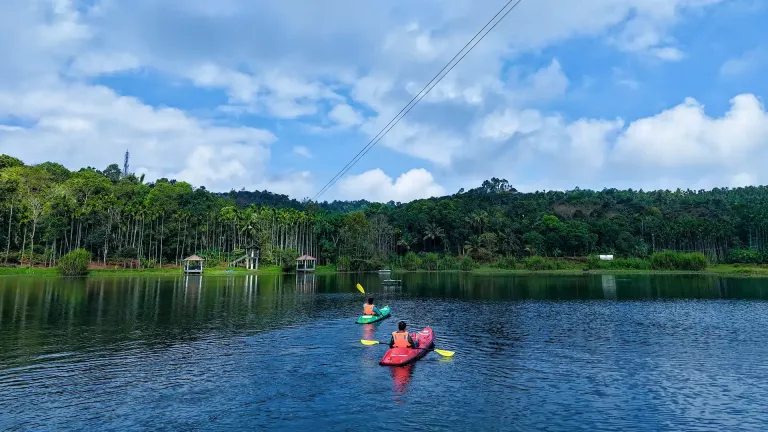
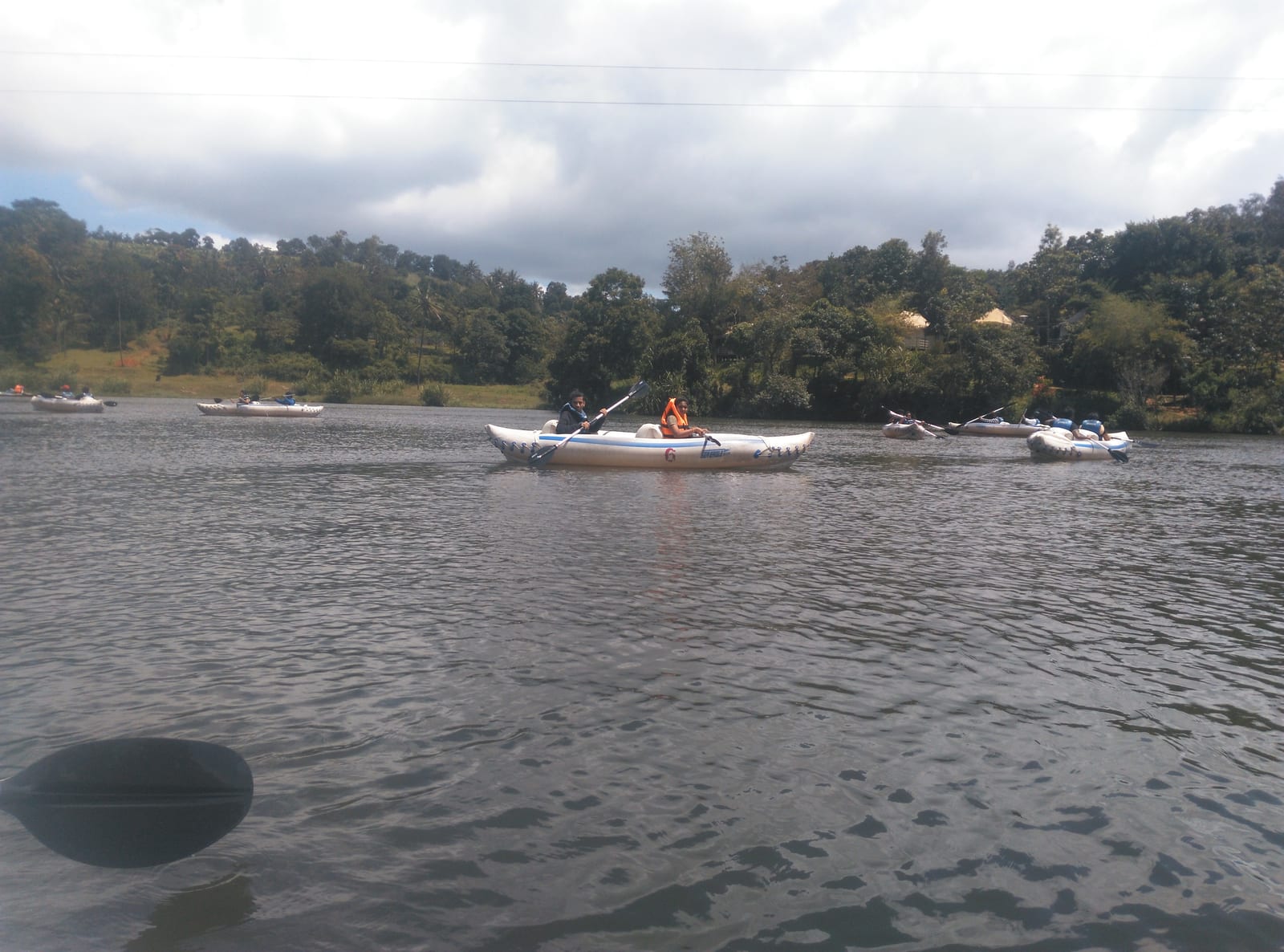
The reservoir behind it is the range’s signature spectacle. When the water rises, the tops of submerged hillocks are left standing as a scatter of little green islands across the blue — a view that has made the dam one of Wayanad’s most photographed spots. Speedboats, pedal boats and other craft ferry visitors out among these islets, and the surrounding hills throw a moody, ever-shifting backdrop of cloud and light.
The wider Banasura tract is also a gateway to some of Wayanad’s finest water and forest country. Meenmutty Falls — reckoned among the largest waterfalls in the district — lies within trekking reach of the same forest belt, and the slopes carry the streams, wildflowers, birdlife and occasional wildlife of the Western Ghats, a recognised global biodiversity hotspot. Coffee, tea and spice estates fringe the approach roads, so even the drive in is quietly beautiful.
Put together — myth on the summit, engineering at the base, islands on the water and waterfalls in the forest — the Banasura Hills give Wayanad one of its most complete days out: equal parts pilgrimage of the imagination, gentle family outing and hard-earned trekker’s reward.
Legend & myth
In the Puranas, Banasura is the eldest of the hundred sons of the righteous asura king Mahabali — the same Mahabali whom Malayalis welcome home each Onam. A thousand-armed warrior and an ardent devotee of Shiva, Banasura ruled Sonitapura, and legend credits him with fierce penance on these hills to win the god’s protection; Wayanad tradition points to the peak and its summit cave as the place of that austerity.
The tale that gives the legend its heart is the love of Banasura’s daughter, Usha, for Aniruddha — grandson of Lord Krishna. As the story is told, Usha dreamt of a handsome youth and pined for him; her companion Chitralekha, gifted in the arts, sketched face after face until Usha recognised Aniruddha, and Chitralekha spirited him by night into the guarded palace. When Banasura discovered the prince within his walls he had him bound, and Krishna marched on Sonitapura to free his kinsman.
In the war that followed, Krishna is said to have shorn away Banasura’s thousand arms — sparing his life only when Shiva, honouring his devotee, intervened to plead for him — after which Usha and Aniruddha were united. Framed as legend and Puranic myth rather than history, it is this story of a father’s pride, a daughter’s longing and a god-versus-god reckoning that Wayanad still hears in the name of these hills.
History
Long before it became a tourism landmark, this corner of Wayanad was estate-and-forest country on the high Western Ghats plateau, its economy shaped by coffee, tea, pepper and cardamom and its slopes home to Adivasi communities and Ghats wildlife. The Banasura name, carried down through oral legend, marked the range on the mental map of the region long before any dam existed.
The modern chapter opens with the Banasura Sagar project, part of the wider Kakkayam / Kuttiadi hydro-and-irrigation scheme drawing on the Kabini river system. The earthen dam across the Karamanathodu was completed in 1979 (indicative — confirm locally), built to store water for irrigation, drinking supply and hydroelectric generation downstream rather than as a tourist attraction.
As an earth-fill (embankment) dam — a graded mass of compacted soil and rock rather than a concrete gravity wall — Banasura Sagar drew engineering attention in its own right, and is routinely described as the largest earthen dam in India and one of the largest in Asia (often cited as such — confirm locally). Its long, green-turfed bund became an unlikely walking promenade with reservoir views on one side and valley on the other.
It was the filling of the reservoir that turned the site into a destination. As water backed up behind the bund, low hills drowned to leave only their crowns exposed — the islands that now define the postcard view — and boating operations, viewpoints and a small tourism ecosystem of guides, drivers and eateries grew up around it, today run under the eye of Kerala’s tourism and irrigation authorities.
In recent decades the Banasura tract has been woven into Wayanad’s wider adventure-and-nature circuit — peak trekking under forest-department control, waterfalls, ziplines and speedboating — while remaining, at heart, a working dam on a fragile stretch of the Ghats, mindful of monsoon flood risk and conservation limits.
Why visit
The island-dotted reservoir is the headline: when levels are high, the flooded hilltops stand as green islets across a sheet of blue water framed by the hills — one of the most distinctive and photogenic scenes in all of Wayanad.
Speedboating and other water rides let almost anyone — families, older travellers, first-timers — get out onto that reservoir and in among the islands, making the site rewarding even for those who will never attempt the peak.
For fit trekkers, Banasura Peak offers one of Wayanad’s great summit walks: grassland ridges, shola pockets, a legend-soaked cave and a top-of-the-world panorama over the reservoir and the surrounding Ghats.
The legend layer gives the whole place a resonance few dams can claim — the asura king Banasura, his penance, and the Usha–Aniruddha love story that pulled Krishna into war — turning a walk on the bund into a stroll through the Puranas.
It sits at the centre of a rich day-trip cluster: Meenmutty Falls, Padinjarathara, coffee and spice estates, and easy reach of Kalpetta, so the dam pairs naturally with waterfalls, plantations and other Wayanad sights.
And it delivers pure Western Ghats atmosphere — cool plateau air, drifting cloud, birdsong and big green horizons — the kind of restorative hill-country day that draws people to Wayanad in the first place.