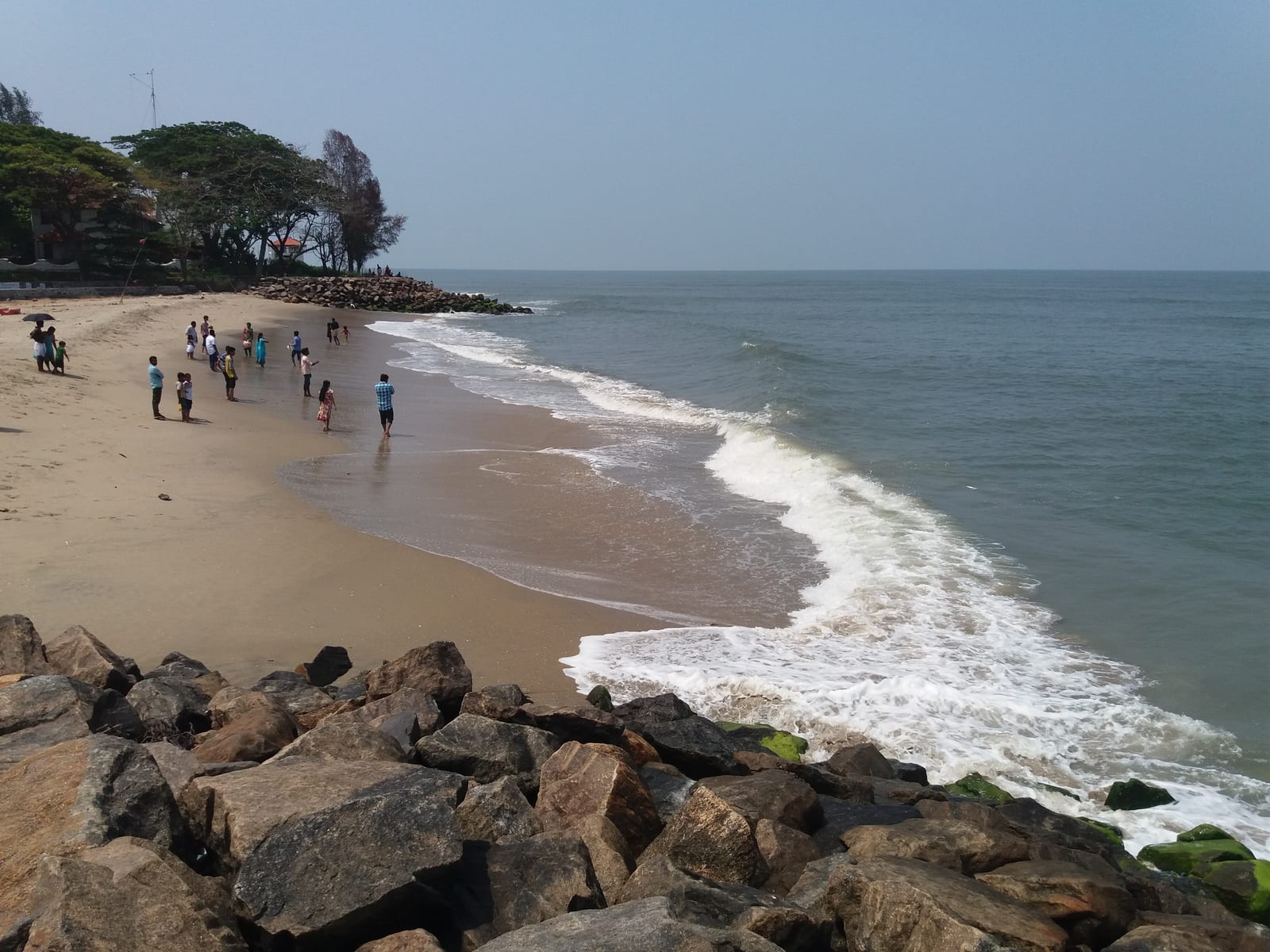
Puthuvype Beach unspools along the southern tip of Vypin Island, where the Kochi backwaters finally spill into the Arabian Sea beside the harbour mouth. It is a long, quiet, dark-sand shore watched over by Kerala’s tallest lighthouse — a place to walk, watch ships slide in and out of port, and catch a big open-sky sunset without the crowds of the city’s busier beaches.
The story of Puthuvype Beach
Come to Puthuvype (also spelt Puthuvypin or Puthuvypeen) for the space. Where Fort Kochi’s waterfront can feel busy and Cherai draws the weekend beach parties, this stretch near the island’s tip stays wide, plain and largely empty on weekday mornings. The sand runs dark — an ashy grey-brown that turns almost black where the last wave has soaked it — and the shoreline stretches far enough that walkers, joggers and the odd fisherman never quite crowd one another.
The great landmark is the lighthouse. Painted in bold white-and-red horizontal bands and rising to roughly forty-six metres, the Puthuvype (Vypin) light is the tallest in Kerala, and on the days its gallery is open you can ride most of the way up by lift, climb the last flight, and step out onto a viewing balcony. From there the whole geography of the place clicks into focus: the Arabian Sea on one side, the mouth of the Kochi backwaters on the other, container cranes and church spires and coconut fringe laid out below.
This is often described as a drive-in beach, and that captures its character. Reaching it means crossing the Goshree bridges from the city and driving out along Vypin, past the fishing harbour and the container terminal, and many visitors simply park close to the sand and take in the sea from near their vehicle. It gives the whole outing an easy, unhurried feel — a short escape rather than a full-blown beach day.
The setting beside the harbour mouth means the water here is working water. Ships and fishing craft pass on their way to and from the port, and the interplay of river current and sea makes the near-shore livelier than it looks. That same restlessness is why locals treat the sea with respect: the beach is lovely to sit beside and paddle along, but it is not a carefree swimming pool.
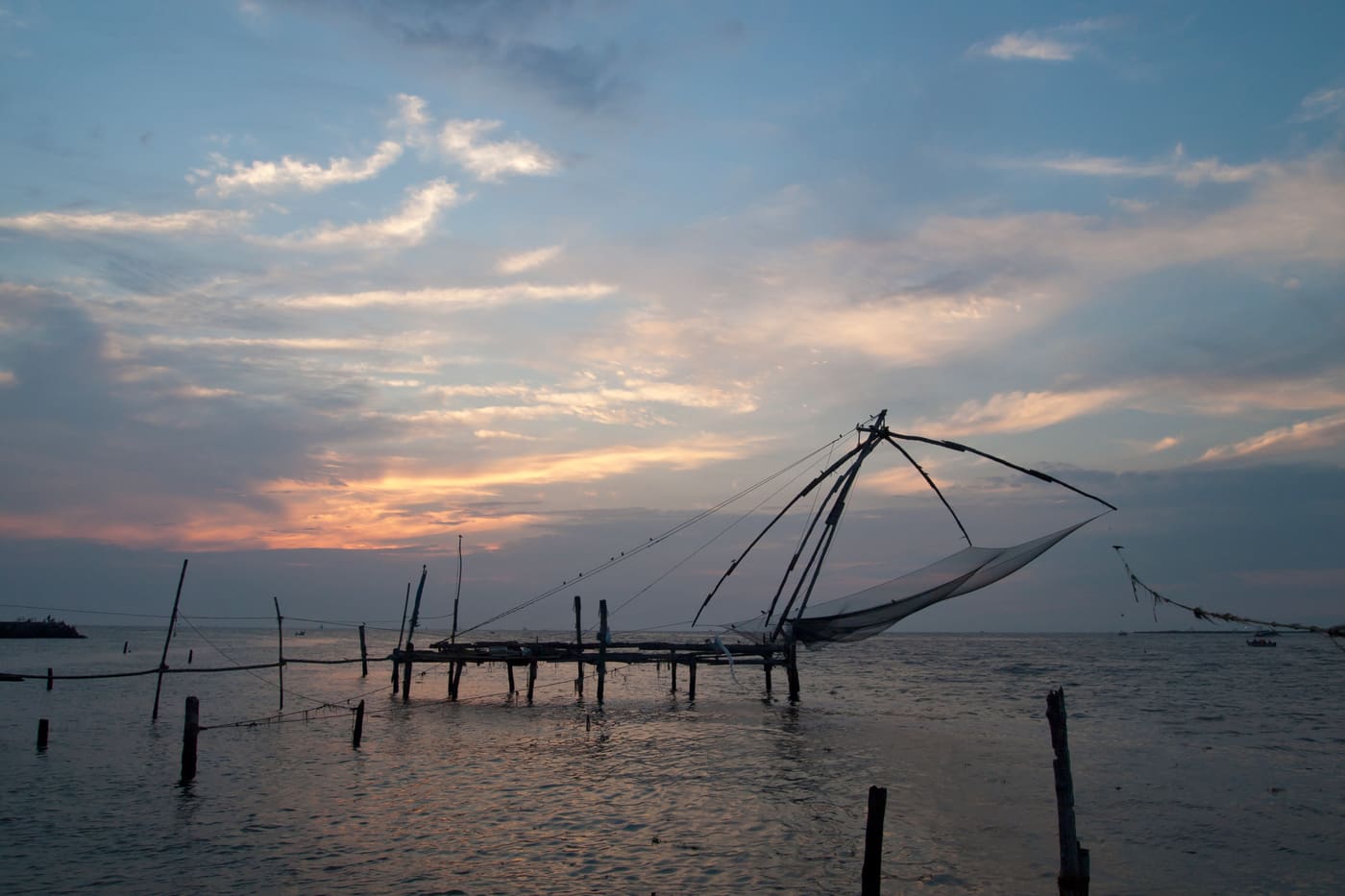
Evenings are when Puthuvype comes into its own. Families drift down as the heat softens, children chase the shallow edge of the waves, and the sun drops straight into the Arabian Sea in a wide, unobstructed arc. With the lighthouse throwing its first sweeps of the night and boats lit up on the water, it is one of the more atmospheric sunset spots around Kochi.
It remains, above all, an uncommercial place. There is no boardwalk of stalls, no ticket gate at the sand, only a scatter of snack carts, the lighthouse, and a long horizon. That plainness is exactly the appeal for the travellers who seek it out — a genuine slice of coastal Vypin, close to the city yet a world away from it.
History
Vypin Island itself owes its shape to the sea. The island and the natural harbour mouth beside it are widely traced to the great Periyar flood of 1341, when the river is said to have shifted course, silted up the old port at Kodungallur, and carved open the deep-water entrance that made Kochi one of the finest natural harbours on the coast — the making of Vypin and, indirectly, of the modern city.
For centuries the low, sandy spit at the harbour mouth was prime ground for a guiding light. The lineage of the lighthouse that now stands at Puthuvype reaches back to 1839, when an oil-fuelled lamp was first lit on the Fort Kochi side to steer vessels into the port. Over the following decades the light was repeatedly upgraded — new optics early in the twentieth century, a ten-metre tower in the 1920s, and by 1936 a taller steel tower carrying a gaslight.
As shipping grew and the old Fort Kochi site ran short of room, the light was rebuilt across the harbour mouth at Puthuvype on Vypin Island around 1979. The present tower — octagonal, double-walled concrete, in its white-and-red livery — rises to about forty-six metres, making it the tallest lighthouse in Kerala, with a beam reported to reach roughly twenty-eight nautical miles out to sea.
The lighthouse is a working aid to navigation under the national lighthouse authority, not merely a monument, and its flashing character still marks the entrance to the port every night. In recent years the authorities have opened many such towers to the public with viewing galleries, and Puthuvype’s gallery has become the beach’s headline attraction.
The wider area has changed fast in the modern era. The Goshree bridges knitted the once-isolated Vypin islands to mainland Kochi, and the growth of the harbour — including the container terminal at Vallarpadam nearby — has put heavy maritime traffic just offshore. Puthuvype today sits at the meeting point of that industrial harbour world and a quiet, still-rural stretch of island coast.
Why visit
You get Kerala’s tallest lighthouse with a public viewing gallery — a lift most of the way up and a balcony with sweeping views over sea, harbour mouth and island (open days and hours permitting).
The beach is long, uncrowded and peaceful, one of the cleaner and calmer shores around Kochi, ideal for an unhurried walk far from the city bustle.
It is an easy drive-in escape: cross the Goshree bridges, drive out along Vypin past the fishing harbour, and you are at the sand within a short trip from the city.
The harbour-mouth setting is genuinely scenic — ships and fishing boats passing, the backwaters meeting the Arabian Sea, and a real working coastline rather than a manicured one.
Sunsets are wide open and dramatic, with the sun dropping straight into the sea and the lighthouse beginning its nightly sweep — one of the best evening spots on this side of Kochi.
It pairs neatly with the rest of Vypin — Cherai Beach, the fishing harbour, and the ferry hop to Fort Kochi — for a full day exploring the islands.