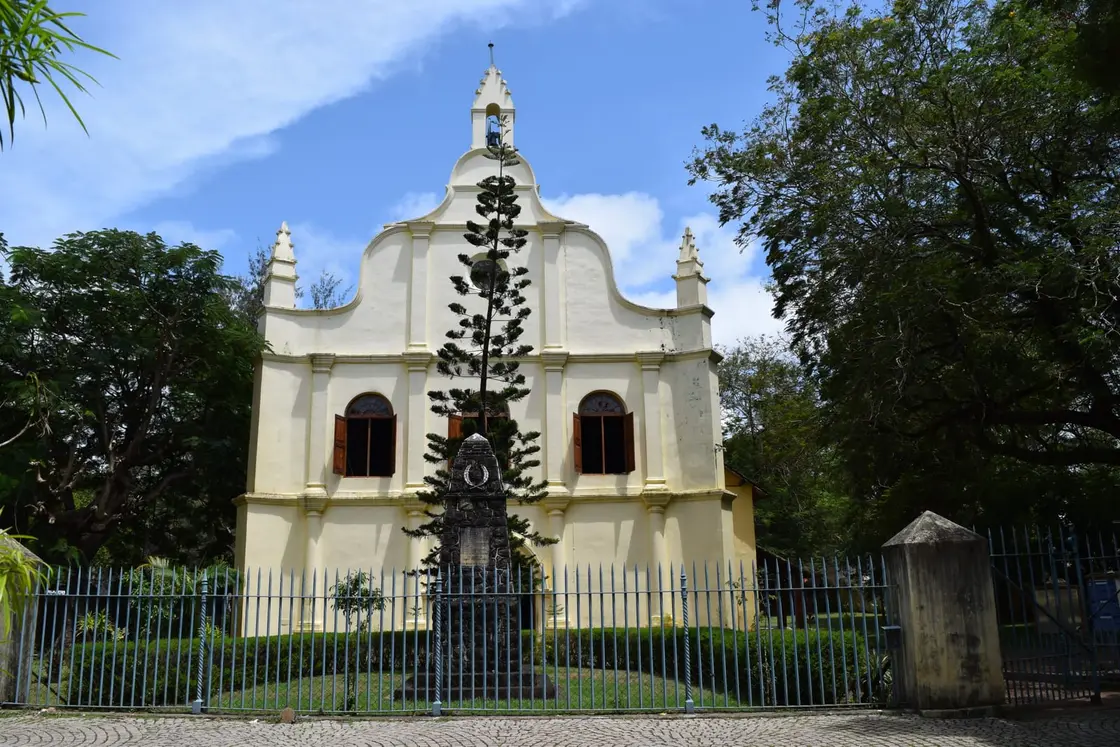
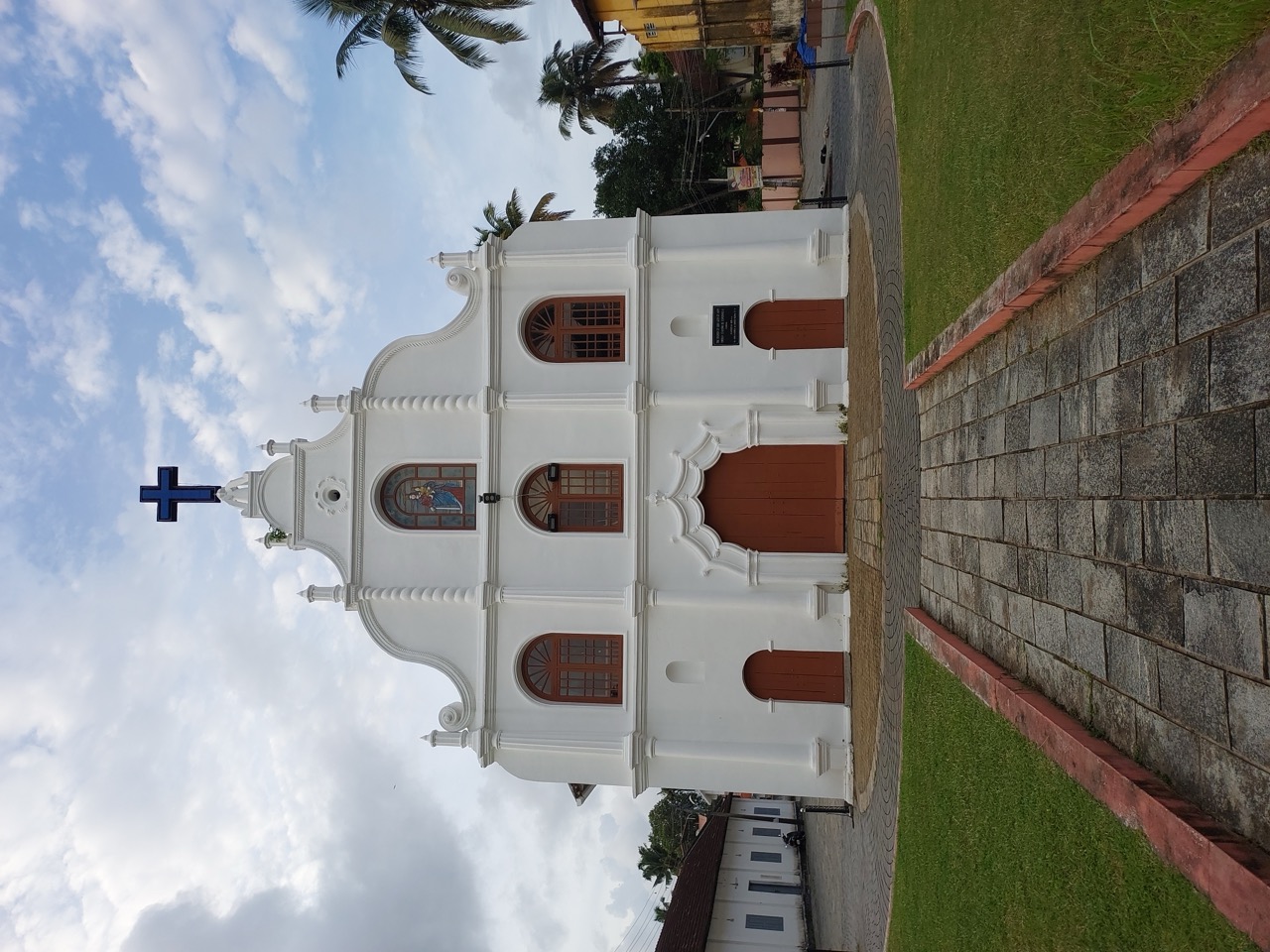
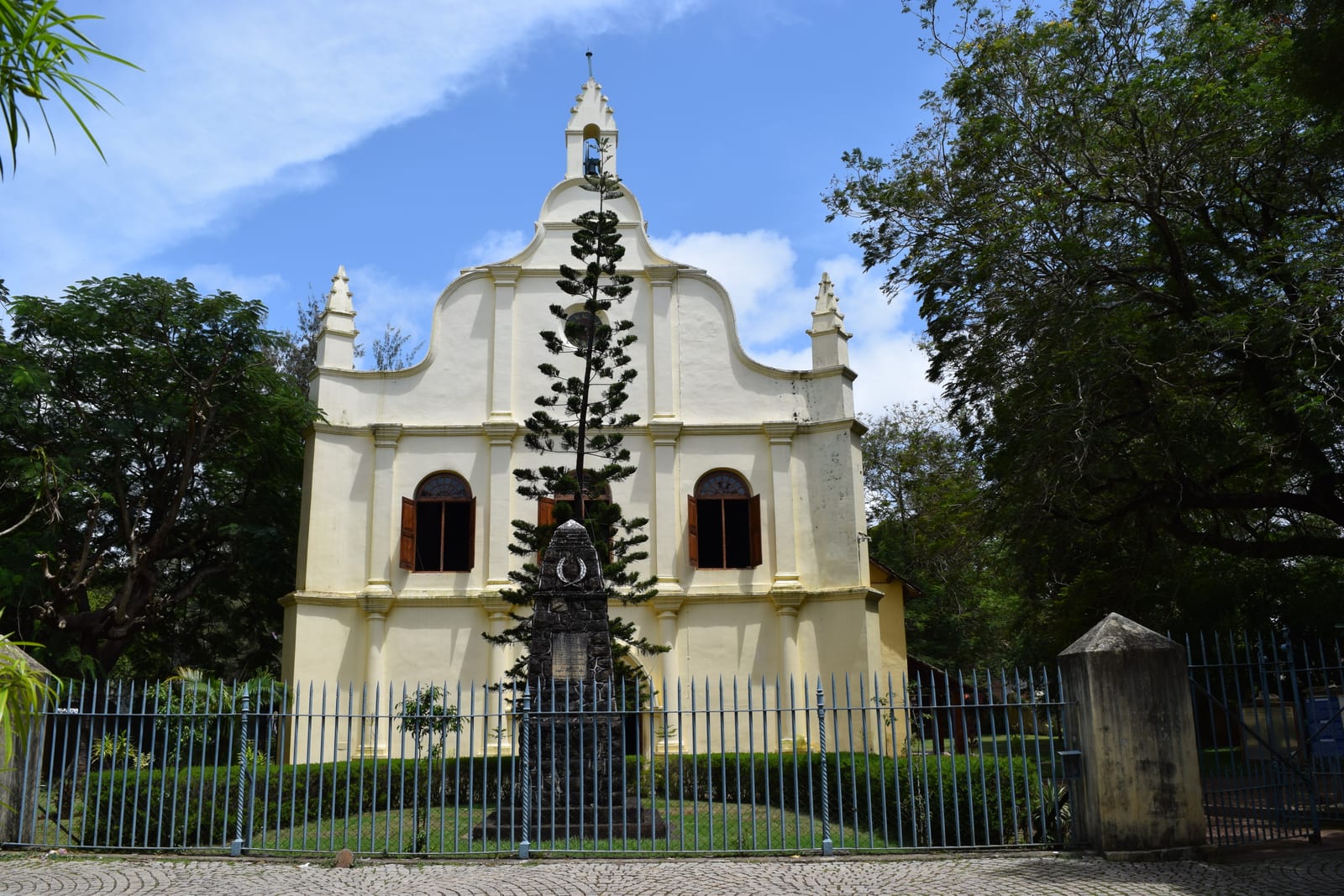
A plain, whitewashed gable rising from a shady Fort Kochi green — yet inside lies the empty grave where Vasco da Gama once rested, in what is widely called the oldest European-built church in India.
The story of St. Francis Church
Walk in from the sun-glare of Fort Kochi and the first thing that reaches you is the cool hush of thick lime-washed walls and a bare, barn-simple nave. There are no soaring vaults or gilded altars here; St Francis Church is famous not for grandeur but for age and memory. It is very commonly described as the oldest surviving European-built church on Indian soil (a claim worth attributing rather than treating as gospel), and every stone underfoot seems to carry a date and a name from five centuries of colonial coming and going.
The building you see is the sum of many hands. The Portuguese raised it first, the Dutch made it their own, the British reshaped it again, and today it belongs to the Church of South India — a single roof that has answered to Roman Catholic, Protestant Reformed and Anglican worship in turn. That layered custodianship is the real story of the place: a small parish church that quietly mirrors the whole arc of European power along the Malabar coast.
Its greatest draw is a rectangle of stone set into the floor. Here, tradition holds, the explorer Vasco da Gama was buried after he died in Kochi in 1524 on his third voyage to India. His remains were later carried home to Portugal, but the gravestone site is still marked and railed off, and visitors drift towards it almost by instinct, standing a moment over the spot where the man who opened the sea route from Europe to India once lay.
Look up and you will notice the punkahs — long horizontal cloth fans slung on wooden frames above the pews. In the days before electric fans, servants seated outside would pull ropes to swing these great flaps and keep the congregation cool through humid Kerala services. Several survive in place, a small, human detail of colonial church-going that most grand cathedrals cannot show you.
The walls themselves read like a stone ledger of the dead. Old Portuguese and Dutch tombstones and epitaphs, many lifted from the floor and fixed upright along the interior, record merchants, officials and their families in worn Latin and Dutch lettering, the earliest reaching back to the sixteenth and seventeenth centuries. On the lawn outside stands a cenotaph, and the whole ensemble sits under the protection of the Archaeological Survey of India, tended as a monument as much as a working church.
For all its museum-like fame, St Francis is still a place of worship, so the atmosphere shifts with the hour — quietly touristic on a weekday morning, prayerful during a Sunday service. That double life is part of its charm: you come for da Gama and colonial history, and leave having sat, however briefly, inside a living congregation that has kept a candle lit here for roughly five hundred years.
History
The church traces its origins to around 1503 (indicative — confirm locally), when Portuguese Franciscan friars, arriving in the wake of Pedro Alvares Cabral, built a modest structure of timber and mud within the fort that the Portuguese had raised at Kochi with the permission of the Raja of Cochin. This first church is generally said to have been dedicated to St Bartholomew. A little over a decade later it was rebuilt in stone and masonry — commonly dated to around 1516 (indicative — confirm locally) — and re-dedicated, most accounts say, to Santo Antonio (St Anthony/Antony), the exact dedication history being somewhat tangled across sources.
Its most celebrated chapter belongs to Vasco da Gama. The Portuguese navigator, who had pioneered the sea route from Europe to India, died at Kochi in 1524 during his third visit and was originally buried inside this church. About fourteen years later — around 1538 to 1539 (indicative — confirm locally) — his remains were exhumed and shipped back to Portugal, eventually reinterred in Lisbon. The burial spot inside St Francis is still marked by a gravestone and remains the single most visited feature of the church.
Custodianship changed with the tides of empire. When the Dutch captured Kochi from the Portuguese in 1663 they took the church for Protestant (Dutch Reformed) worship, and are said to have demolished the other churches of the town while sparing and repairing this one; a notable restoration is dated to 1779 (indicative — confirm locally). With the British ascendancy at the end of the eighteenth century — the hand-over is variously dated to the 1790s and early 1800s (indicative — confirm locally) — the church passed into Anglican use, and further rebuilding and reshaping followed during the nineteenth century.
The interior became, over these centuries, a repository of colonial memory. Portuguese and Dutch tombstones were set into the floor and walls, the earliest Portuguese epitaph often cited from 1562 and the earliest Dutch from 1664 (indicative — confirm locally). On the lawn a cenotaph was later added, commonly associated with remembrance of those who died in the First World War (indicative — confirm locally), and the swinging cloth punkahs preserved a vanished mode of tropical church-going.
In the early twentieth century the building was recognised as a protected monument — frequently dated to 1923 under the Ancient Monuments Preservation Act of 1904 (indicative — confirm locally) — and it remains under the care of the Archaeological Survey of India. Since the reorganisation of Protestant churches in India, St Francis has been part of the Church of South India (CSI), under whose congregation it continues as an active place of worship today.
Why visit
Stand at the marked gravestone where Vasco da Gama was first buried in 1524 — one of the most evocative colonial-era spots in India.
See what is widely regarded as the oldest European-built church in the country, roughly five centuries old.
Trace three colonial eras under one roof — Portuguese Catholic, Dutch Protestant and British Anglican, now Church of South India.
Look up at the rare surviving punkahs, the rope-pulled cloth fans of pre-electric tropical worship.
Read the old Portuguese and Dutch tombstones and epitaphs set into the walls, some dating to the 1500s and 1600s.
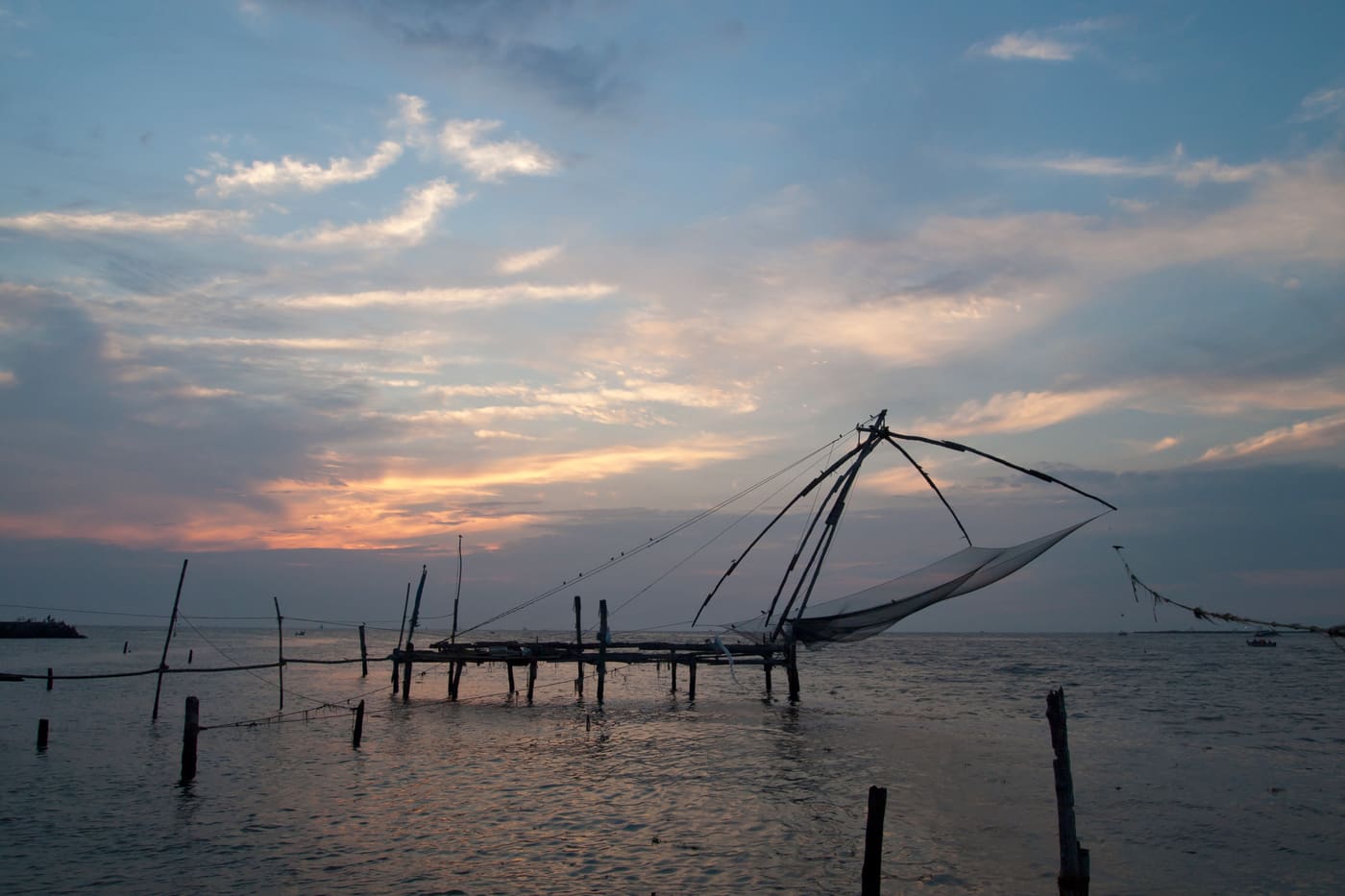
It sits at the heart of the Fort Kochi heritage quarter, an easy walk from the Chinese fishing nets, the Dutch Palace area and colonial streets.