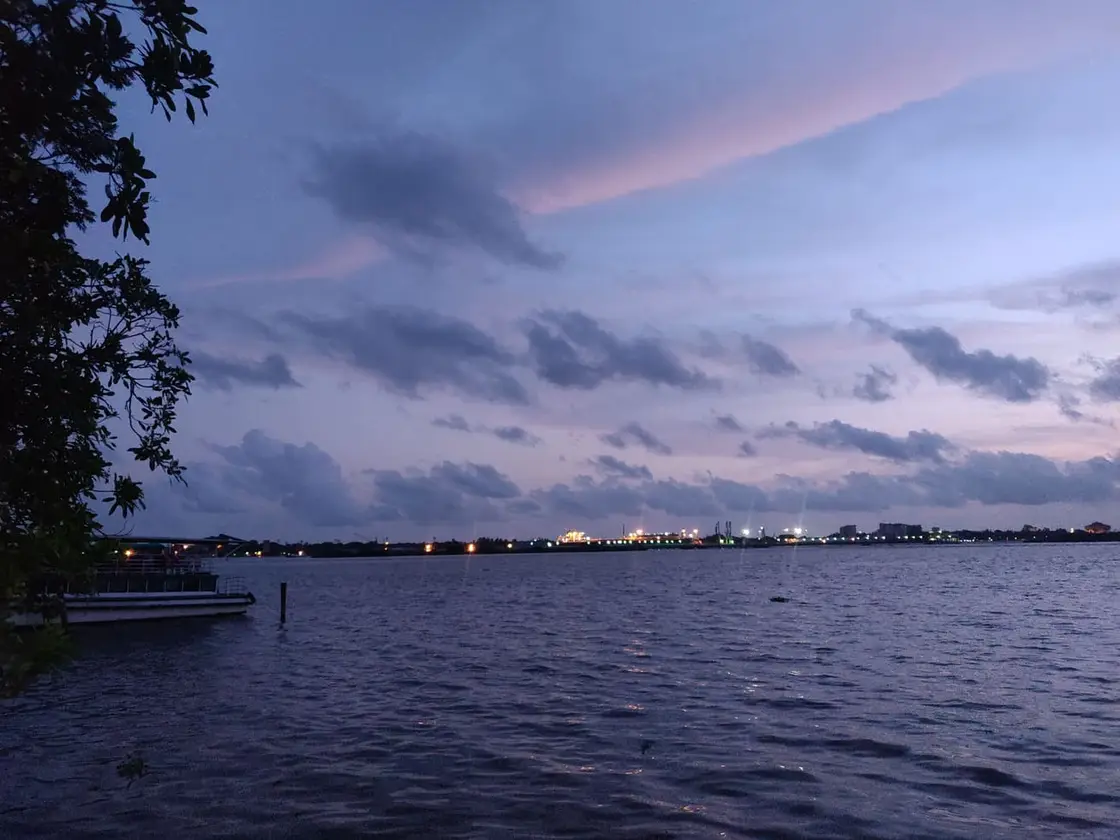
As the sun slides down over Vembanad Lake and the sky turns molten orange, Kochi drifts to its waterfront. Marine Drive — a breezy, traffic-free promenade reclaimed from the backwaters — is where the whole city comes to breathe: couples on the parapet, children chasing bubbles, ferries churning towards Fort Kochi, and the arched Rainbow Bridge waiting to light up against the dusk.
The story of Marine Drive
Marine Drive is Kochi’s living room by the water — a roughly 1.75-km pedestrian promenade running along the eastern shore of Vembanad Lake, one of India’s largest backwater lakes. Officially named APJ Abdul Kalam Marg, it stretches from the Kerala High Court junction down towards Rajendra Maidan, and — unusually for a place with ‘Drive’ in its name — no vehicles are allowed on the walkway itself. It is a street built entirely for people on foot.
The rhythm of the place changes with the light. Mornings belong to walkers and joggers who come for the cool lake breeze; afternoons are quieter, the tiled parapet warm underfoot; and evenings bring the crowds, when families, students and tourists gather along the railing to watch the sun set over the water. The gentle wind off Vembanad, the slap of small waves against the reclaimed embankment, and the low horn of passing boats give the promenade an easy, unhurried mood that locals treasure.
The signature landmark is the Rainbow Bridge — an arched pedestrian span over the Market Canal near the GCDA shopping complex — which after dark is washed in bands of coloured light that give it its name and make it Kochi’s most-photographed footbridge. Two more walkway bridges punctuate the stroll: the Chinese Fishing Net Bridge crossing the Mullassery canal near the Children’s Park, and the House Boat Bridge towards the Goshree end, together threading the promenade over the little canals that lace this reclaimed shore.
Marine Drive is also a working ferry-front. Boat jetties dot the walkway, and from here government and private boats cross the harbour to Fort Kochi, Mattancherry, Vypin island and Bolgatty — an inexpensive, breezy alternative to the road bridges and a small adventure in itself. In the evenings, speedboats, motorboats and cruise boats offer short backwater rides on Vembanad, and you can watch houseboats and the occasional cargo ship glide across the wide sea-mouth of the harbour.
The promenade doubles as a street-food and hangout strip. Vendors sell roasted peanuts, cut fruit, ice cream, gram (kadala) and Kerala snacks, while cafes and stalls line the landward side. Behind them rise the malls and towers of new Kochi — Centre Square Mall, Bay Pride Mall and the GCDA complex — so an evening here can fold together a lakeside walk, a bag of hot snacks, a boat ride and a bit of shopping without ever moving far.
What makes it quietly remarkable is the ground you stand on: almost all of Marine Drive is reclaimed land, coaxed out of the Kochi backwaters. Where there is now a broad tiled walkway, ornamental lamps, seating and gardens, there was once open lake. That origin is why the setting feels so intimate with the water — the promenade doesn’t merely look at Vembanad, it sits right on its edge, with the lake lapping just beyond the parapet.
History
Until around 1980, the name ‘Marine Drive’ in Kochi was loosely attached to Shanmugham Road, which runs beside the lake. The waterfront promenade known by that name today did not yet exist — the site was part of the Kochi backwaters themselves.
In the 1980s the Greater Cochin Development Authority (GCDA) launched the Kochi Marine Drive project, reclaiming land from the lake to create a waterfront for public recreation and commerce. The scheme was consciously modelled on Mumbai’s famous Marine Drive, the idea being to give the growing city of Kochi a signature seafront of its own.
The original plan was more ambitious than what exists now: GCDA intended to run an actual road along the western, lake-facing edge of the reclaimed land. That roadway was never built. With the enforcement of India’s Coastal Regulation / Coastal Protection laws in the 1990s, construction of a road along the water’s edge became impossible, so the authorities developed a pedestrian marine walkway instead — which is why, despite the name, it is a promenade rather than a drive.
Over the following decades the reclaimed strip filled in with the infrastructure that defines it today — the tiled walkway and parapet, the GCDA shopping complex, boat jetties, gardens and the trio of canal footbridges. The Rainbow Bridge, arching over the Market Canal near the GCDA complex and lit in rainbow colours at night, became the promenade’s emblem, while the Chinese Fishing Net Bridge and House Boat Bridge carried the walkway over the smaller canals.
The setting is inseparable from Kochi’s identity as a great natural harbour. Marine Drive faces the broad mouth of the harbour on Vembanad Lake, across which lie Fort Kochi, Willingdon Island, the Cochin shipyard and the port — so the everyday view from the parapet is of a genuinely working waterway of ferries, houseboats and ships, not merely a scenic lake. In recent years it has grown into central Kochi’s premier public gathering place and a venue for major city events and celebrations.
Why visit
Kochi’s best free sunset — the sky over Vembanad Lake turns spectacular colours as boats drift past.
The Rainbow Bridge lit up in colour after dark, the city’s most photographed footbridge.
A traffic-free 1.75-km lakeside promenade perfect for an unhurried evening walk.
Cheap, breezy ferry rides from the jetties to Fort Kochi, Mattancherry, Vypin and Bolgatty.
Evening boat rides on the backwaters — speedboats, motorboats and cruises straight from the walkway.
Street food, cafes and malls right behind you, so walk, snack, shop and boat in one outing.