The story
At Tripunithura, the old seat of the Cochin royal house on the south-eastern edge of Ernakulam, stands Sree Poornathrayeesa Temple — the family shrine of the Kochi Maharajas and, by tradition, the foremost of the eight great temples of the erstwhile Kingdom of Cochin. Its presiding deity, Poornathrayeesa, is Vishnu in a rare seated posture upon the serpent Ananta, worshipped as Santhana Gopala, the granter of children. The temple is best known beyond Kerala for its Vrischikotsavam, one of the state’s grandest temple festivals, when scores of caparisoned elephants and thundering percussion fill the sand courtyard for eight nights.
The story of Sree Poornathrayeesa Temple
Poornathrayeesa is a name that devotees like to unpack syllable by syllable — ‘poorna’ meaning complete or full, ‘traya’ the three (often read as the three Vedas — Rig, Yajur and Sama), and ‘isa’ the lord. Together the name is taken to mean the lord of complete knowledge, or the master of the three Vedas. This is Vishnu approached not as a distant cosmic figure but as the intimate deity of a royal town, a presence woven into the daily and dynastic life of Tripunithura for centuries.
What makes the deity unusual is the posture. Across most Vishnu temples the lord stands, or reclines upon Ananta as Anantasayana. Here he is worshipped seated upon the coils of the serpent Ananta — a form devotees associate with Santhana Gopala Murthy, the Vishnu who restores and protects children. It is this association that has, for generations, drawn childless couples to Tripunithura to pray for offspring, and that gives the temple its tender, domestic character alongside its royal grandeur.
The sanctum itself carries a story in its very shape. Tradition holds that the srikovil was conceived in the form of a chariot (ratha), commemorating the legend of Krishna and Arjuna riding out to recover a Brahmin’s lost sons — the Santhanagopalam episode from which the deity’s child-granting reputation flows. Another oft-noted peculiarity is the shrine of Ganapati, said to face south rather than the customary east or west, a small orientation quirk that pilgrims and guides love to point out.
For the Cochin royal family, this was not simply a temple they patronised — it was their household and state deity, the guardian of the capital. When you walk the broad complex today, with its long entrance corridor, spacious courtyards and the towering western gopuram, you are moving through a landscape shaped by that royal devotion, where the rhythms of temple ritual and the fortunes of a kingdom were once tightly entwined.
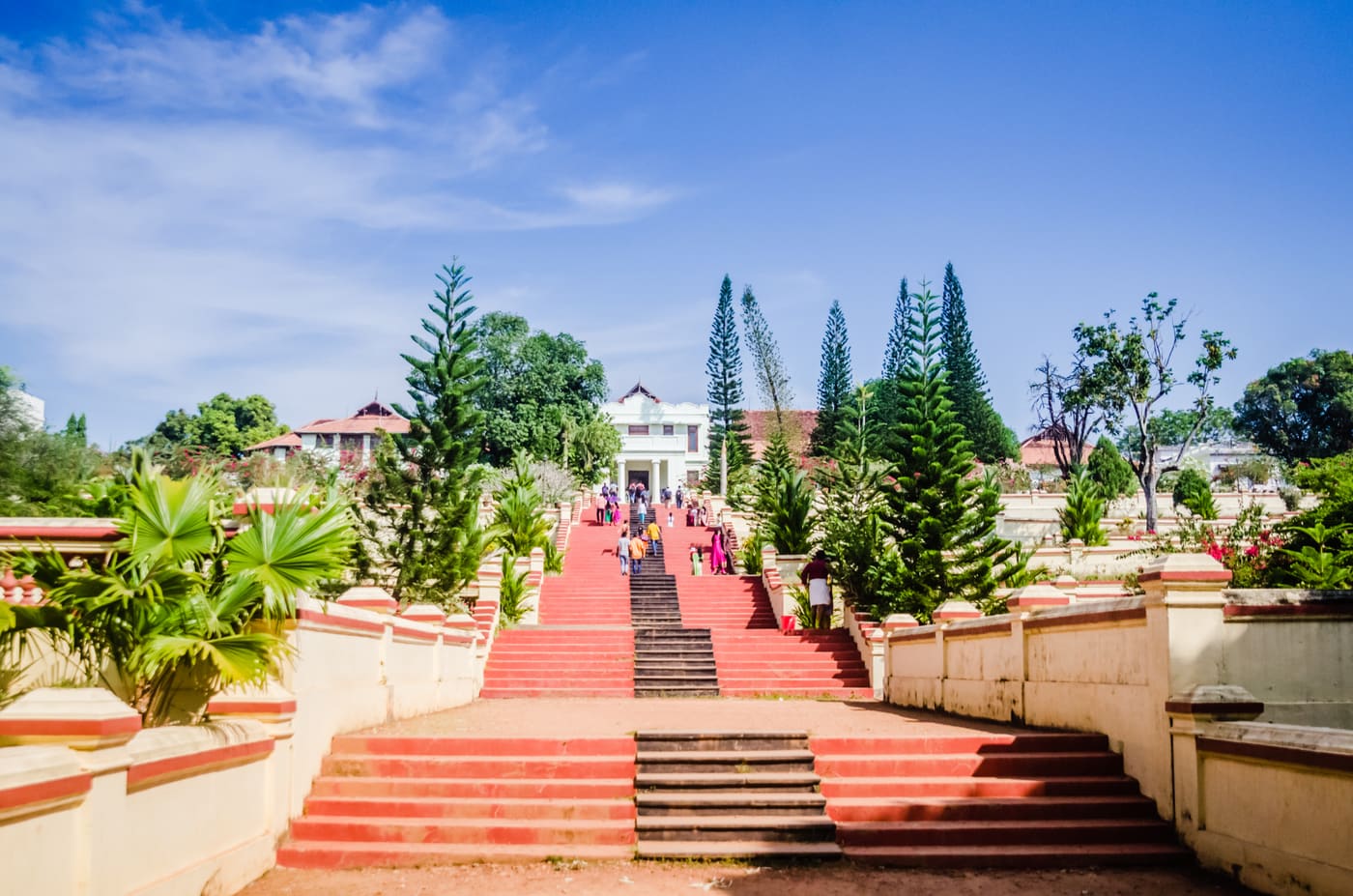
The temple sits at the heart of Tripunithura, a town that still wears its heritage openly — the old Hill Palace, the traditions of Kathakali and classical music, the streets that fill during festival season. The shrine anchors this cultural quarter, and much of Tripunithura’s calendar, especially in the Malayalam month of Vrischikam, still orbits around the temple’s festival timetable.
For a visitor, Poornathrayeesa offers two quite different experiences depending on when you come. On an ordinary morning it is a calm, dignified Kerala mahakshetram, all lamplight, wet granite and the murmur of prayer. During Vrischikotsavam it transforms into a blaze of colour and sound — a reminder that this is at once a place of quiet child-blessing devotion and one of Kerala’s great festival stages.
Legend & myth
The legend most closely bound to this temple is the Santhanagopalam story, told here as sacred tradition rather than documented fact. In it, a devout Brahmin of Dwaraka watches child after child die at birth, until he has lost several sons in succession. Grief-stricken, he carries his complaint to the very court of Krishna, blaming the failure of dharma and kingship for his sorrow.
As the tale goes, Arjuna, moved and stung by the Brahmin’s despair, vows on his own bow to save the next child — pledging to enter the fire if he fails. When that child too vanishes at the moment of birth, Arjuna’s worldly powers prove useless, and it falls to Krishna himself. Krishna and Arjuna are said to journey beyond the edges of the created world to the abode of Vishnu, where the lord reveals that he had drawn the children to himself simply out of a wish to behold his devotees. The lost sons are restored, and the Brahmin’s house made whole again.
Devotees connect this episode to Poornathrayeesa through the idol said to have been given to Arjuna and to the chariot-shaped sanctum that recalls the divine journey — and it is from this legend that the deity’s enduring reputation as Santhana Gopala, protector and giver of children, is drawn. As with all such temple lore, it is offered as devotional narrative and belief, not as historical record.
History
Sree Poornathrayeesa Temple is inseparable from the history of the Kingdom of Cochin. Poornathrayeesa was revered as the state deity of Cochin and the tutelary deity of Tripunithura, and the shrine is traditionally counted as the first, or foremost, among the eight great royal temples of the erstwhile Cochin state. The Kochi royal family were its principal patrons, and the temple’s fortunes rose with theirs across the centuries (broad tradition — precise dating is uncertain).
The temple’s most dramatic modern chapter is the great fire. In 1920, an accidental blaze is said to have destroyed almost the entire structure — including the original wooden sanctum — sparing, remarkably, only the western gopuram (indicative account — confirm details locally). That surviving gopuram, an ancient and much-loved landmark, is wrapped in its own aura, with popular belief holding its age and endurance to be something of a mystery.
Reconstruction followed swiftly. In 1921 the temple was rebuilt under the celebrated architect Eachara Warrier, and the new sanctum is widely described as among the earliest concrete temple structures in Kerala — an unusual claim to modernity for so traditional a shrine (indicative — verify locally). The royal family were again the chief contributors to this rebuilding, reaffirming the bond between dynasty and deity.
The temple’s ritual life has long centred on its festivals, above all the eight-day Vrischikotsavam held in the Malayalam month of Vrischikam (roughly November–December — dates shift each year with the Malayalam calendar, so confirm locally). Poornathrayeesa is fondly said to love elephants, and the festival is famous for the great number of caparisoned tuskers that take part over its course, accompanied by panchavadyam and pandi melam, temple percussion ensembles, and the ceremonial Vilakku illuminations, before culminating in the Arattu procession.
In recent years the festival has also drawn attention on the question of elephant welfare, with Kerala’s courts weighing safety norms for temple processions — a reminder that these ancient traditions now unfold within a modern regulatory frame. Through all of it, the temple remains a living centre of worship and a proud emblem of Tripunithura’s royal and cultural heritage.
Why visit
To stand before one of Kerala’s great mahakshetrams — the family temple of the Cochin royal house and, by tradition, the first of the old kingdom’s eight great temples, dense with history and royal association.
To see a genuinely rare form of Vishnu: Poornathrayeesa seated upon the serpent Ananta and worshipped as Santhana Gopala, the giver and protector of children, in a chariot-shaped sanctum unlike most Vishnu shrines.
For Vrischikotsavam, if your visit falls in Vrischikam (Nov–Dec) — an eight-night spectacle of caparisoned elephants, panchavadyam and pandi melam percussion and lamp-lit processions that ranks among Kerala’s most celebrated temple festivals (dates vary — confirm locally).
For the architecture: the towering, ancient western gopuram that survived the 1920 fire, the broad courtyards and corridors, and a rebuilt sanctum tied to the famous architect Eachara Warrier.
To experience Tripunithura’s heritage quarter as a whole — pairing the temple with the nearby Hill Palace and the town’s living traditions of Kathakali and classical music.
For a quieter, devotional visit on an ordinary morning, when the lamplit shrine offers one of the calmer, more atmospheric temple experiences near Kochi.