The story
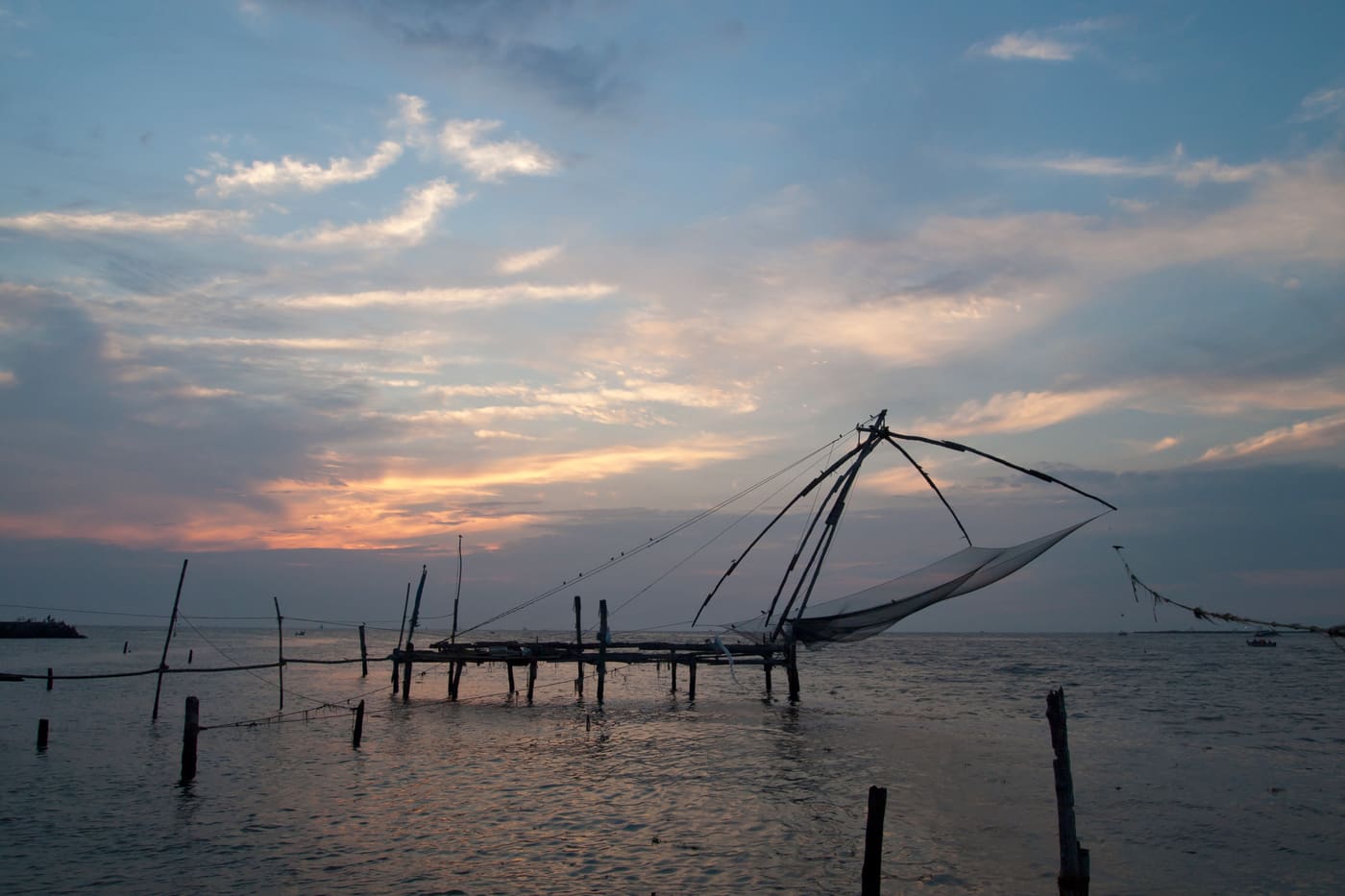
Strung along the Fort Kochi waterfront where the backwaters spill into the Arabian Sea, the Chinese fishing nets — Cheena vala in Malayalam — are the single most photographed silhouette in Kerala. Great cantilevered frames of teak and bamboo, hung with fine mesh and balanced by dangling stones, they dip into the tide and rise again in a slow, creaking arc that has become the emblem of Kochi itself. At sunset, when the sky behind them turns copper and the fishermen lean into the ropes, the sight is pure theatre — a working machine that also happens to be one of the loveliest things on the Indian coast.
The story of Chinese Fishing Nets
Walk out to Vasco da Gama Square on the northern tip of Fort Kochi and you meet them one after another, a row of skeletal giants leaning over the water like herons frozen mid-hunt. Each net is a shore-operated lift net: a horizontal frame perhaps ten metres across, slung from the end of a long cantilever arm and lowered flat into the sea. It is not cast or dragged like an ordinary fishing net — it simply waits, submerged, for fish and prawns to drift over it on the current, and then it is hauled straight up before they can escape.
The physics is beautifully simple and entirely human-powered. The long arm pivots on a heavy timber A-frame planted at the water’s edge. At the shore end hang rows of stones — often smooth granite or laterite blocks lashed in ropes — that act as counterweights. When the net is down, the fishermen add their own weight and walk the main beam down; the counterweights, rising, store the effort. To lift, a team of four to six operators grab the ropes and walk backwards along the gangplank, letting the stones swing down and do most of the work as the dripping net swings up out of the sea. A good crew can drop and raise the net every few minutes, harvesting a small silver flicker of sardines, mullet, prawns or the odd crab each time (indicative — the catch varies enormously with tide and season).
It is slow, patient, sociable fishing. Between lifts the men sit on the platform mending mesh, sharing tea and gossip, watching the ferries cross to Vypin and Ernakulam. Nothing about the rig is powered; every rise and fall is muscle and cleverly stored gravity, a design that has changed remarkably little in six centuries. That antiquity is exactly why visitors are drawn to them — you are watching a piece of living medieval technology still doing, more or less, the job it was built for.
The nets stand where they do because Kochi is one of the great natural harbours of the world. Here the Vembanad backwaters and the rivers of central Kerala meet the sea through a wide tidal mouth, and it was this sheltered, fish-rich channel that made Kochi a magnet for traders from China, Arabia, Portugal, the Netherlands and finally Britain. The nets are a survivor of that cosmopolitan past — a Chinese idea, or perhaps a Portuguese one, planted on an Indian shore and kept alive by generations of local fishing families.
Today the row of nets is as much a stage as a fishery. Come late afternoon the promenade fills with couples, families, photographers and tour groups; hawkers sell tender coconut and cut mango; and the fishermen, sensing an audience, will often wave visitors up onto the platform to lean on a rope and feel the net rise. It is a small, generous piece of theatre — and, increasingly, the tips from that theatre matter as much to the crews as the fish in the mesh.
For all their romance, the nets carry a quiet melancholy too. Many stand idle or half-collapsed; the harbour silts, the catch thins, and the young drift to steadier work. What you are watching at sunset is both a spectacle and, honestly, a tradition in slow retreat — which is all the more reason to stand there while the light lasts and the arm swings down one more time.
Legend & myth
The name itself carries the most enduring legend. Popular tradition holds that the nets were brought to the Malabar coast by Chinese traders — often the tale names the great Ming-dynasty admiral Zheng He (Cheng Ho), whose treasure fleets are recorded as sailing the Indian Ocean between 1405 and 1433, and just as often it invokes the court of Kublai Khan a century earlier. (The two attributions sit awkwardly together, since Kublai Khan was a Yuan-dynasty emperor who died in 1294 and Zheng He served the later Ming — so the “Chinese origin” is best treated as a cherished tradition rather than a single documented event; confirm against scholarship, not folklore.) The romantic version says Chinese merchants trading in spices left the nets behind on Kochi’s shores, and that the design took root here and nowhere else in India. A competing account, taken seriously by many historians, credits the Portuguese, who ruled both Macau and Cochin and may have carried the technology from the South China Sea in the 16th century — a case supported by the old Portuguese-sounding names still used for parts of the rig. The delicious puzzle at the heart of the legend is that these nets survive in Kochi and its lagoons yet are hard to find in China today. Whichever story is true — Chinese gift, Portuguese import, or a blend of both — treat it as debated tradition, not settled fact, and enjoy it for the window it opens onto Kochi’s tangled, ocean-crossing past.
History
Kochi’s fortune was always the sea. The natural harbour — dramatically reshaped, tradition says, by a great flood in 1341 that opened the estuary and silted up the older port of Muziris (Kodungallur) to the north — became the finest anchorage on the Malabar coast. Long before Europeans arrived, Arab, Chinese and Gujarati merchants were trading here for the black pepper, cardamom and ginger that grew in the hills inland, spices worth their weight in silver in distant markets. It is into this medieval trading world that the fishing nets are said to have arrived, whether by Chinese junk or, later, by Portuguese carrack.
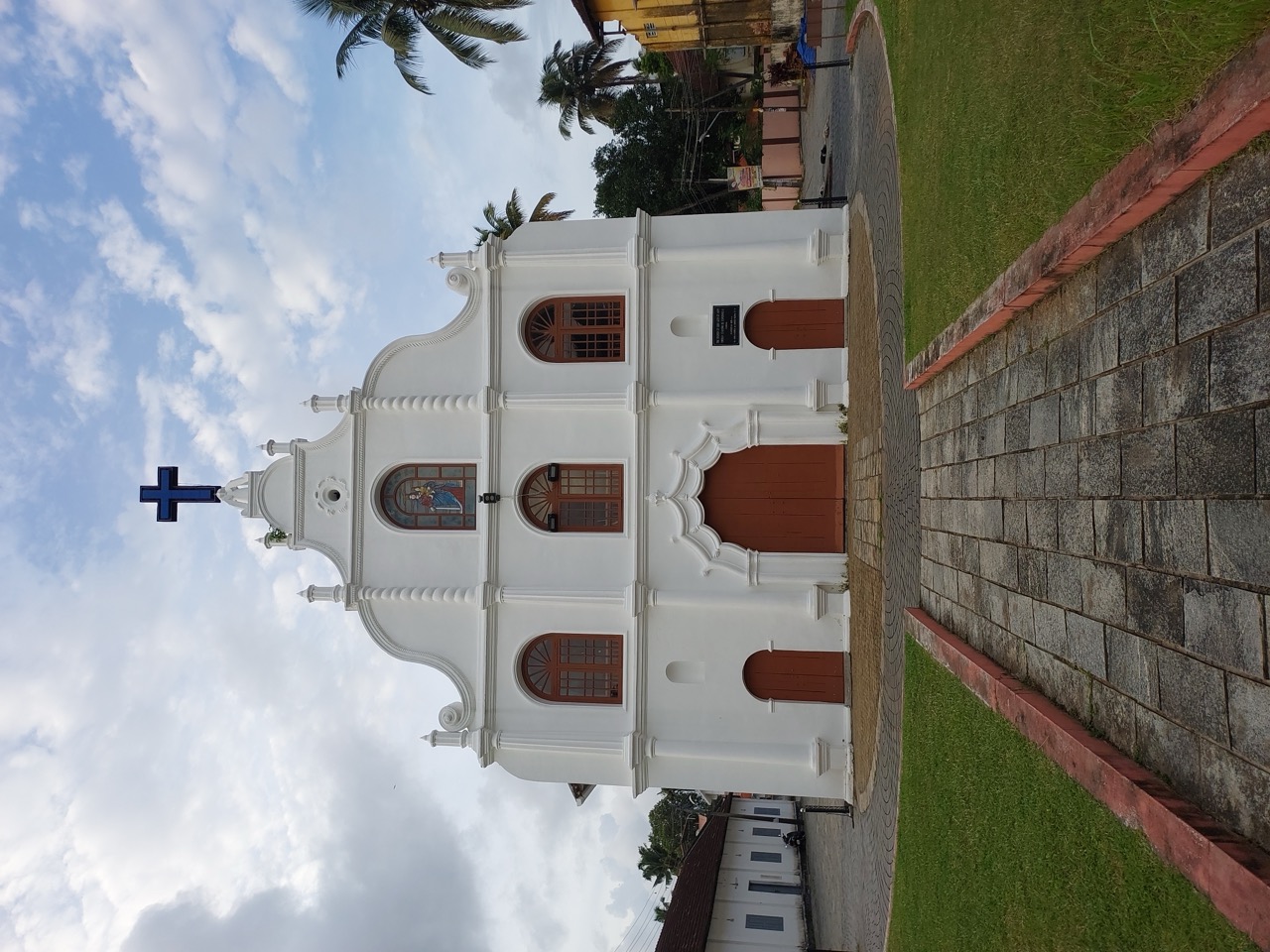
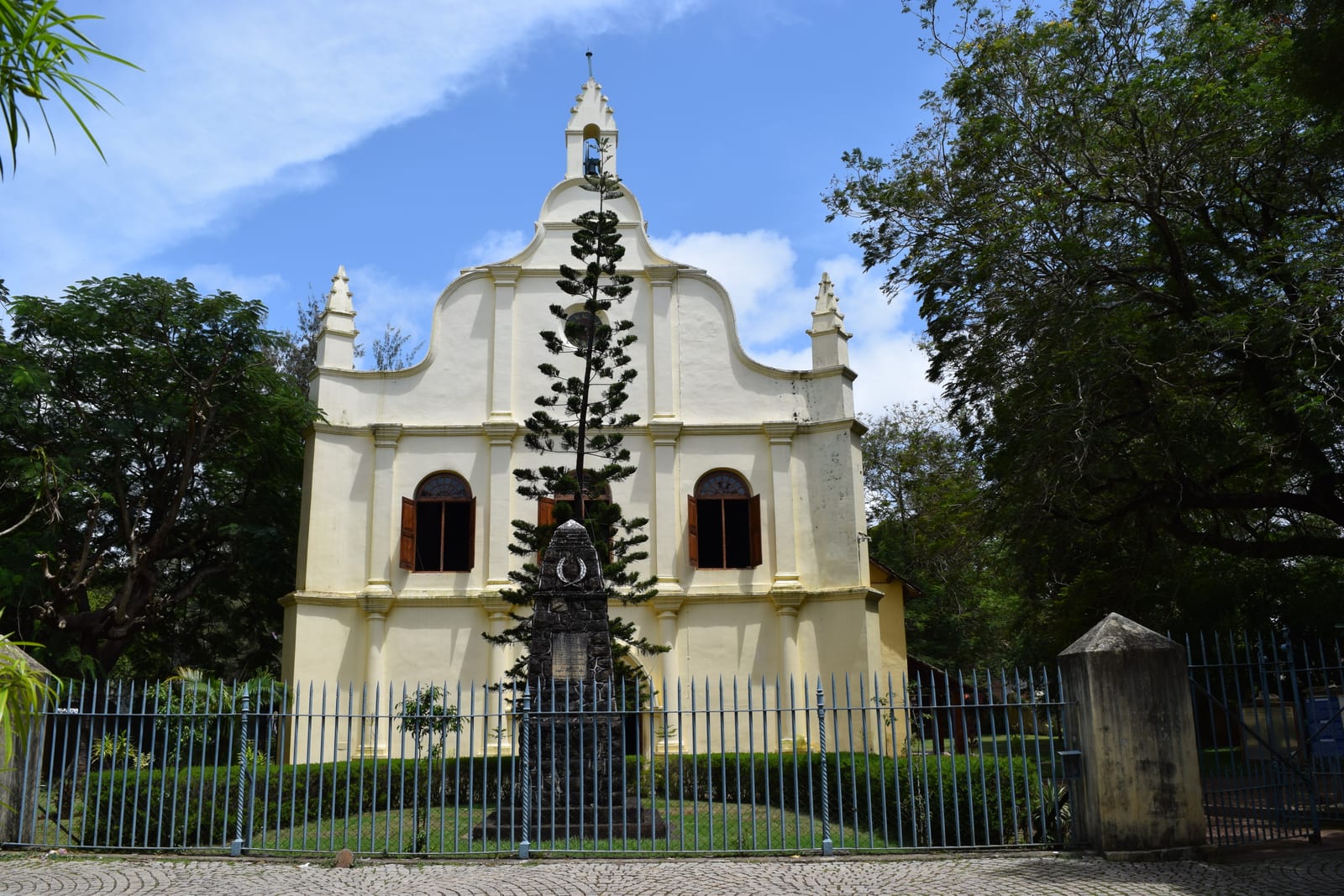
In 1500 the Portuguese reached Cochin, and in 1503 Vasco da Gama’s countrymen built Fort Emmanuel here, the first European fort in India — the origin of the name Fort Kochi. For over a century the Portuguese ran the pepper trade and left their churches, their surnames and, quite possibly, the fishing-net technology carried from their colony at Macau. The very square where the nets stand today is named for Vasco da Gama, and the nearby St Francis Church holds the spot where he was first buried in 1524.
The Dutch seized Cochin from the Portuguese in 1663 and held it for well over a century, remodelling the fort town and the trade to their own advantage; their bungalows, cemetery and the cool, thick-walled architecture of the old quarter still flavour Fort Kochi. The British followed, taking control in 1795, and Cochin grew into a modern port under the Raj and after. Through every change of flag, the nets kept dipping into the same tide — an unbroken domestic tradition running quietly beneath the grand imperial story.
For most of the twentieth century the Cheena vala were genuine working gear, a reliable if modest way for shore families to harvest the estuary without a boat. Whole clusters of nets lined the Fort Kochi and Vypin foreshore, worked in shifts around the tides. They were part of the everyday economy, not yet a postcard.
That balance has tipped in recent decades. Heavy siltation of the harbour, dredging for the modern port and Vallarpadam container terminal, pollution, and above all the far greater efficiency of motorised trawlers have thinned the estuary catch (indicative — reported widely by fishing crews and local press). Many frames now stand un-repaired; some have collapsed in storms. Today the nets survive above all as heritage and as a tourist draw, sustained as much by visitors’ tips and photographs as by the fish they still occasionally lift — a working symbol that is slowly becoming a monument.
Why visit
It is the iconic image of Kerala. If you have seen one photograph of Kochi, it was almost certainly these nets against a burning sky — and standing among them in person, hearing the timber creak and the ropes strain, is far more atmospheric than any picture suggests.
The sunset is the headline act. As the sun sinks over the Arabian Sea directly behind the row of nets, the frames turn to black silhouettes and the water lights up gold and rose. Arrive an hour before dusk, claim a spot on the promenade, and watch one of India’s great free spectacles unfold (indicative — timing shifts with the season).
You can join in. For a small tip, the fishermen will usually invite you up onto the platform to grab a rope and help walk the net down and haul it up — a genuinely memorable, hands-on brush with a six-hundred-year-old technique, and a good photograph into the bargain.
Fish doesn’t get fresher. A cluster of stalls beside the nets sells the day’s catch — prawns, pearl spot (karimeen), squid, crab, kingfish — which you pick and hand to a neighbouring shack to be cleaned, spiced and grilled or fried on the spot. Eating fish landed a few metres away, watching the nets work, is a Fort Kochi rite of passage (prices indicative — agree the rate by weight before you order).
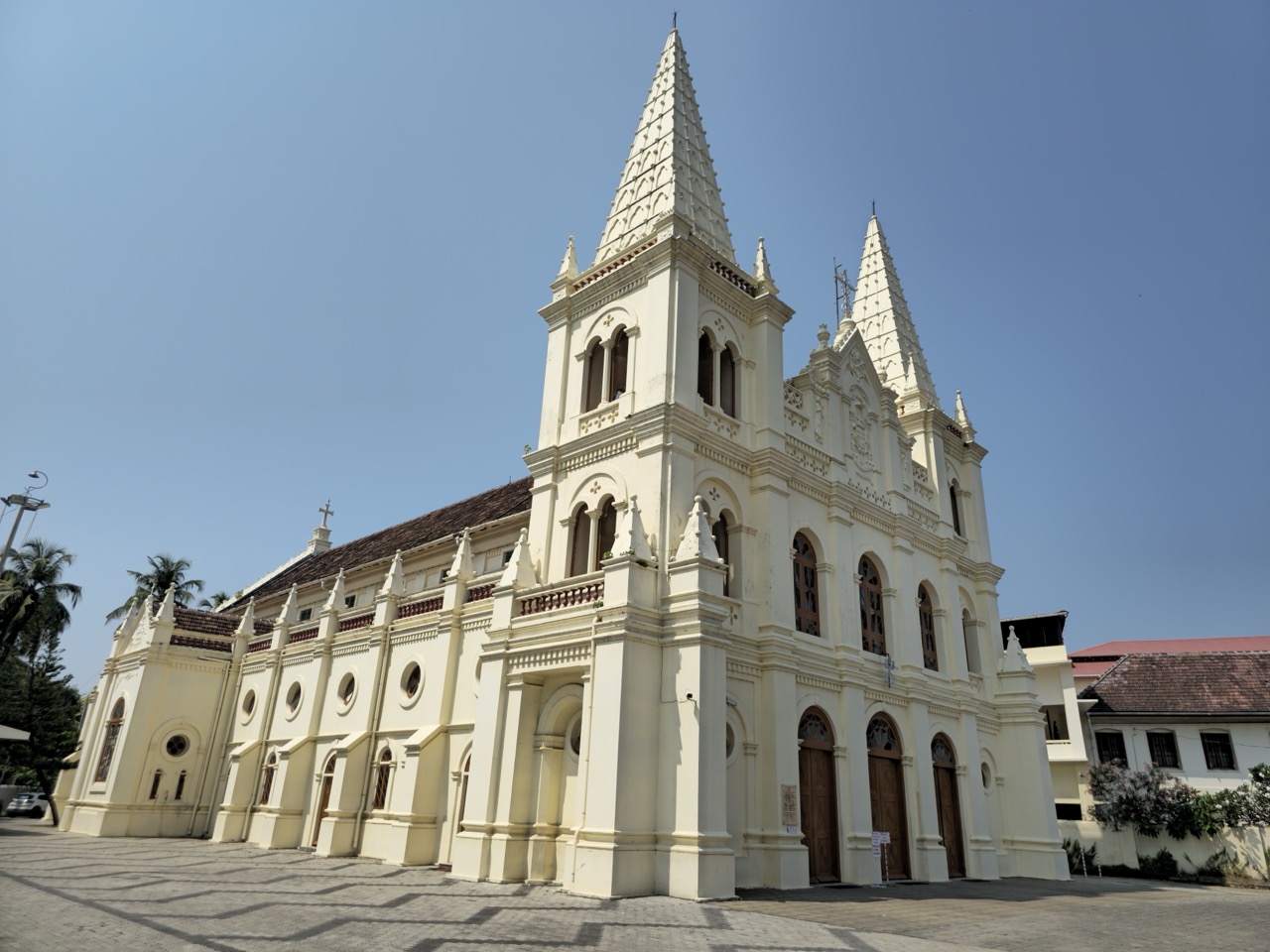
It is the perfect start to Fort Kochi on foot. The nets sit at the head of a wonderfully walkable heritage quarter — St Francis Church, the Santa Cruz Basilica, the Dutch-era streets, the spice warehouses and Jew Town of Mattancherry are all a stroll or short auto-ride away, so the nets anchor a whole day of wandering.
You are witnessing something genuinely endangered. Watching a living tradition that is quietly fading gives the visit a poignancy the postcard never shows — a reason to come now, while the arms still swing and the crews still work them.