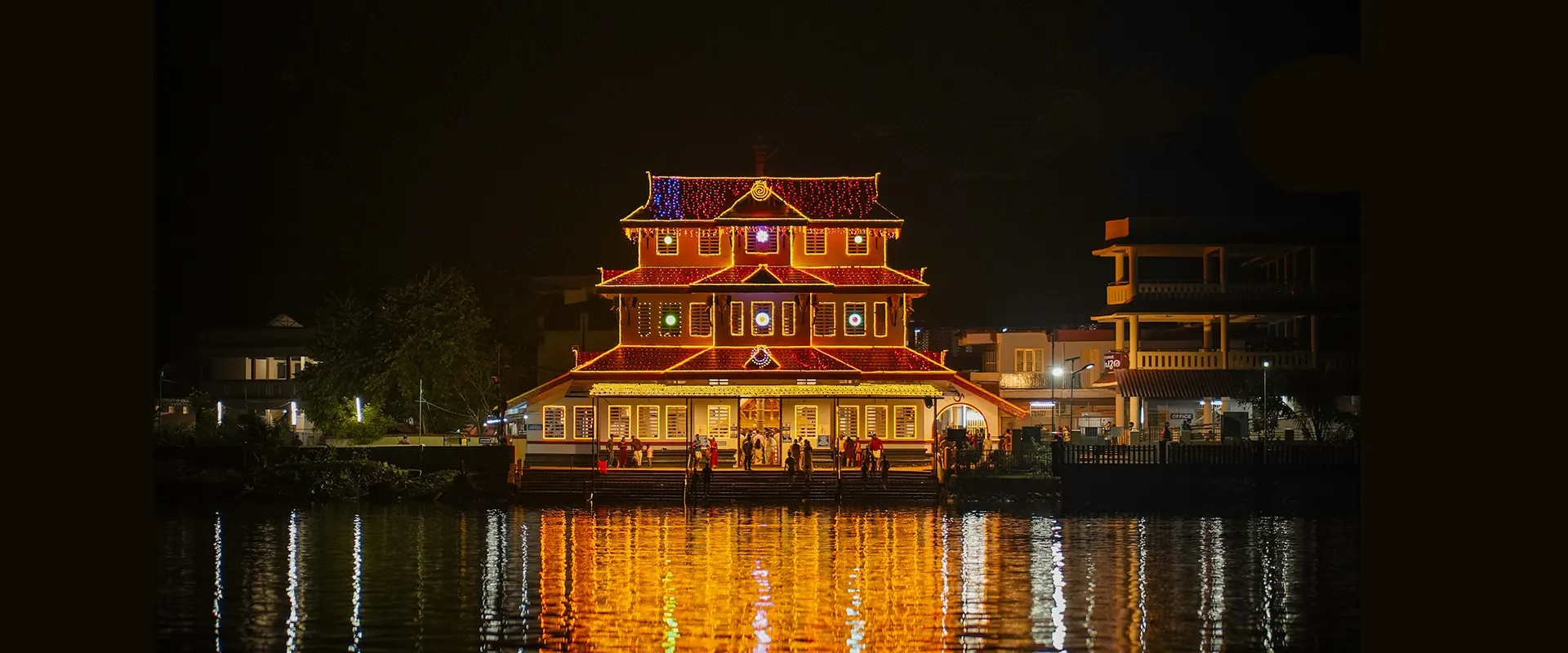
On the palm-fringed banks of the Valapattanam river a little north of Kannur town stands the Sree Kalarivathukkal Bhagavathy Temple — a fierce and famous Bhadrakali shrine revered across North Malabar as the guardian goddess of kalaripayattu, the ancient Kerala martial art. Its very name, Kalari-vathukkal, means ‘at the gateway of the kalari’, and for generations a warrior would seek the mother’s blessing before ever lifting a sword.
The story of Kalarivathukkal Temple
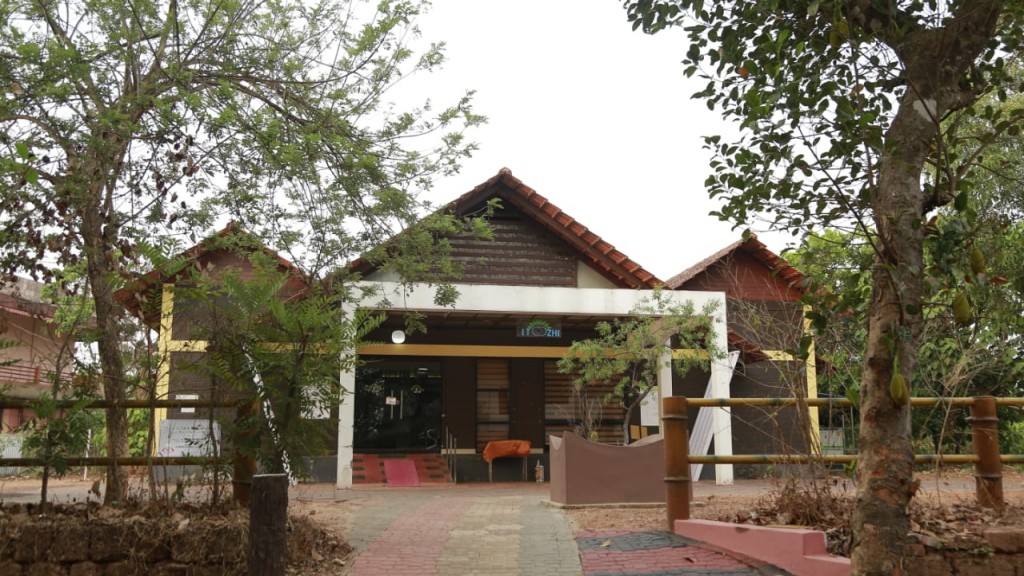
Kalarivathukkal sits in a quiet, tree-shaded compound near Valapattanam, roughly seven kilometres from the heart of Kannur town, where the broad Valapattanam river slides toward the Arabian Sea. The temple is unassuming at first glance — a classic Kerala shrine of tiled roofs, lamp-studded walls and a west-facing sanctum — yet within North Malabar it carries an outsized reputation. This is widely held to be the ‘mother temple’ of kalaripayattu, the presiding shrine of the martial art that Kerala gave to the world, and pilgrims, gurukkals and curious travellers alike are drawn to its threshold.
The presiding deity is Bhadrakali, worshipped here in a fierce, protective form. She is enshrined as the archana bimbam within a sanctum built in the elaborate Rurujith Vidhanam tradition, and the temple complex holds a constellation of subsidiary shrines — to Shiva, to the Sapta Mathrukkal (the seven mother goddesses), to Ganapathy, to Veerabhadra and to the guardian Kshetrapalakan. The goddess faces west while Shiva’s shrine faces east, and the whole layout speaks to an old, layered form of Shakti worship rather than a single simple altar.
What sets Kalarivathukkal apart is its bond with kalaripayattu. The goddess is regarded as the mother and guardian of the martial art itself, and by long tradition a student stepping into the disciplined world of the kalari begins by invoking her — the gateway of learning is understood to be the gateway of the goddess. That symbolism runs through the temple’s daily life: a sacred sword is carried each morning to the mandapam beside the shrine and returned at dusk, a ritual read locally as a reminder of the martial heritage the deity protects.
The temple is closely tied to the old Kolathiri, or Chirakkal, royal house, which shifted its seat to Chirakkal near the Valapattanam river. Kalarivathukkal is counted as one of a trio of great Devi temples associated with that kingdom, alongside the Cherukunnu Annapoorneshwari temple and the Thiruvarkadu (Madayikavu) Bhagavathy temple. As the family deity of the Kolathiri, the shrine holds a place of ritual seniority in the Malabar calendar that ordinary temples do not.
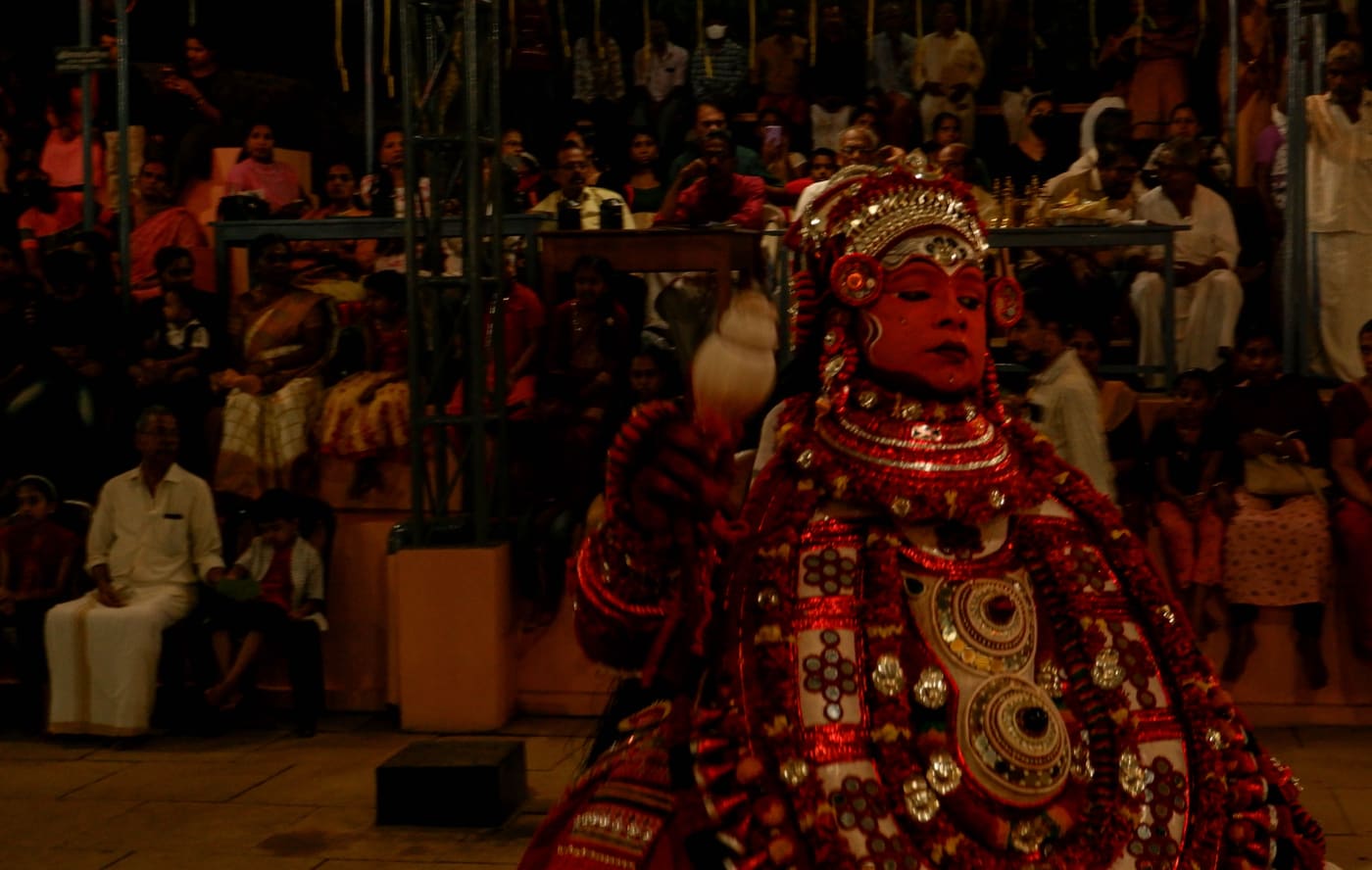
Around the goddess swirls the living culture of North Malabar. Kalarivathukkal is celebrated for its theyyam — the spectacular ritual dance-worship in which a costumed, painted performer is believed to become the deity — and the temple traditionally conducts a season-defining theyyam of Kalarivathukkal Amma, whose towering thirumudi (headdress) is often described as among the tallest seen in the Kannur region. Alongside this comes the grand nine-day Pooram in spring and the Kalasam that closes the theyyam cycle, so the shrine is as much a stage for Malabar’s sacred performance traditions as it is a place of quiet darshan.
For the traveller, Kalarivathukkal offers a rare combination — a genuine, atmospheric temple of deep local devotion, set in the green riverine landscape of Kannur, and a doorway into the martial and ritual soul of North Kerala. Whether you come for the goddess, for the kalaripayattu heritage or to catch a theyyam ablaze with fire and drumming, this is a shrine where Kerala’s warrior past and its living faith meet.
Legend & myth
As the temple’s devotees tell it, Bhadrakali was born to destroy evil. The legend recounts that when the demon Darika grew invincible and terrorised the worlds, a furious goddess sprang from the third eye of Lord Shiva — Bhadrakali, blazing and armed — and marched to war. In the great battle that followed she is said to have slain Darika and quelled the terror he had spread, and it is this triumphant, protective fury that is worshipped at Kalarivathukkal. The story is recounted here as sacred legend rather than history, but it explains why the goddess is imagined as a warrior mother rather than a gentle one.
It is precisely that warrior aspect that binds her to kalaripayattu. In the tradition passed down in North Malabar, Bhadrakali of Kalarivathukkal is honoured as the mother and guardian deity of the martial art, the divine source from which its discipline flows. So the name of the place — ‘at the gateway of the kalari’ — is taken to mean that the goddess herself stands at the threshold of every training ground. By custom a novice does not simply take up arms; the student first bows at the goddess’s gateway, so that learning to fight begins as an act of devotion. These beliefs are cherished as living tradition, and are shared here as legend rather than documented fact.
History
The temple’s deeper history is bound to the Kolathiri (Chirakkal) dynasty, one of the great ruling houses of North Malabar, whose lineage tradition traces back to the earlier Mooshika kings. When the Kolathiri established their seat at Chirakkal near the Valapattanam river, the Devi temples of the region became closely woven into the fortunes and ritual identity of the royal family, and Kalarivathukkal emerged as one of the house’s principal shrines.
In local temple lore, Kalarivathukkal belongs to a triad of Devi temples of the erstwhile Chirakkal kingdom — together with the Cherukunnu Annapoorneshwari temple and the Thiruvarkadu Bhagavathy temple (Madayikavu). A traditional account holds that these goddesses came by boat from Kasi (Varanasi) to the Malabar coast, a narrative that ties the shrines together as sister temples and is remembered as sacred tradition rather than dated record.
The temple is built in the classic Kerala idiom, with its sanctum following the Rurujith Vidhanam form associated with fierce Bhadrakali worship, and it houses the goddess as an idol venerated through elaborate daily rites. Over the centuries it accumulated its distinctive ritual grammar — the daily journey of the sacred sword, the ordered cycle of poojas from morning to evening, and the seasonal theyyam and Pooram observances that mark it out among Malabar shrines.
Its reputation as the guardian temple of kalaripayattu reflects the martial culture of medieval North Malabar, where kalari training grounds and warrior clans were part of the social fabric and where devotion to a fierce protective goddess sat naturally alongside the practice of arms. As kalaripayattu itself gained renewed fame in modern times, Kalarivathukkal’s standing as its presiding shrine drew fresh attention to a temple that had long been central to the region’s warrior identity.
Today the temple is administered under the Malabar Devaswom Board and is maintained as a significant public shrine, its festivals drawing large crowds from across Kannur and beyond. While precise dates for its founding are not firmly documented, its continuity as a Kolathiri family deity and a hub of Malabar theyyam culture places it firmly among the historically important temples of North Kerala.
Why visit
It is widely revered as the guardian goddess and ‘mother temple’ of kalaripayattu — a rare chance to stand at the spiritual gateway of Kerala’s celebrated martial art.
The presiding deity is a fierce, protective Bhadrakali, worshipped in the elaborate Rurujith Vidhanam tradition, giving the shrine an intensity that quieter Vishnu or Shiva temples do not have.
Kalarivathukkal is famous for its theyyam, and if your visit falls in the season you may witness the towering thirumudi of Kalarivathukkal Amma’s theyyam — often cited as among the tallest in the Kannur region — in a blaze of colour, fire and drumming.
The temple’s nine-day Pooram in spring opens with a kalaripayattu performance and features traditional arts such as Thayambaka and Poorakkali, making it a living showcase of North Malabar culture.
Its ties to the Kolathiri (Chirakkal) royal family and its place in the trio of great Chirakkal Devi temples give the shrine real historical depth for travellers interested in Kerala’s past.
The setting itself rewards the trip — a green, riverside pocket near Valapattanam only a short drive from Kannur town, and close to the well-known Parassinikadavu Muthappan temple and the snake park, so it slots easily into a North Kerala itinerary.