The story
One of the greatest and most ancient Shiva temples of Malabar, the Sree Rajarajeswara Temple at Taliparamba is reckoned among the 108 great Shiva shrines of old Kerala — and, by many traditions, foremost among them. A colossal granite structure ringed by towering brass lamp-posts, it is renowned for the prasna, for the ghee offering, and for the singular custom by which women enter the sanctum only after the evening worship.
The story of Rajarajeswara Temple, Taliparamba
You feel the age of this place before you understand it. The Rajarajeswara Temple stands at Taliparamba, an old market town on the road north of Kannur, and it has the gravity of a shrine that has been continuously worshipped for a very long time. Locals do not call the deity by a single name — he is Rajarajeswara, the great king among lords; he is Perumthrikkovilappan and Perumchelloorappan, titles that root the god to the ancient land of Perumchellur, as Taliparamba was once known. This is Shiva, but a Shiva reckoned above ordinary Shivas, which is exactly how the pilgrims of Malabar have always treated him.
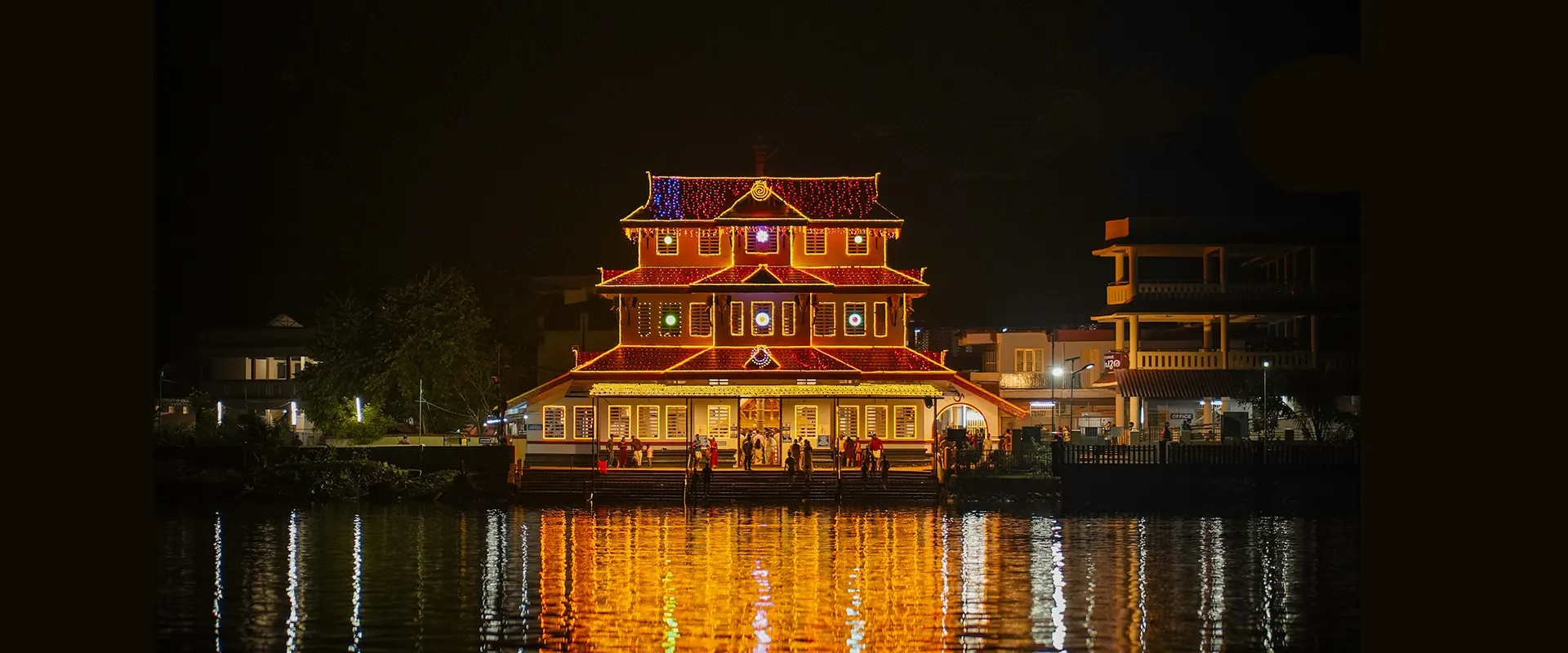
The temple is built almost entirely of granite, low and immense, its two-tiered sanctum roofed in copper that tapers to a golden kalasam. There is no soaring gopuram in the Tamil manner; the grandeur here is horizontal and heavy, a fortress of dark stone set within wide courtyards. Tall deepastambhams — brass lamp-columns — rise before the shrine, and when they are lit for the evening the whole enclosure seems to breathe fire. It is said the shrine once carried among the tallest sanctum-towers of its age in the region, and even in repose it dwarfs the visitor.
What sets this temple apart, more than its stone, is a living tradition of consultation. Across Kerala, when a doubt or a disturbance arises in the worship of another temple, the answer is sought here — through a prasna, the old astrological method of divination conducted on a raised platform outside the shrine. Devotees, too, are said to bring their private troubles to Rajarajeswara not by clamouring their petitions aloud but by placing their problems before the god quietly and awaiting his verdict through the prasna. In this sense the temple has long functioned as a kind of supreme court of Malabar devotion, the place to which other places turn.
The signature offering is ghee. Small pots of clarified butter — Neyyamruthu — are carried up and set upon the steps leading to the sanctum, an act tied to the founding legend of the shrine. On a grander scale devotees make the Ponkudam, pots of ghee in gold, silver and copper poured out in intense devotion. Among the harvest-season observances the temple keeps the Nira, and the nirapara — a para measure heaped high with the first new paddy — is offered in the manner of Kerala’s great shrines, a thanksgiving of the land laid before the god (details and eligibility are best confirmed at the temple office).
Then there is the custom that fascinates every first-time visitor. By long tradition, women do not enter the inner nalambalam of Rajarajeswara during the day; they are admitted only in the evening, after the Athazha pooja — the last worship of the day — is completed. The belief attached to the practice is gentle rather than exclusionary: at that hour Shiva is held to be in his most contented mood, seated in the company of his consort Parvati, so that a woman who enters then worships not one deity but two, and is thought most likely to have her prayers granted. Whether and how the timing is observed can change, so intending visitors should check the current rules on the day.
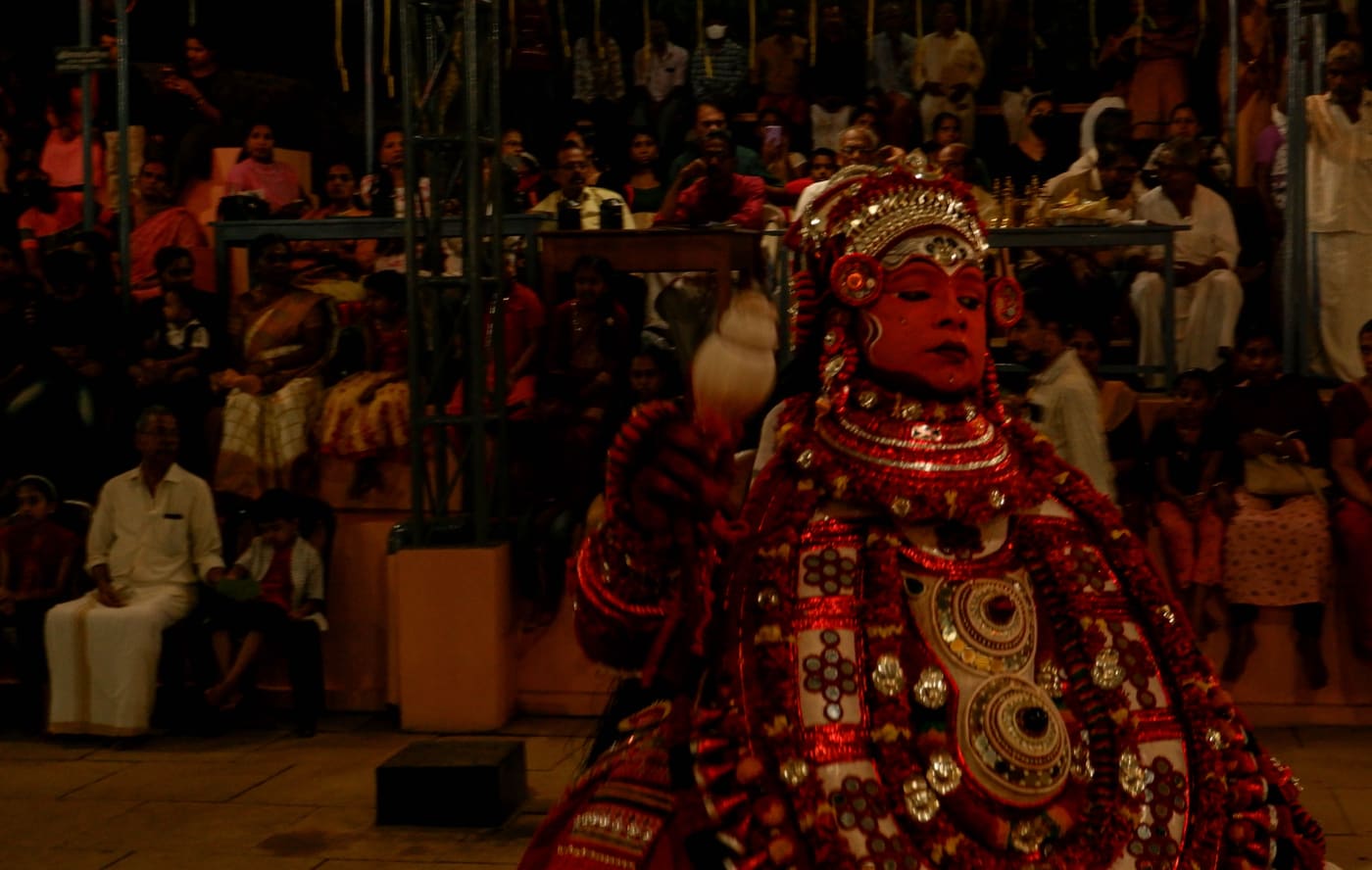
The temple is also a sanctuary of the classical arts. Its stage has for centuries been counted among the most sacred in Kerala for Koodiyattam and Chakyar Koothu, the ancient Sanskrit theatre of the region, and performers of the highest attainment have been honoured here with the Veerasrinkhala, a golden bracelet of recognition. To sit in these courtyards while the lamps are lit and the old temple theatre unfolds is to touch a continuity of ritual, drama and stone that very few places on earth still keep.
Legend & myth
The founding legend of Taliparamba is told as the story of three kings and three lingas. It is said that Lord Shiva once gave three especially sacred Shiva lingas to the goddess for her worship, and that these passed, through her grace, into the hands of great sovereigns. King Mandhata, so the tale runs, propitiated the goddess with fierce penance and received one linga, on the condition that it be installed only where no cremation ground had ever been. He searched far and wide and found no spot purer than Taliparamba, and there he set the linga up — but after his death it sank away into the earth.
Then his son (in the retelling, Muchukunda) performed the same austerities and won a second linga, which he installed at the very same place; and it too, in the fullness of time, dissolved into the ground. At last a third king — remembered as Satasoma of the Mushika line — obtained the third and final linga and brought it to Taliparamba. This linga, too, began to sink. According to the legend it was the sage Agastya who intervened: lighting a ghee lamp and prostrating before the linga twelve times without success, he bowed a thirteenth time, and on that thirteenth prostration the linga at last stood firm and fixed in the earth. From that moment, the story says, ghee became the great offering of this shrine.
Because of these threefold origins the linga here is spoken of as swayambhu — self-manifest — and exceedingly powerful, and folk tradition links the shrine to the Mrityunjaya aspect of Shiva, the conqueror of death, sought by kings who longed to overcome mortality. Some accounts fold the temple among the jyotirlingas, the columns of light through which Shiva is said to have revealed himself. Taliparamba is also remembered in another legend as one of the ancient Shakti Peethams, where a portion of the goddess Sati is said to have fallen after her self-immolation and Shiva’s grief-maddened dance. All of this is the living lore of the place, told and retold as legend rather than as chronicle — but it is exactly this weight of story that has made Rajarajeswara so revered across Malabar.
The deity is counted among the 108 great Shiva temples said to have been consecrated by Parasurama when he raised the land of Kerala from the sea, and among the twelve most important of these — the Dwadasa Shivalayas — Taliparamba holds pride of place. To pilgrims here it is not merely one temple in a list; it is, by the reckoning of the old traditions, the first and greatest of them all.
History
The historical origins of the temple are lost in antiquity, but Taliparamba — the old Perumchellur — was clearly a major religious and political centre of north Malabar in early medieval times, and the Shiva shrine here stood at its heart. The temple belongs to the family of the 108 ancient Shiva temples of Kerala, and its fame ran alongside the greatest of them — the shrines of Vaikom, Ettumanur and the Vadakkunnathan at Thrissur — as one of the pre-eminent Shaiva centres of the land.
The shrine flourished under the patronage of the ruling houses of the north. It was closely associated with the Mushika dynasty and its successors the Kolathiri (Chirakkal) rajas, who governed Kolathunad, and it also received the devotion and gifts of the Zamorins of Kozhikode to the south — a rare instance of rival powers venerating a common shrine. That royal patronage is reflected in the very name of the deity, Rajarajeswara, the lord of kings.
The temple was substantially rebuilt in granite in later centuries, giving it the massive stone character it wears today. An inscription associated with the temple tank records a renovation in 1524 CE under a king named Satasoma of the Mushika Vamsa — the same name that appears in the founding legend of the third linga, so that history and myth here reach out and touch one another. Successive repairs and endowments by the Kolathiri house maintained the shrine as the ceremonial centre of the region.
Distinctive practices set the temple apart from its peers and speak to its unusual antiquity. It keeps no kodimaram (the ceremonial flag-mast that stands before most Kerala temples), holds no conventional annual festival with a flag-hoisting, and by custom the deity is never carried in procession beyond the temple precincts. Uniquely, Tulsi (holy basil) leaves are offered here rather than the Bilva leaves usual in Shiva worship, and certain observances associated with Vishnu are kept alongside those of Shiva — an intertwining that gives the shrine its Sankara-Narayana character.
Through all of this the temple has preserved its role as a seat of classical performance. Its courtyards have hosted Koodiyattam and Chakyar Koothu for many centuries, and it remains among the handful of temple stages regarded as most sacred for these ancient art forms — a rare surviving thread connecting the living present to the ritual theatre of the medieval Malabar temple.
Why visit
To stand before one of the greatest and most ancient Shiva temples of Kerala — reckoned by tradition the foremost of the 108 great Shiva shrines and one of the twelve Dwadasa Shivalayas — in a colossal granite structure quite unlike the towered temples of the south.
For the singular atmosphere of a shrine that other temples consult: the home of the prasna, where troubles are laid quietly before Rajarajeswara and answered through divination rather than shouted petitions.
To see the great brass deepastambhams lit for the evening worship, and to witness the ghee offering — Neyyamruthu and the golden Ponkudam — that flows from the temple’s own founding legend.
For the rare and gently-told women-entry tradition, by which women worship in the sanctum after the Athazha pooja, when Shiva is believed to sit contentedly beside Parvati (observance can vary — confirm on the day).
For the depth of legend — the three kings and three lingas, Agastya and the thirteenth prostration, the swayambhu Mrityunjaya linga, the Shakti Peetham lore — woven through a place still worshipped exactly as it has been for centuries.
For the classical arts: a temple stage counted among the most sacred in Kerala for Koodiyattam and Chakyar Koothu, and an easy, rewarding detour from Kannur into the older, quieter heart of north Malabar.