A wounded eagle the size of a stadium lies frozen on a Kollam hilltop — the world's largest bird sculpture, where the Ramayana meets a cable car and a zip line.
The story of Jatayu Earth’s Center
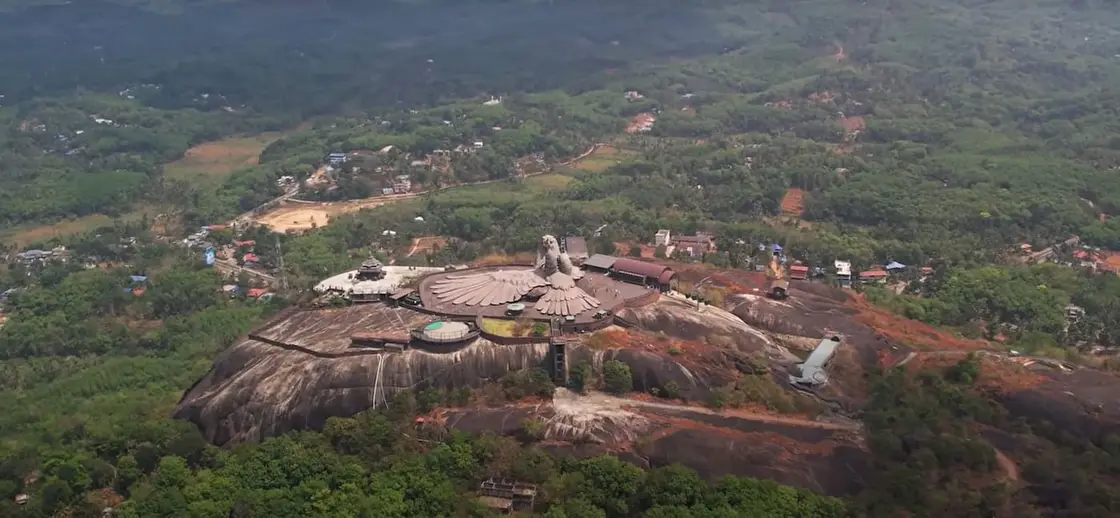
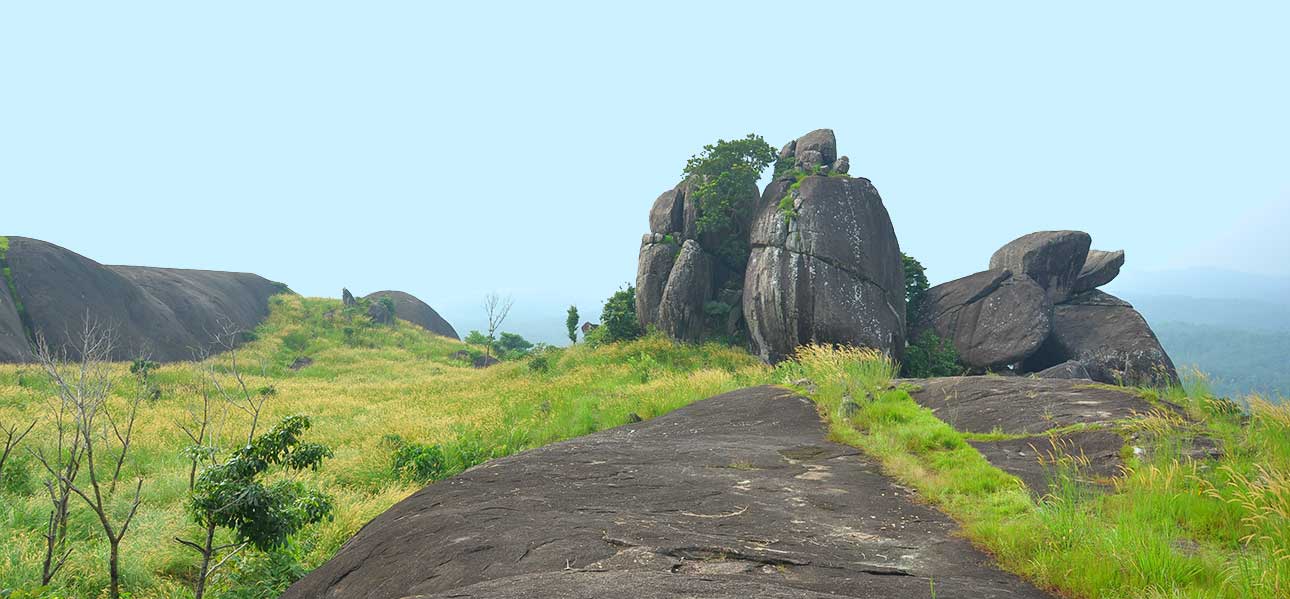
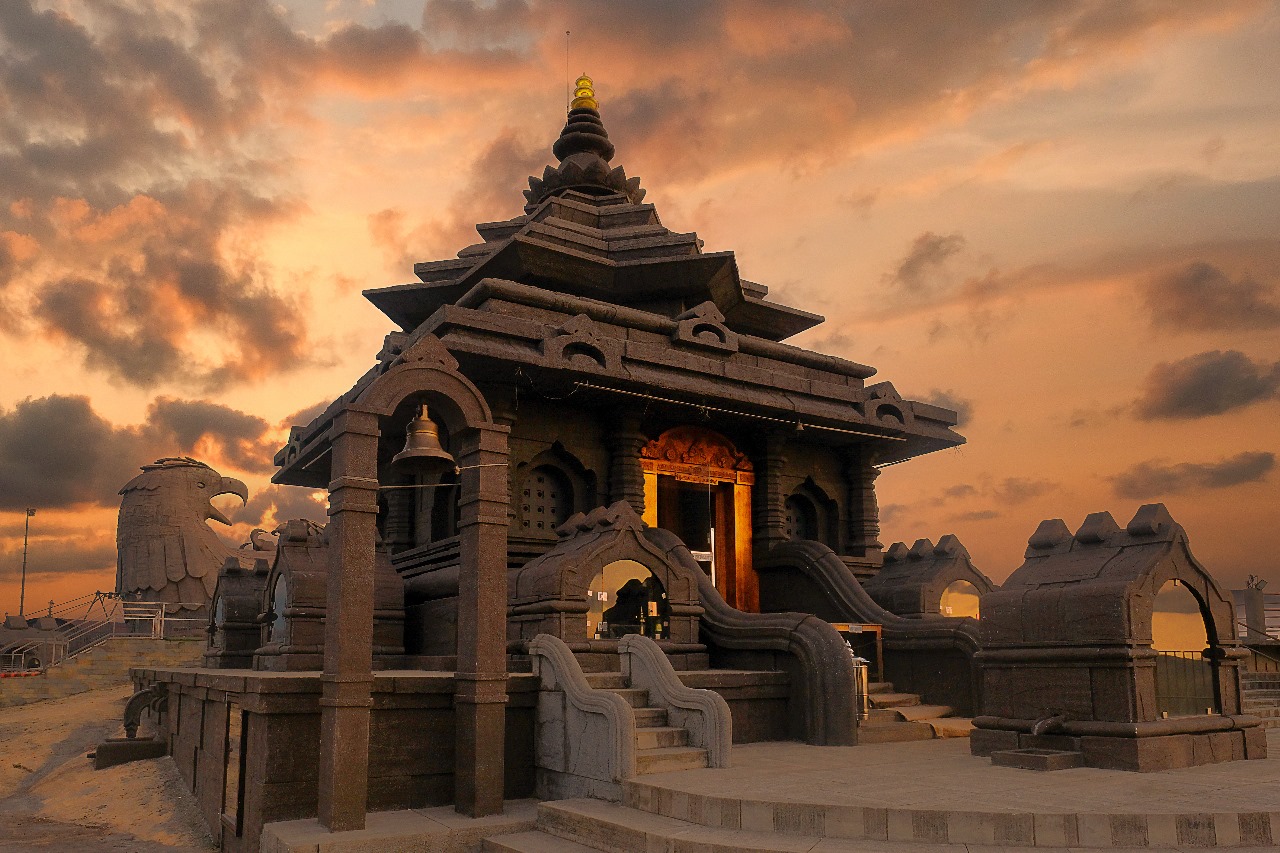
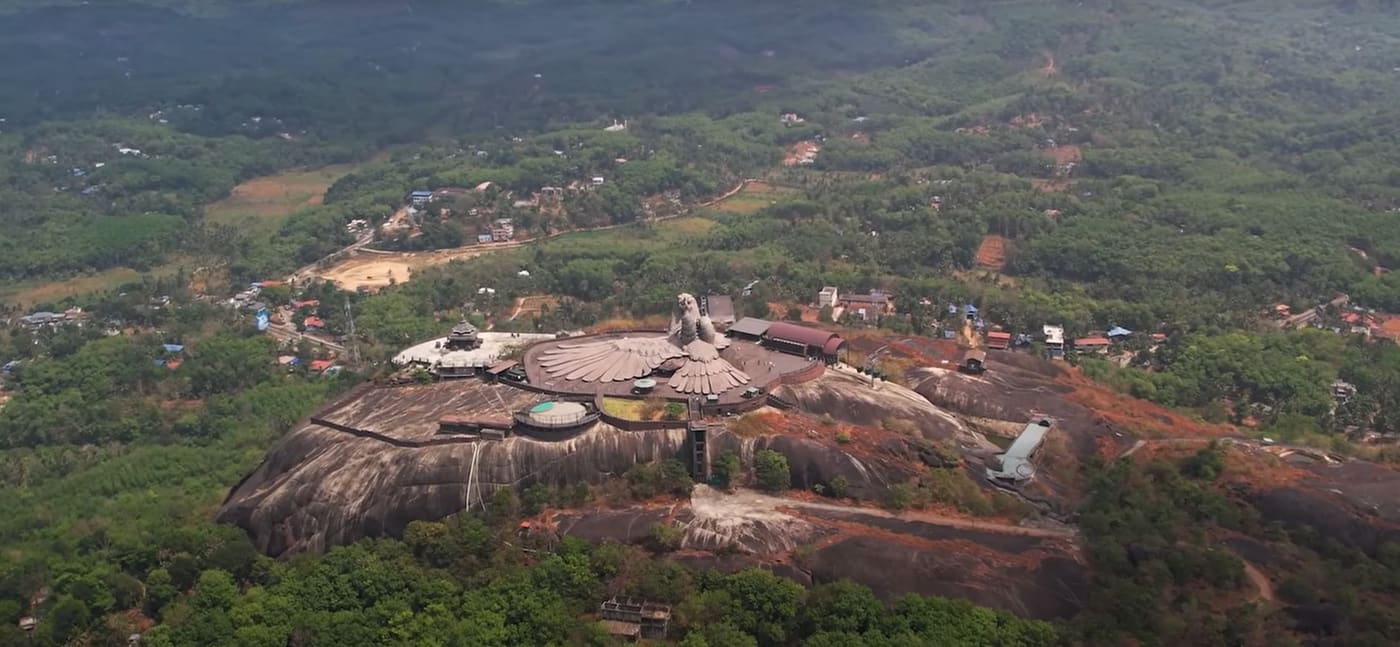
Crest a rocky hill near Chadayamangalam in Kollam district and you meet a sight that is impossible to prepare for: a colossal bird, wings folded and beak parted as if in its last breath, lying broken across the summit. This is the Jatayu sculpture, reported as roughly 200 ft long, 150 ft wide and 70 ft high (indicative — confirm locally), and widely billed as the world's largest bird sculpture. It depicts Jatayu, the mythical eagle-vulture of the Ramayana, at the moment he fell to earth. Built of concrete and steel over some 15,000 sq ft of floor area (indicative — confirm locally), the figure is less a statue than a walk-in monument you can enter and climb inside.
Getting to the top is half the experience. Jatayu Earth's Center is spread across a multi-terrain landscape of caves, boulders, hills and valleys said to cover around 65 acres (indicative — confirm locally), and the hill is reached by what is often described as Kerala's only cable car — an imported ropeway whose glass cabins each seat a small group and glide up over the treetops in a few minutes, delivering sweeping views of the surrounding countryside. Those who prefer their feet on the ground can instead take a walkway and stairway climb to the summit, usually offered at a lower ticket price.
Inside and around the giant bird sit the attractions that make this a themed leisure park rather than a shrine. A 6D theatre housed within the sculpture runs a short immersive film retelling the Jatayu legend, and a digital museum and audio-visual displays fill in the mythology for visitors who arrive knowing little of the Ramayana. The summit also serves simply as a spectacular viewpoint, with the reclining eagle as a foreground unlike any other in India.
A short distance across the terrain lies the adventure zone, run as a separately ticketed activity park. Depending on what is operating on the day, visitors can try rock climbing and rappelling on natural boulder faces, a long zip line strung across a valley, sky cycling, paintball, laser tag, an archery or shooting range, rope courses and guided trekking. Activities are typically bought individually or as a bundled adventure pass (indicative — confirm locally), and the mix on offer can change, so it is worth checking at the counter before committing.
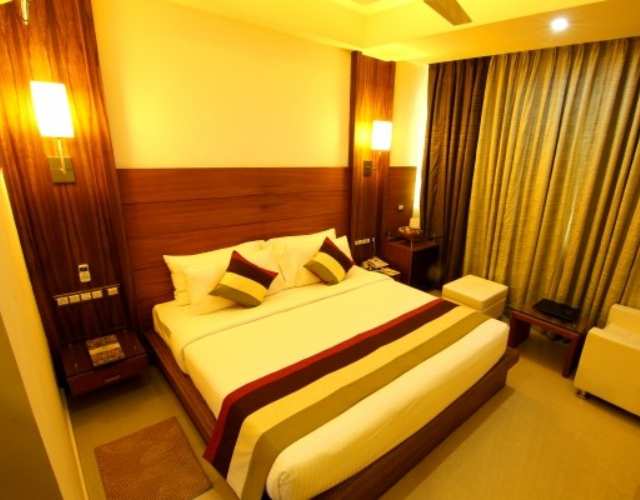
The park also markets a wellness dimension: an Ayurvedic and siddha-themed cave resort set into the hillside, offering treatment-led stays that lean on the site's rocky, secluded setting. This is a modern hospitality offering rather than anything ancient, and rates and availability sit apart from the day-visit tickets.
It is worth being clear-eyed about what Jatayu Earth's Center is: a modern, purpose-built adventure and cultural theme park that opened in the late 2010s, with ticketed entry, priced activities and a firmly commercial visitor operation. It is not an old temple or a natural pilgrimage site. What it does uniquely well is fuse a genuinely awe-inspiring piece of monumental sculpture with the emotional pull of one of the Ramayana's most poignant episodes — and then wrap adventure tourism around it.
Legend & myth
By tradition, this hill is tied to one of the Ramayana's most affecting moments. As the legend is told, the demon king Ravana abducted Sita, wife of Rama, and carried her southward through the sky in his flying chariot. Jatayu — a noble eagle-vulture, described as an old friend of Rama's father Dasharatha — saw Sita being taken against her will and hurled himself at Ravana to stop him. In the sky-battle that followed, the ageing bird fought valiantly but Ravana severed his wings, and the mortally wounded Jatayu is said to have fallen to earth on this very rock.
There, the legend continues, Jatayu clung to life long enough to meet Rama and Lakshmana as they searched for Sita, and to tell them the direction Ravana had fled — a dying act of service that set Rama on the path to Lanka. Rama is said to have performed the last rites for the bird as he would for a father. The sculpture captures Jatayu in this final, fallen state, wings broken beneath him.
Local tradition even links the place-name to the story: Chadayamangalam is popularly connected to Chatayan, a Malayalam form of Jatayu, so that the very name of the town is read as a memorial to the fallen bird. All of this is legend and devotional tradition drawn from the Ramayana rather than documented history, and the park presents it as the mythic meaning that anchors the site.
History
The sculpture is the vision of Rajiv Anchal, a National Award-winning Malayali sculptor and filmmaker, who conceived a monumental Jatayu figure that would turn a little-known hilltop into a landmark. By most accounts he worked on the concept and construction over roughly a decade (indicative — confirm locally), realising the enormous concrete-and-steel bird as the centrepiece of a larger themed destination.
The project was developed on a public-private partnership model in association with Kerala's tourism department, with a private operator (widely reported as the Guruchandrika group) building and running the ropeway, adventure zone and hospitality elements. This blend of a state-backed cultural monument with commercial leisure infrastructure is central to how the site works.
Jatayu Earth's Center opened to the public in the late 2010s — most sources give the opening as 5 December 2017, close to the 2018 date by which it became widely visited (indicative — confirm locally). From the outset it was promoted around the superlative of the Jatayu figure as the world's largest bird sculpture, a claim that has become its main draw.
To carry visitors up the steep terrain, the operators installed a cable car often described as imported from abroad and as Kerala's only ropeway of its kind, with a fleet of cabins each seating a small group. Alongside it, the 6D theatre inside the sculpture, the digital museum, the multi-activity adventure park and the Ayurvedic-siddha cave resort were built out to give the site repeat appeal beyond a single photo stop.
The result is a distinctly 21st-century tourism model for Kerala: a mythological theme woven from the Ramayana, executed as monumental public art, and monetised through tiered tickets — walkway or cable car to the sculpture, separate adventure passes, and paid wellness stays. Details of pricing, operating hours and which activities are running have shifted over the years, so current information should always be confirmed locally before a visit.
Why visit
Stand beneath the world's largest bird sculpture — a genuinely one-of-a-kind monument.
Ride what is billed as Kerala's only cable car up to the hilltop.
Feel the Ramayana come alive: this is the legendary spot where Jatayu fell.
Pack in adventure — zip line, rock climbing, rappelling, paintball, laser tag and more.
Catch a 6D film inside the sculpture and sweeping valley views from the summit.
Combine a family day out, a photo landmark and an optional Ayurvedic cave-resort stay.