Hewn from a single granite outcrop in the rolling midland country between Anchal and Kadakkal, Kottukal Cave Temple is one of the rarest sights in Kerala — a genuine monolithic rock-cut shrine in a land where almost every temple is built up stone by stone rather than carved down into living rock. Its very name says what it is: Kottukal, from kothiya kallu, the “chiselled stone”. Two chambers scooped from one boulder, a Shivalinga with its Nandi, a niche-set Hanuman and a Ganapathy carved in between — a small monument that carries an outsized weight of archaeology, worship and local legend.
The story of Kottukal Cave Temple
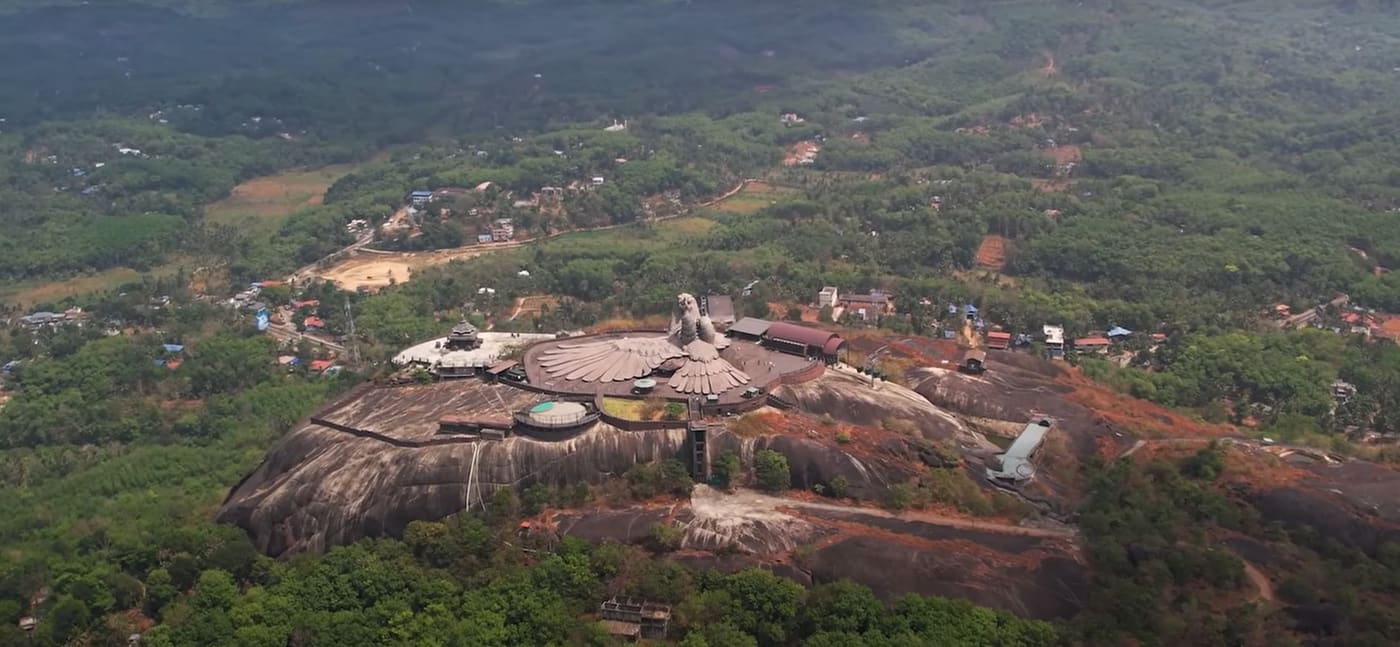
Approach Kottukal and the first thing you notice is the rock itself. A vast, rounded granite mass rises from the greenery, and from a distance the locals will tell you it looks like a sleeping elephant — a low grey bulk at rest among the coconut palms and rubber. Into the eastern face of this single stone, some long-ago hands cut not a wall or a plinth but the whole temple: two rectangular chambers, unequal in size, each roughly ten feet deep and eight feet wide (indicative — confirm locally), both sheltered beneath one continuous slab of the parent rock. Nothing here was assembled. Everything was removed.
That is what makes the place extraordinary. Kerala is overwhelmingly a land of structural temples — timber, laterite and granite fitted together under those famous sloping copper-and-tile roofs. True rock-cut shrines, carved into a cliff or boulder in the manner of the great Tamil and Deccan caves, can be counted on the fingers of two hands across the whole state. Kottukal is one of the finest of that tiny handful, which is why archaeologists speak of it as a foremost example of Kerala’s rock-cut tradition rather than just another wayside temple.
Step to the larger of the two caves and you meet the presiding presence: a Shivalinga, and before it a monolithic Nandi — the bull carved from the same rock, keeping his ancient watch. The chamber is arranged with a sanctum, a small ardhamandapa and a pillared façade, and its entrance hall carries carved pillars and ornamental work, including a Ganapathy figure worked into the stone (indicative — details vary between accounts, confirm on site). It is spare, weathered and quietly powerful, the sculpture softened by centuries of monsoon and worship.
The smaller chamber holds the detail that draws pilgrims and historians alike — a standing figure of Hanuman set within a niche. To find Anjaneya sharing a single carved rock with a Shivalinga and Nandi is genuinely unusual; devotees and local guides describe the Shiva–Nandi–Hanuman grouping here as a rare, perhaps singular, combination, and some tie the placing of Hanuman to the Nandi–Vanara episode remembered in the Puranas. Whether or not one accepts the “nowhere else in India” claim (treat that as devotional tradition rather than settled fact), the arrangement is memorable and unlike almost anything you will see elsewhere in Kerala.
Between the two caves, in an alcove-like recess, sits Ganapathy — the elephant-faced remover of obstacles carved in relief on the face of the rock, presiding over the threshold between the two shrines. Pilgrims pause here first, as tradition asks, before turning to Shiva and to Hanuman. On ordinary days the temple is hushed, tended by daily rituals under the Travancore Devaswom Board; on Maha Shivaratri it comes alive, the little cave complex filling with lamps, chanting and the steady traffic of the faithful who have come to keep the night-long vigil before the linga.
There is a human, almost tender local touch too. A short way from the great boulder lies a smaller stone that villagers call chummadu para — the “headload rock” — and tradition holds that resting your aching head against it, or against the mother rock, brings relief from headaches. It is the kind of intimate, unofficial belief that grows up around a place people have lived beside for a thousand years or more: the monument may belong to the archaeologists and the Devaswom, but the boulder belongs to the neighbourhood.
History
Kottukal sits in the Ittiva area, Kottarakkara taluk of Kollam district, in the midland belt where the coastal plain begins to climb toward the Western Ghats — the same broad landscape that saw early historic settlement, trade routes inland, and the slow spread of Brahminical and popular Hindu worship through what is now central Travancore. It is set back from the coast, roughly forty-five kilometres from Kollam town by the MC Road–Ayoor–Anchal–Kadakkal route (indicative — confirm locally), which is part of why it survived so quietly for so long.
The dating of the shrine is genuinely uncertain and you will find it given differently by different authorities, so it is best held loosely. The Kerala State Department of Archaeology dates the rock-cut temple broadly to about the 8th–9th centuries CE (indicative — confirm locally). Other popular and secondary accounts place it earlier, variously between the 6th and 8th centuries CE, or specifically in the 7th century, and some link it to a local ruler remembered as Nedumchadayan of nearby Chadayamangalam. All of these should be read as competing estimates rather than a confirmed date.
Stylistically the shrine is often discussed alongside the early medieval South Indian rock-cut movement — the same broad tradition that produced the Pallava caves and the Shore Temple at Mahabalipuram, and which in the far south overlapped with the era of the Ay chieftains who held sway over this part of the Kerala–Tamil borderland. Some writers describe Kottukal as “Pallava-influenced” or roughly contemporaneous with that phase of cave-cutting (indicative — this is an art-historical comparison, not documented patronage; treat the Pallava and Ay associations as context, not proven attribution).
What is not in doubt is its protected status. The Government of Kerala, through the State Department of Archaeology, declared Kottukal a protected monument in 1966, recognising it as a rare survivor of the rock-cut form in a region dominated by structural temples. It remains a living shrine as well as a heritage site — an unusual pairing where daily worship under the Travancore Devaswom Board continues inside walls that are themselves legally protected antiquity.
One point worth fixing clearly: this is the Kollam-district Kottukal, near Anchal and Kadakkal — not to be confused with the better-known Kottukal rock-cut cave near Vizhinjam on the coast south of Thiruvananthapuram, which is a separate monument often mentioned in the same breath in guides to Kerala’s cave shrines. If you are navigating or reading up beforehand, make sure your source is describing the inland Kollam cave and not the coastal Trivandrum-district one.
Why visit
It is one of the very few authentic monolithic rock-cut temples in all of Kerala — a chance to stand inside a shrine that was carved out of a single boulder rather than built, in a state where that construction method is genuinely rare. For anyone interested in temple architecture, that alone justifies the detour.
The Shiva–Nandi–Hanuman combination is unusual and atmospheric: a Shivalinga and its monolithic bull in the larger cave, a niche-set Hanuman in the smaller, and a Ganapathy carved in the alcove between them, all from one continuous rock. The devotional geometry of the place is unlike a typical Kerala temple layout.
It is a protected State Archaeology monument (declared 1966) that is still a working shrine — so you get both the hush of an ancient site and the living reality of daily ritual, incense and lamp-flame, rather than a fenced-off ruin.
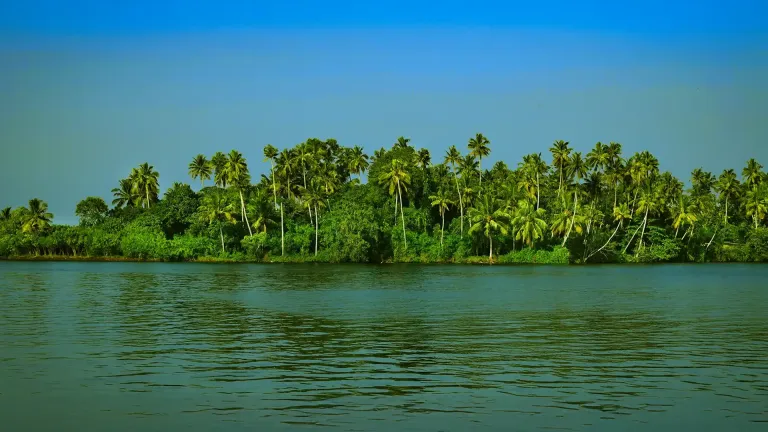
The setting is quiet, rural and un-touristy. This is Kollam’s green midland country of rubber, coconut and small towns; you are unlikely to share the rock with crowds outside festival days, which makes for a contemplative, unhurried visit.
The great boulder itself is a spectacle — the “sleeping elephant” silhouette, the chummadu para “headache rock” beside it, and the sheer physical drama of a temple emerging from stone reward even visitors who come more for the geology and folklore than the worship.
It pairs naturally with a wider Kollam-district exploration — Chadayamangalam and its landmarks, the Anchal–Kadakkal midlands and the run of hill and forest country toward the Ghats — making it an easy add-on to a road trip rather than a destination you must build a whole day around.