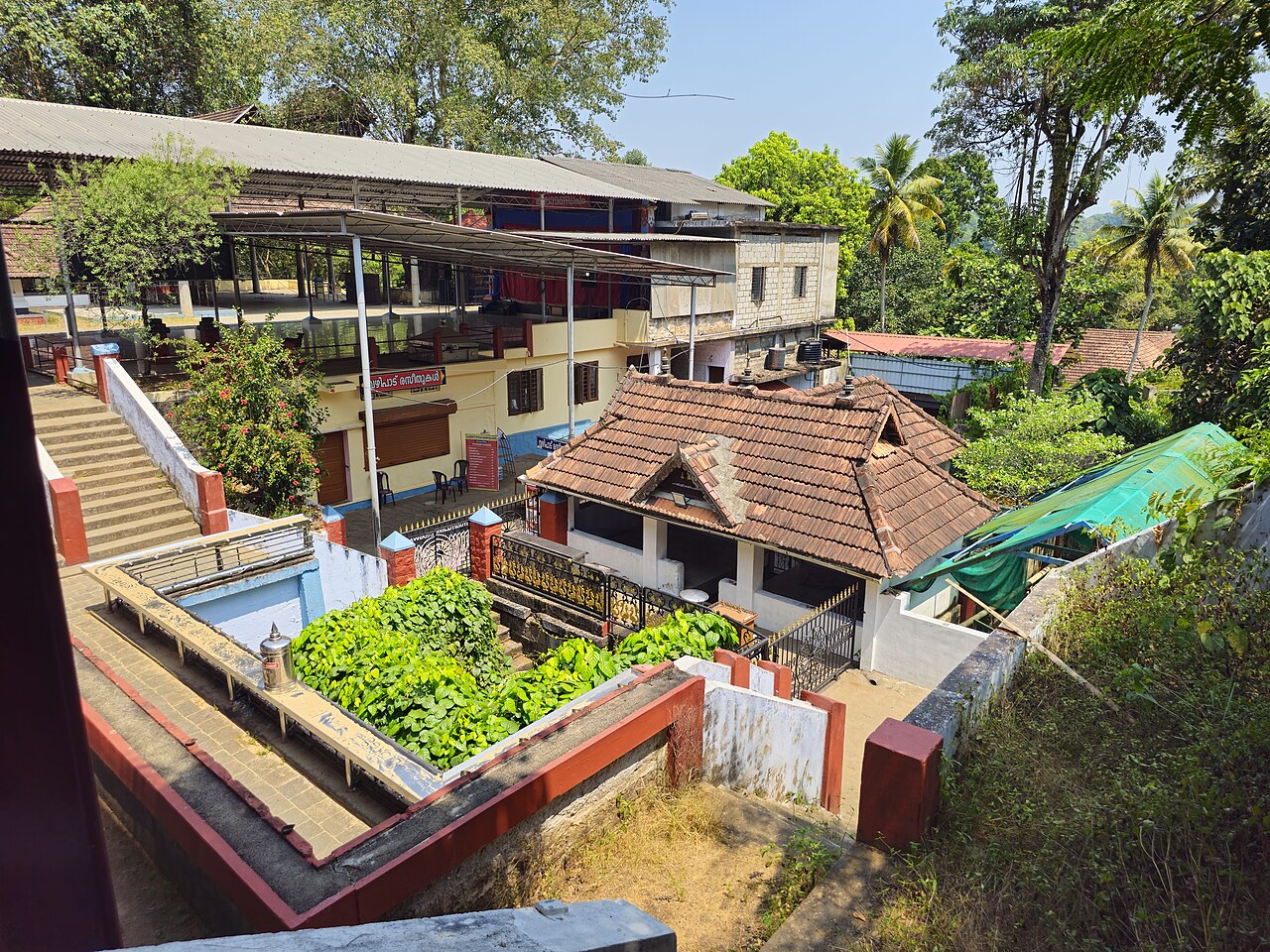
One of Kerala’s oldest and most historically significant temples, the Vazhappally Maha Siva Temple near Changanassery is revered both as a living centre of Shaivite worship and as the home of the celebrated Vazhappally copper-plate — widely regarded as among the earliest dated records connected with the Malayalam language.
The story of Vazhappally Maha Siva Temple
The Vazhappally Maha Siva Temple — also written as the Vazhappally Sree Mahadeva Temple — stands in the village of Vazhappally, just outside the busy market town of Changanassery in Kerala’s Kottayam district. To pilgrims across central Travancore it is one of the venerable ‘great Shiva’ shrines, but to historians it carries a weight few other temples in Kerala can match: it is the reputed source of the Vazhappally copper-plate, a ninth-century inscription that scholars often cite as one of the oldest documents associated with the early growth of Malayalam.
The presiding deity is Shiva, worshipped here as Mahadeva, and by most accounts the temple’s antiquity reaches back to the early Chera era of the first millennium. Local tradition holds that the shrine is unusually old even by Kerala’s standards, its origins tangled up with the semi-legendary figure of Parasurama, the sage credited in Malayali lore with raising the land of Kerala from the sea and establishing its earliest temples.
What sets Vazhappally apart architecturally is a rare feature that visitors quickly notice: the temple is said to possess two nalambalams — the four-walled cloisters that enclose a sanctum — and two flag-masts (kodimarams), a configuration seldom seen in Kerala temple design. This has led many to describe it as a temple with, in effect, two principal sanctums, and travellers should treat the exact dedication of each shrine as best confirmed on site, since accounts vary and the arrangement reflects centuries of growth rather than a single plan.
Alongside the Mahadeva, the temple complex is generally said to house Parvati and a set of the familiar subsidiary deities of a major Kerala Shiva temple — figures such as Ganesha and Dakshinamurti are commonly mentioned. Some accounts also point to Vaishnavite worship within the wider complex; because descriptions differ, it is best to regard the presence and prominence of a Vishnu shrine as something to verify during a visit rather than to state with certainty.
For most of its long life Vazhappally has been, above all, a working temple rather than a monument. The daily rhythm of pujas, the lamps of the sreekovil, the seasonal festival crowds and the quiet devotion of Changanassery’s townsfolk have continued more or less unbroken, even as scholars pored over the copper-plate that made the temple’s name known far beyond Kerala. It is this doubleness — a place of living faith that is also a landmark of documented history — that gives Vazhappally its particular character.
A visit rewards those who come with curiosity as well as reverence. The temple’s wooden craftsmanship, its unusual twin layout, and its association with the beginnings of written Malayalam make it a rich stop for anyone interested in the deep past of Kerala, while the surrounding town offers the easy comforts of a well-connected central-Travancore hub.
Legend & myth
According to a widely repeated tradition, the consecration of the Mahadeva idol at Vazhappally was performed by Parasurama himself, the axe-wielding sage of Malayali legend who is said to have created Kerala and endowed it with its first temples. In this telling, Vazhappally is counted among the 108 Shiva temples that Parasurama is believed to have established across the land.
This origin story should be understood as sacred legend rather than documented fact — Parasurama features in the founding myths of countless Kerala shrines, and his name is a way of expressing a temple’s great antiquity and sanctity. At Vazhappally the legend sits comfortably alongside the very real historical record of the copper-plate, each in its own way testifying to how old and how honoured the temple is felt to be.
History
Vazhappally’s claim on history rests above all on the Vazhappally copper-plate, an engraved copper record long associated with this temple and frequently described as among the earliest surviving documents connected with the Malayalam language. The plate is written in the old Vattezhuthu script, with some Grantha letters mixed in — the very script-world from which literary Malayalam would later grow — and for that reason it occupies a cherished place in accounts of Kerala’s linguistic and epigraphic origins.
The inscription is conventionally attributed to a Chera ruler named Rajasekhara (Rajasekhara Varma), and is commonly dated to around 832 CE, in the ninth century. Both the exact date and the precise identity of the king are matters of scholarly discussion: dates ranging across the ninth century have been proposed, and Rajasekhara is often identified with the venerated Shaiva figure remembered as Cheraman Perumal. Readers should treat the ‘c. 832 CE’ date and the attribution as the widely-cited scholarly reading rather than as a settled certainty.
In content, the copper-plate is not a grand royal proclamation but something more revealing: a resolution about the ordinary business of running a temple. It records arrangements — a temple committee and the local landholders (the Urar of Vazhappally, together with a body often given as the Thiruvatruvay Pathinettu Nattar) agreeing on land grants and endowments to fund the daily worship — and it lays down penalties, expressed in dinara coins, for anyone who obstructs the rituals. Through this small document we glimpse how a Kerala temple economy was organised more than a thousand years ago.
The temple’s fabric itself reflects long centuries of use and renewal. Tradition links its early building or rebuilding to the Chera period — a rebuilding in the early ninth century, in the era of Rajasekhara Varman, is often mentioned — while the woodwork and carved timber panels (daru silpas) that survive today are generally dated much later, to around the seventeenth century, depicting scenes from the epics. As with most ancient Kerala temples, the structure a visitor sees is the product of many phases rather than one original moment.
The plate itself is no longer kept at the temple; it is generally reported to be preserved by a religious establishment (a madham) at Thiruvalla, and it was brought to wider scholarly notice after being identified near Changanassery. Whatever the fine points of its dating, the Vazhappally copper-plate remains one of the touchstones by which the early documented history of Kerala — and of its language — is studied, and it is the single fact that lifts this temple from local landmark to national heritage.
Why visit
To stand at one of Kerala’s genuinely ancient Shiva temples, with roots reaching into the early Chera era and a place in the founding legends of the land through its association with Parasurama.
For its rare architectural signature — the twin nalambalams and twin flag-masts that make Vazhappally one of the most unusual temple layouts in Kerala, described by many as a shrine with two sanctums.
For its unmatched historical resonance as the temple linked to the Vazhappally copper-plate, one of the earliest records tied to the Malayalam language and the old Vattezhuthu script — a pilgrimage of sorts for anyone interested in Kerala’s past.
To experience an unbroken living tradition of Shaivite worship, from the daily lamp-lit pujas to the colour and music of the annual festival season, in a temple that has served its community for well over a millennium.
For the craftsmanship — the carved timber and traditional Kerala temple architecture that reward an unhurried, respectful look.
For its easy setting in Changanassery, a well-connected central-Travancore town that makes the temple a natural stop on a Kottayam-area itinerary taking in backwaters, churches and other heritage sites.