Tucked into the tight lanes of Kuttichira in the old heart of Kozhikode (Calicut), the Mishkal Mosque is one of the oldest and most storied mosques in India — a soaring, multi-tiered timber hall that looks far more like a Kerala temple or an old tharavadu mansion than the domed-and-minaretted mosque most visitors expect. Traditionally dated to around the 14th century and named after Nakhuda Mishkal, a wealthy Arab-Yemeni merchant and shipowner, it is a living monument to the centuries when Calicut was the pepper capital of the world and Arab traders, the Zamorin's court and the Mappila Muslim community were woven together by the spice trade.
The story of Mishkal Mosque
The name tells the story. Nakhuda is a title of Persian origin meaning captain or master of a ship, and Mishkal — sometimes rendered Mithqal — was a merchant of Arab, likely Yemeni, descent whose wealth flowed from the Indian Ocean spice routes that ran through medieval Calicut. Tradition holds that this immensely rich shipowner endowed the mosque that still carries his name, so that the timber hall rising above the Kuttichira lanes is, in effect, a merchant's monument to faith paid for by pepper, cardamom and the monsoon winds. When you stand before it, you are looking at the surviving architecture of a trading world that once linked this shoreline to Aden, Hormuz and the ports of the Red Sea.
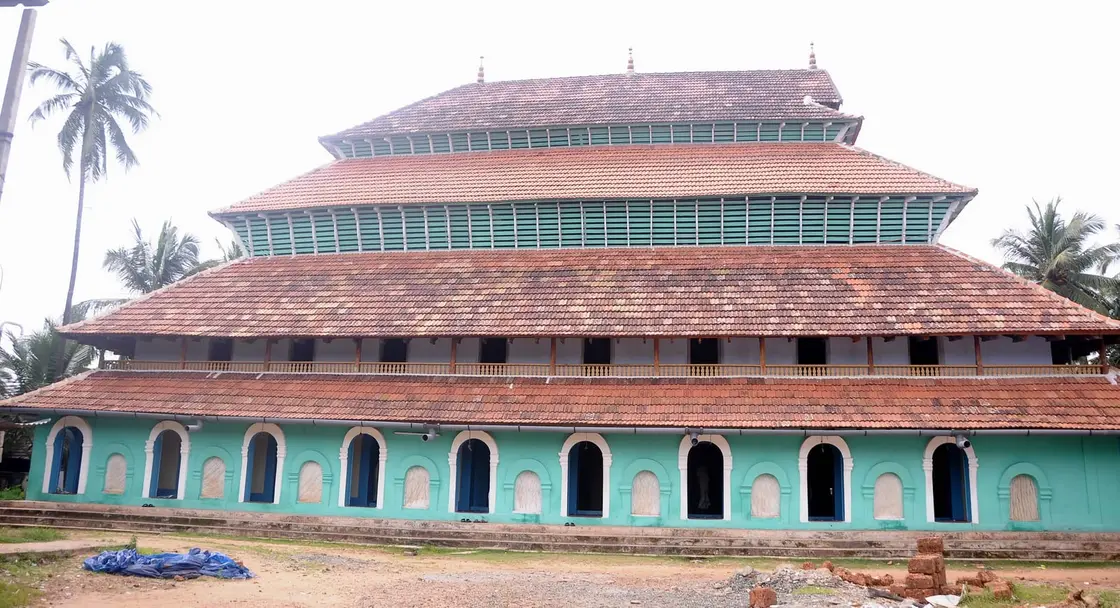
What startles most first-time visitors is that the mosque breaks every stereotype of Islamic architecture. There is no dome. There is no minaret. Instead a tall, layered structure of four tiers — said to have originally been five (indicative — confirm locally) — climbs skyward under steeply pitched, tiled Kerala roofs, its weight carried on rows of carved wooden pillars. Reports commonly cite around 24 engraved timber columns and dozens of carved doors — figures of roughly 47 doors are widely quoted (indicative — confirm locally). It is pure Malabar vernacular: the same gabled, timber-and-tile idiom used for Kerala's Hindu temples and grand family houses, here turned to the service of Islam. The result is one of the finest examples anywhere of a genuinely Keralan Islamic architecture that grew from local soil rather than being imported from Delhi or Persia.
The mosque sits at the centre of Kuttichira, one of the oldest Muslim quarters of Kozhikode and the ancestral home of the Mappila community — the Muslims of the Malabar coast, many of them descended from marriages between Arab traders and local families. Around the mosque cluster the old tharavadu-style joint-family houses, narrow lanes thick with the smell of cooking and, close by, the great rectangular tank known as the Kuttichira pond, where generations have performed ablutions and where daily life still gathers. To walk here is to move through a neighbourhood that has kept its rhythm for centuries: the call to prayer, the children by the water, the elders in the shaded verandahs.
This corner of Calicut is central to the tradition of how Islam first came to Kerala — peacefully, by sea, through commerce rather than conquest. Popular tradition links the earliest Malabar mosques to Malik Deenar and companions of the Prophet's era, and whatever the exact chronology, the historical truth is clear enough: Islam took root on this coast through Arab merchants who settled, married and were welcomed by Hindu rulers keen to keep the lucrative spice trade flowing. Mishkal Mosque is one of the great surviving symbols of that early, trade-borne Islam, and Kuttichira as a whole is spoken of as a cradle of the faith in south India.
For all its age, this is not a museum piece but an active, working mosque where the five daily prayers are still called and answered. That living quality is part of its power — the worn timber, the polished floors, the sense of continuous use across some seven centuries. Visitors are asked to remember that they are entering a place of ongoing worship and community life, not merely a heritage attraction, and to tread with the respect a place of this antiquity and devotion deserves.
History
Mishkal Mosque is traditionally assigned to around the 14th century, giving it a history of more than six hundred and fifty years (indicative — confirm locally), which places it among the oldest surviving mosques in India. It belongs to the age when Calicut under the Zamorins (Samoothiris) was the pre-eminent trading port of the Malabar coast, drawing Arab, Chinese and later European merchants. The mosque was endowed by Nakhuda Mishkal, whose fortune came from long-distance maritime trade, and it stands as physical evidence of the deep, prosperous partnership between the Zamorin's kingdom and its Arab-linked Muslim merchant community.
The mosque's most dramatic chapter came with the arrival of the Portuguese in the Indian Ocean. Determined to seize control of the spice trade from the Arab merchants and the Zamorin who backed them, the Portuguese launched repeated attacks on Calicut in the early sixteenth century. In 1510 (indicative — confirm locally) a Portuguese assault set fire to the mosque, and the arson is said to have destroyed the uppermost storey — the reason the building today rises four tiers where tradition says it once rose five. Some accounts hold that charred and blackened beams from that burning can still be seen in the upper timbers, a scar carried down the centuries (indicative — confirm locally).
What followed is why the mosque is so often invoked as a symbol of Kerala's communal harmony. The Zamorin of Calicut — a Hindu king — treated the attack on the mosque as an attack on his own subjects and kingdom, and the ruling house supported the defence of the Muslim community and the rebuilding of their damaged mosque. Sources commonly date the reconstruction to 1578–79 (indicative — confirm locally). The image of a Hindu monarch rebuilding a Muslim place of worship burned by a foreign power has made Mishkal Mosque a lasting emblem of the pluralism of old Malabar, where faith counted for less than the shared bonds of kingdom and trade.
The mosque must be understood within the wider Portuguese-Zamorin wars, a long struggle for command of the pepper trade in which the Kunjali Marakkars — the Zamorin's Muslim naval admirals — famously fought the Portuguese at sea. Kuttichira and its mosques were part of the home front of that conflict: the merchant community whose wealth and shipping the Portuguese sought to break. The survival and rebuilding of Mishkal Mosque is, in that sense, a small victory of resilience in a decades-long war over the spices that made Calicut famous across the world.
Across the following centuries the mosque remained the spiritual anchor of the Kuttichira Muslims, weathering the changes of the Mysorean invasions, British rule and modern Kozhikode without losing its function or its distinctive timber form. Today it is recognised as one of the most important heritage mosques in Kerala and a cornerstone of the Kuttichira heritage precinct, which is increasingly studied and promoted for its unique blend of Islamic devotion and Kerala vernacular craft. It continues to serve its congregation daily, an unbroken thread of worship running back to the age of the Zamorins.
Why visit
You will see one of the oldest mosques in India — a genuine medieval survivor from the age of the Calicut spice trade, with roots traditionally reaching back some seven centuries. Few active places of worship anywhere carry this depth of continuous history.
The architecture is unlike almost any mosque you have seen: a towering four-tier timber hall with no dome and no minaret, built entirely in the gabled, tiled, pillared Kerala vernacular style shared with the region's temples and old family mansions. It is a masterclass in how Islam adapted to local craft and climate.
It is a monument to a rare and moving story of communal harmony — a mosque burned by the Portuguese and rebuilt with the support of a Hindu Zamorin — that speaks to the pluralist history of the Malabar coast in a way few sites can.
The surrounding Kuttichira quarter is one of the most atmospheric heritage neighbourhoods in Kerala, with its ancestral tharavadu-style houses, narrow lanes and the large historic Kuttichira pond right beside the mosque — a whole living precinct rather than a single monument.
For anyone interested in the story of how Islam came to India, this is close to the source: the peaceful, trade-borne arrival of the faith on the Malabar coast, associated in tradition with the earliest mosques of Kerala and the Malik Deenar era.
It offers a quiet, authentic slice of old Calicut far from any theme-park polish — an active, worn, working mosque where the wood, the light and the daily prayers make the centuries feel present.