The story
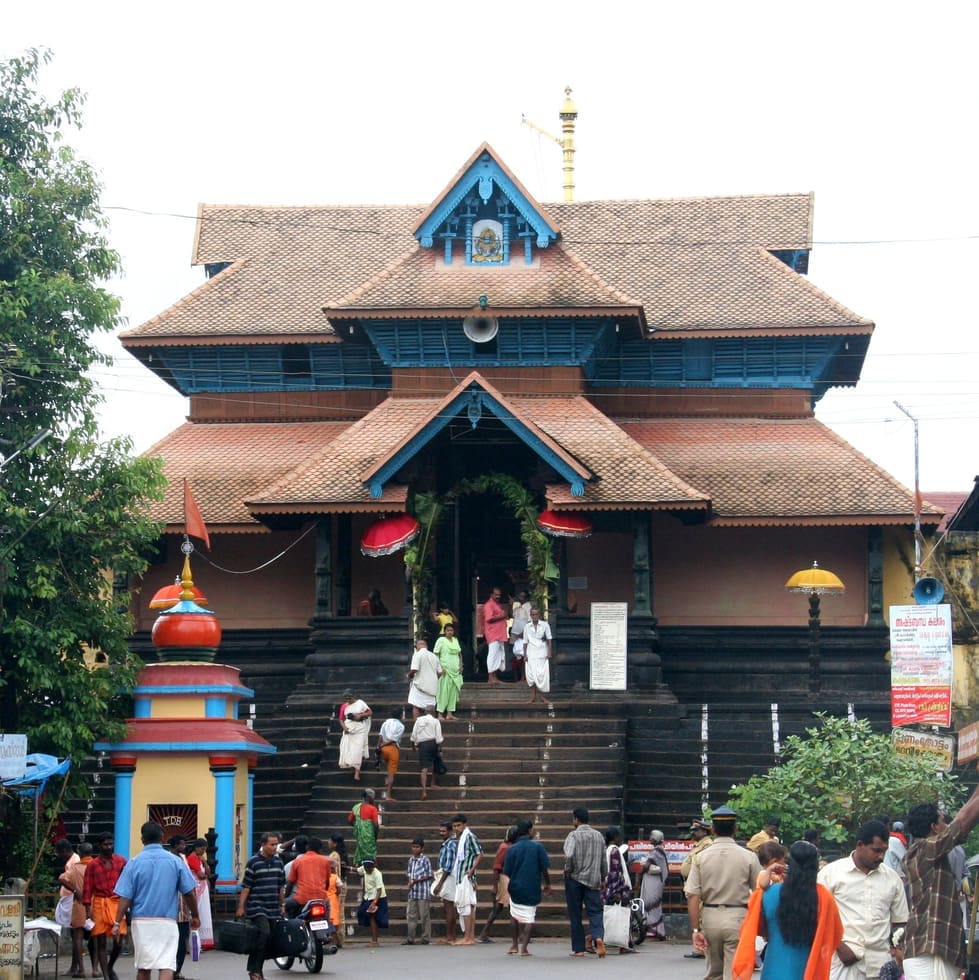
In the temple town of Thiruvalla, where the Manimala river slows and the paddy turns gold, stands one of Kerala’s oldest and grandest Vishnu shrines — the Thiruvalla Sree Vallabha Mahakshetram. It is a temple of superlatives: a towering single-stone flagstaff said to touch the sky, a sanctum where two deities are worshipped from opposite doors, references reaching back to the Tamil Sangam age, and — most singular of all — a full Kathakali performance staged inside the temple every single night as an offering to the god. Few places in India so completely fuse granite antiquity, high classical art and living daily ritual.
The story of Sree Vallabha Temple
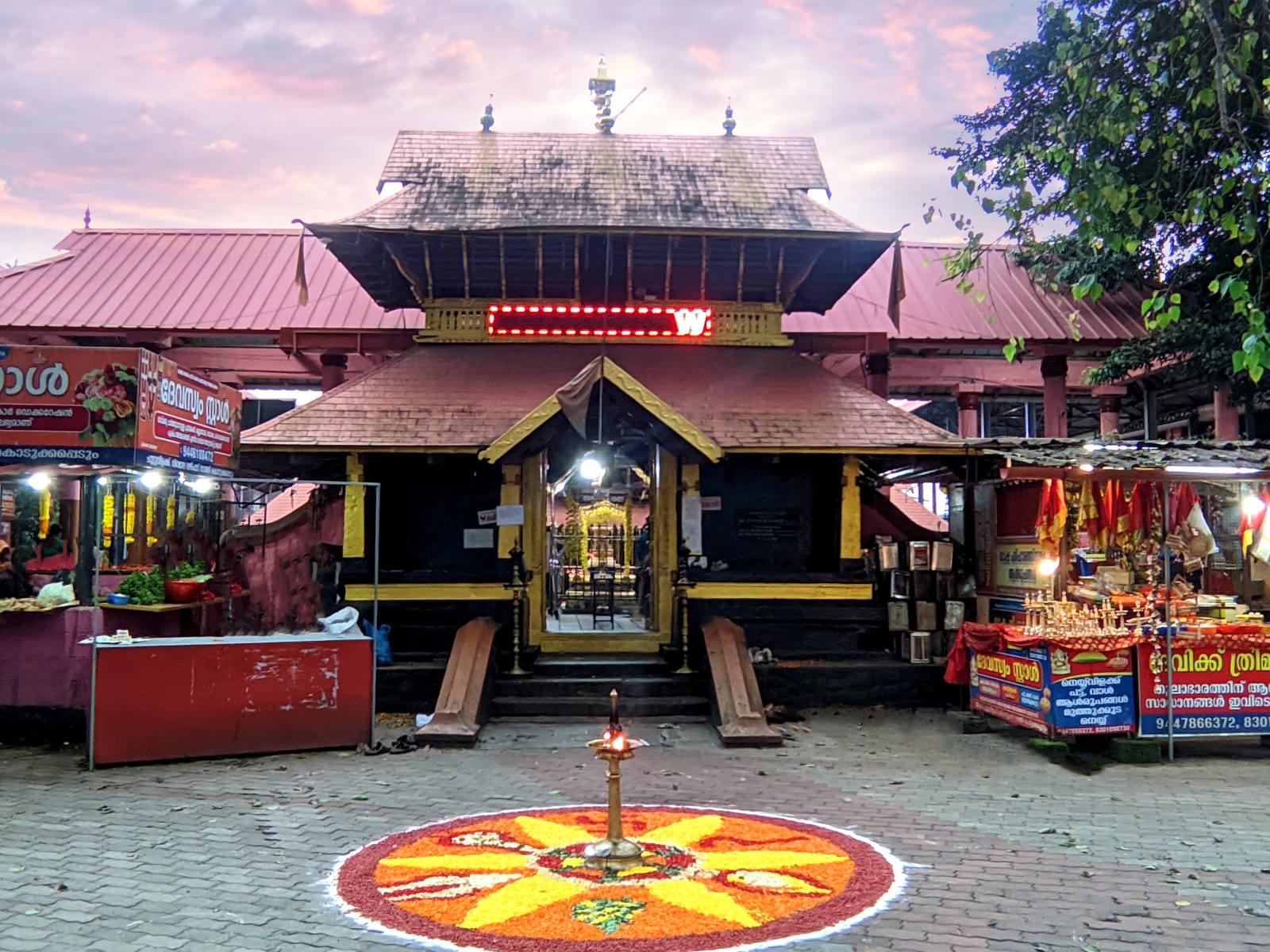
Approach Sree Vallabha Temple at dusk and you feel the weight of centuries before you cross the threshold. The great granite gopuram, the long pillared corridors and the vast rectangular sreekovil speak of an age when temples were carved to outlast empires. This is no modest wayside shrine — it is a mahakshetram, a temple counted among the very oldest and largest in Kerala, its walls dark with the patina of well over a thousand years of oil-lamps and incense.
The presiding deity is Sree Vallabha — Vishnu as the beloved lord of Sree (Lakshmi) — enshrined in a tall standing form so cosmic, tradition says, that it shows neither clear top nor bottom, an image of the boundless. But the temple’s deepest mystery is that it houses two objects of worship in one sanctum. Sree Vallabha faces east; and through the western door the same sreekovil is worshipped as the Sudarshana Chakra, Vishnu’s flaming discus, honoured as a deity in its own right. Devotees circle round to make offerings at both faces, and the temple is often described as the shrine where the Chakra itself is a god.
Then there is the flagstaff. Rising before the sanctum is the dhwaja stambham — the kodimaram, crowned by a figure of Garuda — carved, remarkably, from a single towering shaft of black granite. It is cited as among the tallest single-stone flagstaffs anywhere, often given as roughly 53 to 54 feet (indicative — confirm locally), and folk tradition credits it to the legendary master-craftsman Uliyannoor Perunthachan, said to have raised it in a single day. Whatever the history, standing at its base and looking up the unbroken stone is one of the great quiet astonishments of a Kerala temple visit.
What truly sets Thiruvalla apart, though, unfolds after the last evening puja. Night after night, on a stage within the temple precinct, artists in the towering crowns and green-painted faces of Kathakali enact the old epics — not as a festival spectacle but as a vazhipadu, a devotional offering laid before Sree Vallabha himself. It is said to be among the very few temples in the world, and perhaps the only one in Kerala, where Kathakali is presented daily as routine ritual worship. Some nights a full company performs to a hall of pilgrims; on quieter nights the offering may still be honoured in simpler form (indicative — confirm locally). Either way, the god is understood to be the true and constant spectator.
The setting deepens the spell. To one side lies the temple tank — Jalavanthy, also called the Khandakarna Theertham — a sacred pond wrapped in its own legend of hidden idols and immersed devotees. Around the shrine the compact town of Thiruvalla goes about its day, but within the granite enclosure time moves to the old rhythm of five daily pujas, the deity dressed by turns as a young brahmachari in white, as a householder, and as the supreme Parabrahma.
To visit is to stand where Sangam-age poets, Alvar saints and generations of Malayali pilgrims have stood. The temple appears among the 108 Divya Desams sung by the Tamil Vaishnava Alvars, and Thiruvalla’s ancient inscriptions are prized as among the earliest specimens of Malayalam prose. Antiquity, architecture and art here are not exhibits behind ropes; they are simply the everyday texture of a temple still very much alive.
Legend & myth
The best-loved legend belongs to Khandakarna, a fierce devotee of Shiva. So single-minded was his devotion, the story goes, that he hung great bells upon his ears — his name means the bell-eared one — so that no sound could reach him but the chanting of Shiva’s name. When the sage Durvasa directed him to immerse himself in the temple’s sacred tank, Khandakarna cast off his old bells and rose with new ones tuned to the praise of Vishnu; and there before him Vishnu manifested as Sree Vallabha and granted him liberation. The tank is remembered to this day as the Khandakarna Theertham, and folk belief holds that sixty-four hidden idols of Vishnu lie sunk within its waters.
Another strand of tradition ties the temple’s origin to a pious woman and to royal patrons across the ages. Local lore and the Thiruvalla inscriptions speak of a shrine for the Sudarshana Chakra raised in almost unimaginable antiquity and rebuilt by a queen in centuries long past (dates given in tradition are legendary and not historically verifiable — treat as sacred story, not fact). Whatever the true chronology, the enduring point of the legends is the same: that here the flaming discus of Vishnu came to be worshipped as a living deity, worthy of its own western door and its own daily honours.
The flagstaff, too, has its tale. The single granite shaft is credited to Uliyannoor Perunthachan, the near-mythical master-carpenter and stone-worker of Kerala folklore, who is said to have shaped and raised the whole towering mast in the span of a single day — a story that captures, in one image, the awe the temple’s builders have always inspired.
History
Sree Vallabha Temple is genuinely ancient. It is counted among the oldest surviving temples in Kerala, and its fame reaches back to the Tamil Sangam era, with references that place Thiruvalla among the great early centres of Vaishnava worship. The shrine is one of the 108 Divya Desams — the sacred abodes of Vishnu celebrated in the hymns of the Alvar saints — and is associated with Alvars such as Nammalvar and Thirumangai Alvar, linking it to the pan-South-Indian Sri Vaishnava tradition.
The temple is especially valued by historians of language for the Thiruvalla copper-plate inscriptions, a large body of records regarded as among the earliest examples of Malayalam prose. These document endowments, land grants and the elaborate ritual economy that sustained a temple of this scale, giving a rare, concrete window into medieval Kerala’s religious and social life.
Worship of the Sudarshana Chakra as a distinct deity, honoured through the sanctum’s western door, is traditionally traced to the medieval period (commonly cited as around the 13th century — indicative, confirm locally). This dual worship — Sree Vallabha to the east, the Chakra to the west — is one of the temple’s defining and unusual features, and it shapes how pilgrims move through the shrine to this day.
The monumental granite architecture — the great sreekovil, the pillared halls and above all the single-stone dhwaja stambham — reflects Kerala’s classical temple-building tradition, executed here at exceptional scale. The complex has been maintained, endowed and renovated by rulers, chieftains and devotees across many centuries, and today it is administered under the Travancore Devaswom Board (indicative — confirm locally).
Through all of it, the temple’s most remarkable continuity is the nightly Kathakali. The offering of this classical dance-drama as a daily vazhipadu has made Thiruvalla one of the most important living homes of the art, credited with staging Kathakali on more nights of the year than almost anywhere else — a tradition of devotion and patronage that has kept a demanding classical form alive as everyday worship.
Why visit
To witness the nightly Kathakali offering — a full classical dance-drama performed inside a temple not for tourists but for the god, a devotional experience you can find in almost no other shrine in the world.
To stand beneath the towering single-stone dhwaja stambham, one of the tallest granite flagstaffs anywhere, crowned by Garuda and wrapped in the legend of the master-craftsman Perunthachan.
To experience the rare two-deity worship — offering darshan to Sree Vallabha through the eastern door and to the Sudarshana Chakra through the western — a ritual geometry unique among Kerala temples.
To feel true antiquity: a Sangam-age, Divya Desam shrine sung by the Alvar saints, whose inscriptions rank among the earliest Malayalam prose, its granite halls dark with more than a millennium of worship.
To absorb the atmosphere of a great living mahakshetram — five daily pujas, the deity redressed from brahmachari to householder to Parabrahma, the sacred Khandakarna tank beside the shrine, and the deep calm of Thiruvalla’s temple town.
To combine it easily with a wider Pathanamthitta pilgrimage circuit, Thiruvalla sitting conveniently on the road and rail spine of central Kerala.