The story
Set on the banks of the Killi (Killiyar) river in the Manacaud area of Thiruvananthapuram, the Attukal Bhagavathy Temple is one of Kerala’s most beloved shrines to the Goddess — worshipped here with deep affection as Attukal Amma. Widely known as the ‘Sabarimala of Women’, it is the setting for the Attukal Pongala, a festival reputed to draw the largest single gathering of women anywhere in the world.
The story of Attukal Bhagavathy Temple
Approach Attukal on an ordinary morning and it feels like a warm neighbourhood temple: a compact, brightly painted complex a short walk from the Killi river, garlanded and busy with families slipping in to pray to the Goddess they call, simply, Amma — Mother. Yet this is a shrine whose reputation stretches far beyond its size. For one full-moon night each year the entire city of Thiruvananthapuram becomes an extension of its courtyard.
The presiding deity is a form of Bhagavathy — the Great Goddess — venerated at Attukal as Bhadrakali and lovingly identified with Kannaki, the wronged heroine of the ancient Tamil epic Silappadikaram. Devotees see in Amma both the fierce protectress and the tender mother, and the temple’s enormous popularity rests on that intimacy: people come to her with the small and large troubles of daily life.
The temple’s fame is inseparable from the Attukal Pongala, held during the Malayalam month of Kumbham (roughly February–March). On the appointed day, women fill the roads, pavements, rooftops and open grounds for kilometres around the shrine, each tending a small hearth of three bricks. In earthen pots they cook pongala — a sweet offering of rice, jaggery, coconut and plantain — to be sanctified by the Goddess. The word pongala means ‘to boil over’, and the abundance that spills from the pots is taken as a sign of Amma’s grace.
Because the ritual is performed overwhelmingly by women, Attukal has earned the epithet the ‘Sabarimala of Women’ — a counterpart to the famous Ayyappa pilgrimage. The scale is extraordinary: the festival has twice been recognised by Guinness World Records for the largest gathering of women, and crowd estimates in recent years run into the several millions (figures are widely reported and vary — treat them as indicative).
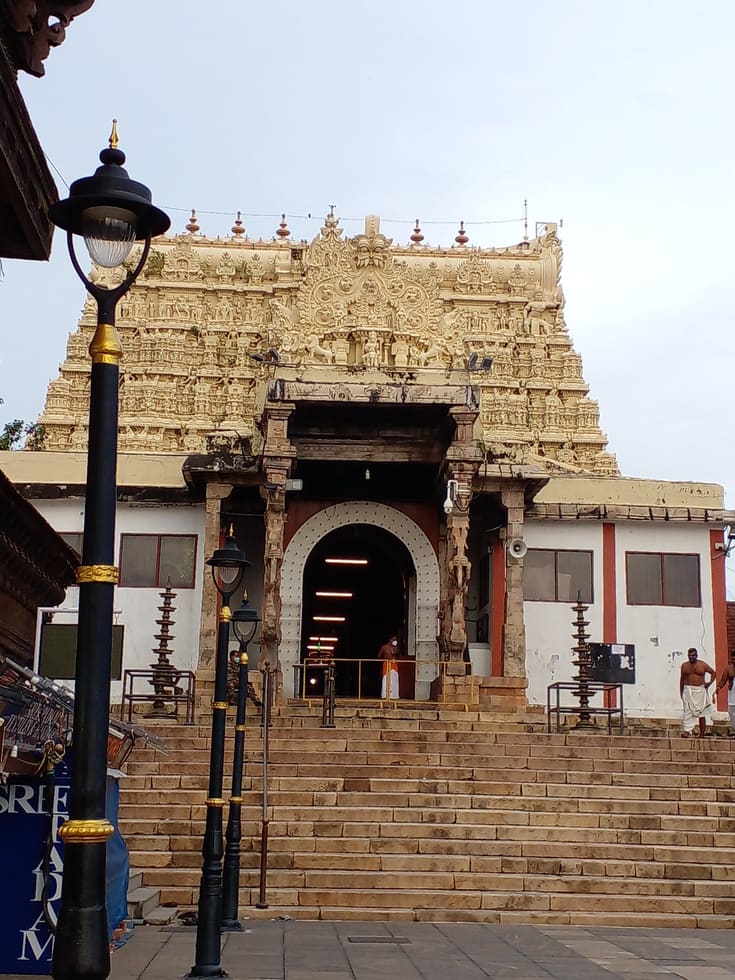
Away from the great festival, Attukal rewards a quieter visit. The gopuram and outer walls carry vivid sculptural work drawn from the Puranas and from the Kannaki story, blending Dravidian and Kerala temple idioms. Inside, oil lamps, the scent of flowers and camphor, and the steady murmur of devotion give the small sanctum a concentrated, homely warmth that many visitors find more moving than any grand scale.
The temple is run by the Attukal Bhagavathy Temple Trust, which has grown the shrine’s facilities, charities and festival management over the decades. For all its modern organisation and global record-book fame, Attukal remains at heart what it has always been — a mother’s house, to which her children return.
Legend & myth
The legends told at Attukal frame the Goddess through the figure of Kannaki, and devotees relate them as sacred story rather than documented history. In the Silappadikaram, Kannaki is the devoted wife of the merchant Kovalan. When Kovalan is wrongly accused of theft and executed by the king of Madurai, Kannaki confronts the court, proves his innocence, and in her grief and fury calls down destruction — burning the city of Madurai — before continuing on her journey as a Goddess.
In the Attukal telling, Kannaki, travelling towards Kodungallur, comes to the Killi river near Attukal in the guise of a young girl. She approaches the elder of the Mullaveettil family — a household of the locality — and asks for help in crossing the stream. The elder assists her and invites her home, but when he looks again the girl has vanished.
That night, the legend continues, the Goddess appears to him in a dream (some versions say she revealed a sacred mark or trident where she had stood), disclosing that the girl was none other than the Devi herself, and directing that a shrine be raised for her at Attukal. The family is said to have established the temple in obedience to that vision — and the Mullaveettil Illam retains a ceremonial connection with the shrine to this day.
Told and retold across generations, these stories are honoured as the spiritual charter of the temple. They explain why Amma is at once the compassionate mother who accepts the humble pongala pot and the powerful Goddess who set Madurai ablaze — mercy and might held together in a single form.
History
The documented history of Attukal is more modest than its legends, and the temple’s own accounts and popular tradition do not always agree — a common feature of long-venerated shrines. Tradition links the site to great antiquity and to royal patronage, while the structures a visitor sees today largely reflect building and rebuilding over the nineteenth and twentieth centuries.
What is clear is the temple’s steady rise from a local Bhagavathy shrine on the Killi river to a pilgrimage centre of state-wide and then national renown. Its growth has been closely tied to the expansion of the Attukal Pongala, whose gathering swelled from a regional observance into a mass event as Thiruvananthapuram grew and communications improved.
A turning point in the temple’s public profile came with formal recognition of the Pongala’s scale. The festival is reported to have entered the Guinness World Records in 1997 for the largest gathering of women — with figures of the order of 1.5 million widely cited — and to have been recognised again in 2009, with reported figures around 2.5 million (these numbers are frequently quoted but hard to verify precisely; treat them as indicative). Such recognition sharpened the temple’s identity as the ‘Sabarimala of Women’.
Administration of the shrine rests with the Attukal Bhagavathy Temple Trust, which manages worship, the vast logistics of the annual festival, and a range of charitable and welfare activities. Coordinating a gathering of millions across an entire city — water, safety, sanitation, crowd flow — has made the Trust’s festival management a considerable civic undertaking in its own right.
In recent decades the temple has continued to develop its facilities and the ceremonial calendar around the Pongala, while retaining the character of an approachable, devotion-centred shrine. Its story is less about monumental architecture than about a living tradition that has scaled, year by year, to remarkable size.
Why visit
To witness — or simply to sense the aftermath of — the Attukal Pongala, one of the world’s great expressions of collective devotion, when millions of women turn a whole city into a single vast offering ground.
To pray at a shrine of unusual intimacy: Attukal Amma is approached as a mother, and the atmosphere of the small sanctum, thick with lamplight and flowers, is warm and personal rather than austere.
For the living connection to the Kannaki legend and the Silappadikaram, one of the oldest and most powerful stories of the Tamil-Malayalam world, told here as sacred history.
For the temple’s vivid gopuram and sculptural panels, which repay a slow, unhurried look at the Puranic and Kannaki scenes worked into the walls.
For its easy access — barely a couple of kilometres from Thiruvananthapuram Central and close to the city’s other landmarks — making it a natural stop on any visit to the capital.
To experience the ‘Sabarimala of Women’: a rare major pilgrimage in which women are the central actors, and whose spirit of shared purpose lingers even outside festival time.