A honey-coloured teak-and-rosewood palace crouched on the south-eastern flank of the Sree Padmanabhaswamy Temple, Kuthiramalika is Thiruvananthapuram’s loveliest secret hiding in plain sight — a mansion whose name, ‘the palace of horses’, comes from the 122 wooden horses that gallop, frozen mid-stride, beneath its southern eaves. It was raised in the 1840s by Maharaja Swathi Thirunal Rama Varma, the composer-king of Travancore, and today it keeps his memory as a museum of thrones, ivory, crystal and Kathakali, and as the courtyard where his music returns to life each January.
The story of Kuthiramalika Palace
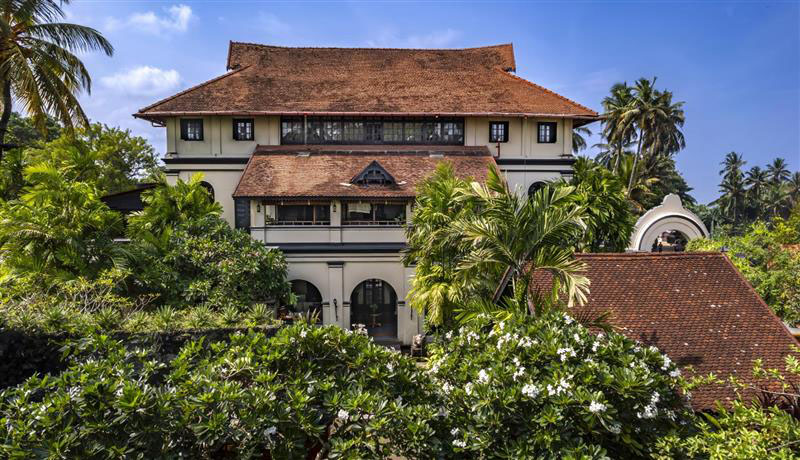
Walk out of the East Fort gate of the Padmanabhaswamy Temple, turn left, and the crowds thin almost at once. There, behind a low wall and a stand of trees, sits a long, low palace the colour of old honey — all sloping tiled roofs, deep overhanging eaves and dark polished wood. Look up beneath the southern roof and you understand the name at a glance: a cavalcade of horses, one hundred and twenty-two of them (indicative — confirm on site), carved into the wooden wall brackets, each rearing or straining as though the whole eave were about to break into a charge. Kuthiramalika — ‘the mansion of horses’, also known as Puthenmalika, ‘the new mansion’ — earns its name in a single upward glance.
The horses are the flourish, but the building beneath them is the real marvel. It is Travancore woodcraft at its serene peak: teakwood and rosewood for the columns, screens and ceilings, marble and granite for the cool grey floors, and — so the guides will tell you — a flooring mix of egg white, charcoal and burnt lime, hand-polished until it stays cool underfoot even in the coastal heat (indicative — confirm locally). Forty-two carved wooden beams are said to span the roof, resting on granite pillars, and no two of the main rooms repeat the same carved pattern. The whole palace is a study in how to keep a house cool, shaded and beautiful without a single pane of coloured glass shouting for attention.
The man who built it was no ordinary patron. Swathi Thirunal Rama Varma (1813–1846) came to the throne of Travancore as a boy and ruled for barely more than a decade, yet he is remembered less as a king than as one of the towering composers of Indian classical music. He wrote — by tradition, hundreds of compositions — in Malayalam, Sanskrit, Telugu, Kannada and Hindi, moving with astonishing ease between the Carnatic krithi and the Hindustani thumri and bhajan (indicative figures — confirm). Padams, varnams, keerthanas, a Navaratri song-cycle: the range is enormous. That so slight and short-lived a reign should have produced so vast a musical legacy is the quiet miracle at the heart of this house.
Inside, twenty or so of the palace’s eighty rooms are open (indicative — confirm on the day), and each is a cabinet of Travancore’s magpie splendour. Two thrones dominate the memory: one carved, it is said, from twenty-four elephant tusks, the other cut from Bohemian crystal. Around them stand fourteen life-sized Kathakali figures in full painted regalia, Belgian and Italian mirrors, crystal chandeliers, white marble sculptures, imported statuary, royal weapons, portraits of the Travancore line, and cabinets of musical instruments — veenas, flutes, drums. There is even a carved ‘musical tree’ said to sound several distinct notes when tapped (indicative — confirm on site). It is less a stern state museum than a royal family’s treasure-loft, thrown open.
The palace hall was built for sound as much as for show. In the concert space, tradition holds, some fifty clay pots hang mouth-down from the ceiling as acoustic reflectors, softening and carrying the human voice (indicative — confirm locally). That instinct for music has never left the building. For most of the year Kuthiramalika is a hushed museum; but for ten days each January its courtyard fills with lamps, listeners and the greatest names in Carnatic and Hindustani music for the Swathi Sangeetholsavam, and the composer-king’s krithis are sung again in the very house where many of them are believed to have been written.
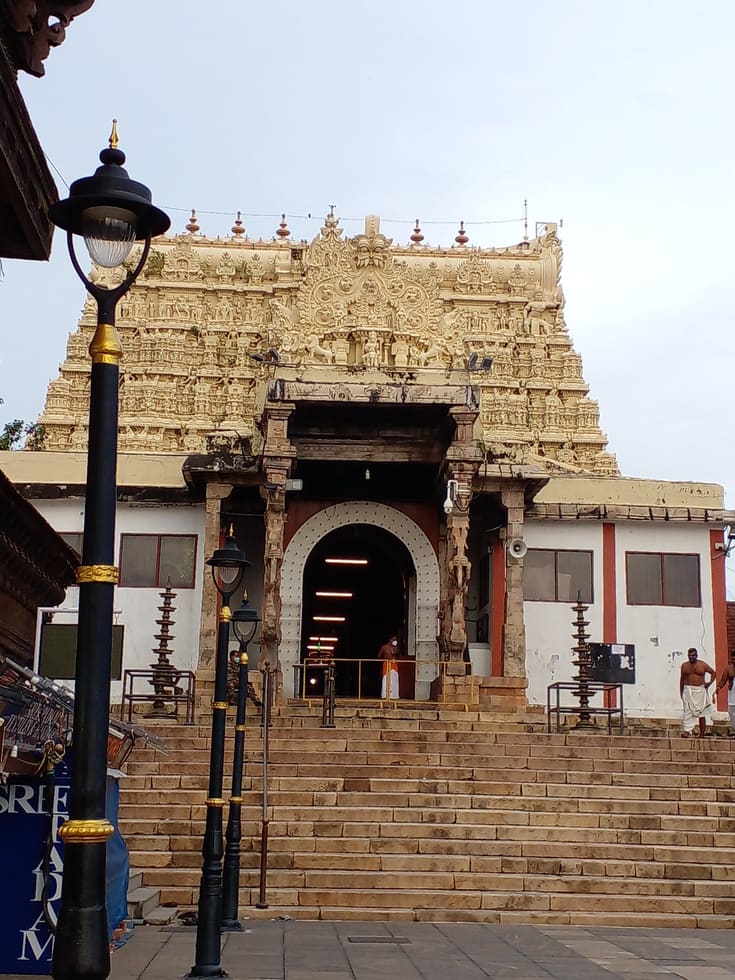
Because it stands within the temple’s royal precinct — the Travancore dynasty were, and style themselves still, servants of Lord Padmanabha — Kuthiramalika is best understood not on its own but as one wing of a larger sacred-royal world: the great temple, the fort walls, the palace of horses. To see it is to catch nineteenth-century Travancore at its most refined: a kingdom that governed in the name of a god, and that produced, in one short-lived Maharaja, both a wooden masterpiece and a body of music still performed two centuries on.
History
Kuthiramalika was built in the 1840s, in the last years of the reign of Maharaja Swathi Thirunal Rama Varma of Travancore (indicative dating — confirm). It rose within the royal complex immediately south-east of the Sree Padmanabhaswamy Temple at East Fort, the ceremonial heart of the Travancore capital, where the dynasty ruled as the god’s deputies under the title Padmanabha Dasa.
Swathi Thirunal himself was born in 1813 and died young, in 1846, aged only about thirty-three. His court at Thiruvananthapuram became a magnet for musicians and scholars from across the south — the celebrated Tanjavur Quartet among them — and he composed prolifically in several languages and in both the Carnatic and Hindustani traditions. Kuthiramalika is remembered as one of the settings in which he lived, worked and, by tradition, composed.
After the Maharaja’s early death the palace is said to have stood largely unoccupied for a very long stretch — by some accounts more than a century — which helped preserve its woodwork, floors and carved horses from heavy alteration (indicative — confirm). It survived as a dynastic property of the Travancore royal family rather than as a public building.
In more recent decades a portion of the palace was opened as a museum under the aegis of the royal family and heritage authorities, displaying thrones, weapons, paintings, musical instruments and other Travancore artefacts, while the surrounding precinct remains bound up with the still-living rituals of the Padmanabhaswamy Temple next door.
The palace’s modern identity is inseparable from the Swathi Sangeetholsavam, the annual January music festival instituted to honour Swathi Thirunal’s compositions, which has made Kuthiramalika’s courtyard one of the most storied concert venues in Kerala and keeps the composer-king’s legacy in living performance rather than glass cases alone.
Why visit
For the 122 horses and the woodwork: this is arguably the finest surviving example of Travancore palace architecture open to visitors — teak, rosewood, marble and granite worked with a restraint and craftsmanship that reward slow, upward-looking attention.
For the museum itself: ivory and crystal thrones, fourteen life-sized Kathakali figures, Belgian and Italian mirrors, crystal chandeliers, royal arms, marble statuary and cabinets of instruments make this one of the richest royal collections in south Kerala.
For the Swathi Thirunal story: few buildings anywhere are so directly the home of a great composer. To stand in the hall of the composer-king, beneath the pot-hung acoustic ceiling, is to visit the source of a still-performed musical tradition.
For the pairing with Padmanabhaswamy Temple: the palace sits a two-minute walk from one of India’s most famous temples, letting you combine the great gopuram, the fort and the royal palace into a single, coherent East Fort morning.
For the January festival: if you time your visit to the Swathi Sangeetholsavam, the courtyard becomes a lamp-lit open-air concert hall hosting the leading names in Carnatic and Hindustani music — a rare chance to hear the building do what it was built for.
For the calm: after the intensity of the temple queue, Kuthiramalika is cool, shaded and unhurried — a place to sit on a wooden verandah, feel the egg-white floors underfoot and let a very old kind of quiet settle.