Where a placid lagoon slips beneath a sandbar to greet the Arabian Sea, Veli Tourist Village is Thiruvananthapuram’s best-loved picnic spot — a landscaped waterfront of pedal boats, a swaying floating bridge, whimsical stone sculptures and a floating café, all barely ten minutes from the capital.
The story of Veli Tourist Village
Veli sits at one of the most photogenic geographic seams in Kerala — the exact point where the freshwater backwaters of the Veli–Akkulam system meet the salt swell of the Arabian Sea. A slim sandbar keeps the two apart, so on one side you have a mirror-calm lagoon dotted with drifting boats, and on the other the open surf of Veli beach. Standing on the bar you can watch both worlds at once, which is precisely the appeal that turned a quiet coastal backwater into the city’s favourite day out.
The lagoon is the beating heart of the village. Pedal boats and paddle boats bob at the jetty in bright reds and yellows, while faster speed boats and safari-style craft carry visitors deeper into the water, past coconut groves and thick riverside vegetation where the Veli backwaters run on towards neighbouring Akkulam. For many Thiruvananthapuram families, learning to work a pedal boat here is a rite of childhood, and weekend afternoons see the water busy with laughter and gentle collisions.
Connecting the garden on the southern bank to the beach beyond is Veli’s signature floating bridge — a pontoon walkway that rests directly on the water and shifts underfoot as the lagoon breathes. Crossing it is half the fun and half the thrill: the deck rolls with every wave and every passing boat, and children squeal their way across while parents grip the ropes. It is the single most photographed feature of the village, and the crossing delivers you straight onto the sand.
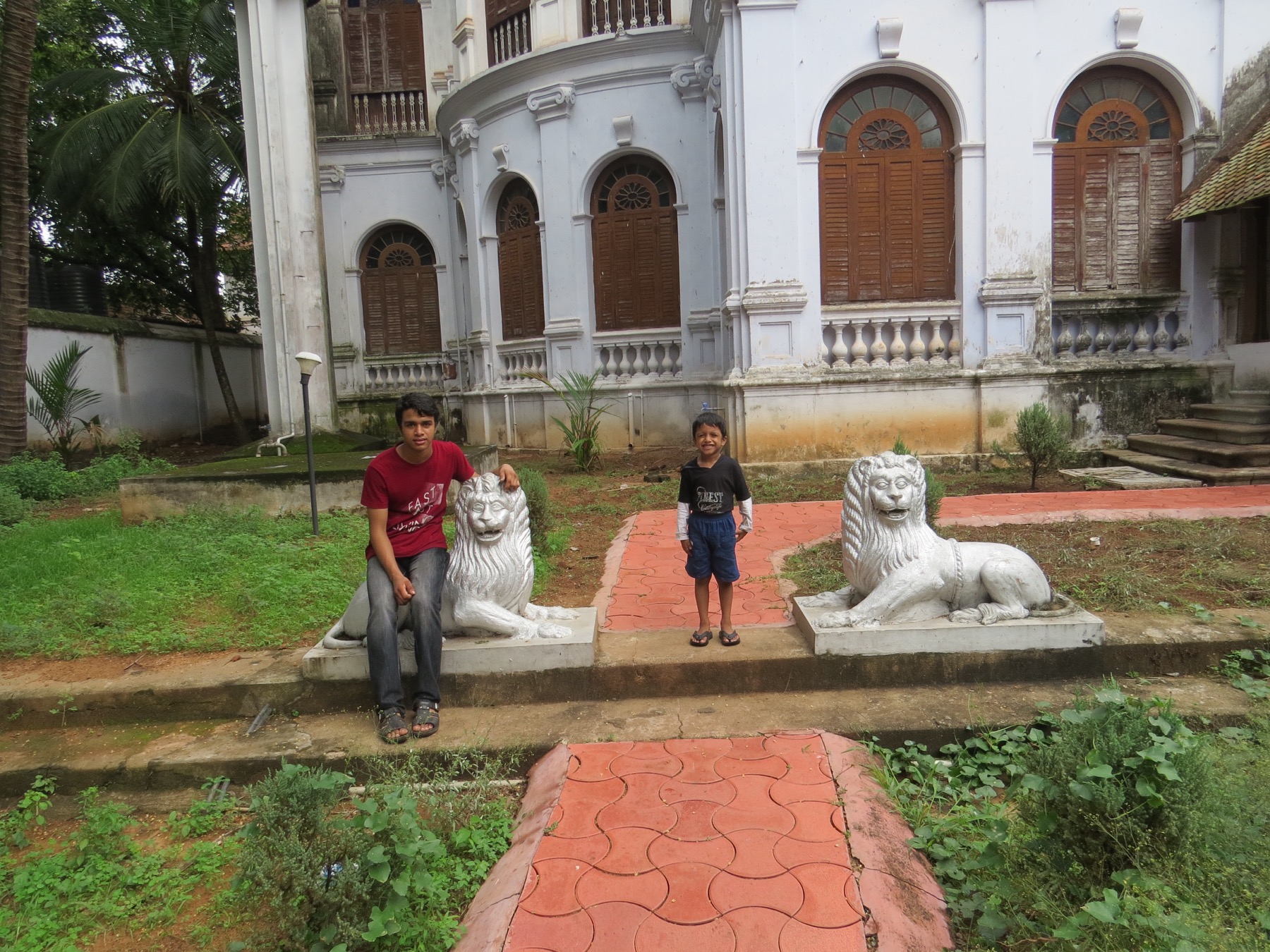
The landscaped garden itself is scattered with the unmistakable work of Kanayi Kunhiraman, the pioneering Malayali sculptor and the first sculptor to receive the Raja Ravi Varma Award. His giant conch shell rises from the lawns as the village’s emblem, joined by other stone and grass forms that give Veli an open-air-gallery character rare among Kerala’s parks. The sculptures turn an ordinary lakeside stroll into a small encounter with modern Indian art.
Around the greenery the village packs in everything a family day needs — a children’s park thick with swings, slides, see-saws, merry-go-rounds and spring riders; horse rides along the paths; a calm pool; and food stalls. A floating restaurant moored on the lagoon serves South Indian fare with water lapping beneath the tables, and a solar-powered miniature train — often described as India’s first of its kind — loops a scenic circuit through the landscaped grounds.
Late afternoon is Veli at its finest. As the light softens, the lagoon turns molten, boats trail long ripples, and the crowd drifts across the floating bridge to catch the sun going down over the Arabian Sea. It is unhurried, inexpensive and quintessentially local — less a manicured attraction than a beloved civic commons where the city comes to breathe by the water.
History
Veli’s emergence as a tourist destination belongs to Kerala’s early push, from around the 1980s, to build accessible recreational spaces around Thiruvananthapuram’s waterbodies. The same era that saw the District Tourism Promotion Council and the state tourism apparatus develop the neighbouring Akkulam lakeside shaped Veli — the idea being to blend natural scenic beauty with wholesome family facilities on land that the government controlled along the coast.
The site was developed through Kerala’s tourism agencies as a landscaped village around the Veli lagoon, exploiting its dramatic setting at the lagoon–sea junction. Gardens were laid out on the southern bank, a children’s park and pool were added, boating jetties were established on the lagoon, and the floating bridge was built to link the garden directly to the beach across the water — the feature that gave Veli its distinctive identity.
The artistic character of the village owes much to Kanayi Kunhiraman, whose monumental public sculpture defined a generation of Kerala’s open spaces. His conch and companion stone-and-grass works were integrated into the Veli landscape, making the village as much a showcase of modern Malayali sculpture as a boating park, and reinforcing the state’s idea of tourism spaces that carried cultural weight.
Over the following decades the village was steadily expanded and refreshed to keep families returning — a floating café and restaurant on the lagoon, horse rides, a wider range of boats from pedal craft to speed and safari boats, and more recently a solar-powered miniature train reported to be India’s first, which runs a scenic loop through the grounds.
Today Veli sits within a chain of Thiruvananthapuram lakeside attractions — Veli, Akkulam and the beaches of the capital’s coast — that together represent one of Kerala Tourism’s oldest and most enduring urban-recreation experiments, still drawing steady weekend crowds decades after it first opened.
Why visit
The setting is genuinely special — a rare spot where you can stand on a sandbar and watch a calm lagoon and the open Arabian Sea meet almost within arm’s reach.
The floating bridge is a small adventure in itself: a pontoon walkway that sways over the water and delivers you from the garden straight to the beach.
Boating is affordable and varied, from gentle pedal boats ideal for children to speed boats and safari craft that push out along the Veli–Akkulam backwaters amid coconut groves.
It doubles as an open-air sculpture park, with Kanayi Kunhiraman’s landmark conch and other stone-and-grass works giving the grounds a cultural dimension most city parks lack.
It is a complete family day out — children’s play area, horse rides, a floating café, a miniature train and picnic lawns — all in one compact, low-cost package.
It is barely ten minutes from the heart of Thiruvananthapuram, making it the easiest waterfront escape in the city and a natural pairing with a sunset on Veli beach.