The story
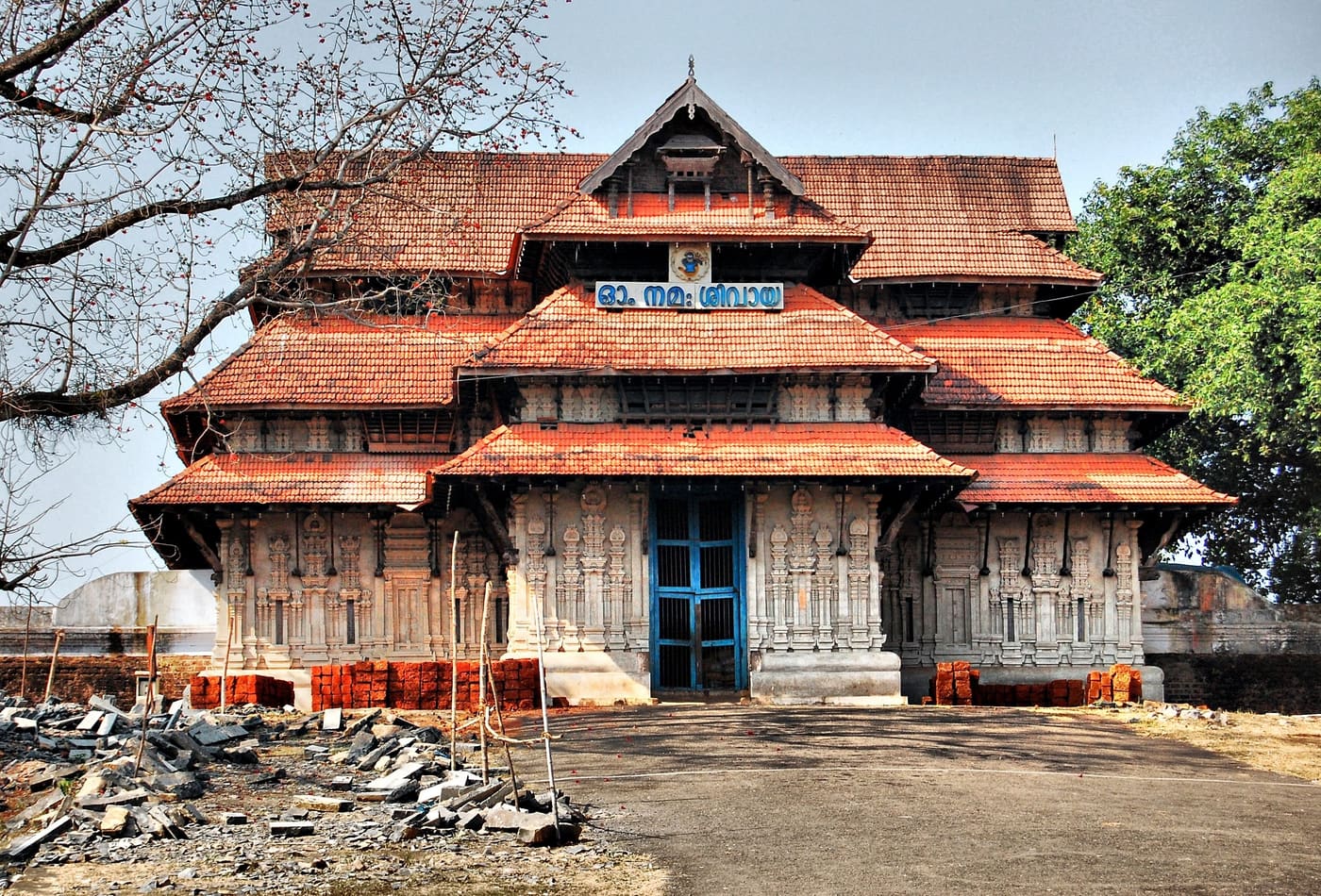
Crowning the low, wooded Vilwadri hill above the Bharathapuzha (the Nila) at Thiruvilwamala, the Sree Vilwadrinatha Temple is one of Kerala’s most distinctive Rama shrines — a place where, by tradition, both Sree Rama and his brother Lakshmana are enshrined and worshipped together as principal deities. It is best known beyond its walls for the Punarjani Noozhal, an arduous once-a-year rite of crawling through a natural rock tunnel that devotees believe washes away sin and offers a symbolic rebirth.
The story of Vilwadrinatha Temple
Thiruvilwamala sits in the eastern reaches of Thrissur district, close to the Palakkad border, where the broad sandy sweep of the Bharathapuzha — Kerala’s second-longest river, revered as the Nila — separates the district from Palakkad. The temple stands on a modest hillock said to rise around 30 metres (roughly 100 feet) above the surrounding land, so that from its precincts pilgrims look out over paddy, palm and the distant silver line of the river. The hill itself gives the shrine and the town their names: Vilwadri, the hill of the bilva (vilwa) tree, and Thiru-vilwa-mala, the sacred bilva hill.
What sets Vilwadrinatha apart from Kerala’s other great Rama temples is its dual dedication. Local tradition holds that the sanctum enshrines both Rama — worshipped here as Vilwadrinatha, the Lord of the Vilwa hill — and Lakshmana, given near-equal honour. Accounts differ on the precise arrangement, and visitors should treat the details as living tradition rather than settled fact: some descriptions speak of two adjoining sreekovils (sanctums) facing opposite ways, with a west-facing shrine for Rama and an east-facing shrine for Lakshmana; others frame it as the two brothers venerated together within the same complex. Either way, a standing image of Lakshmana as a principal deity is genuinely rare across India, and it is this that draws many devotees.
The presiding image of Rama is described in temple lore as swayambhu — self-manifested rather than sculpted by human hand — and is said to stand roughly five feet tall, carved (by tradition) from a rare dark stone locally called Pathalanjana Sila. The four-armed form is worshipped bearing the emblems of Vishnu — conch, discus, mace and lotus — reflecting the understanding of Rama as an avatar of Vishnu. Devotees should hold these material claims lightly and reverently; they are matters of faith and temple record rather than independent verification.
Vilwadrinatha is counted among the principal Rama temples of the region, spoken of alongside shrines such as Thriprayar, Kadavallur and Thiruvangad. Beyond Rama and Lakshmana, the temple complex is associated with a cluster of other deities honoured by pilgrims — among them Hanuman (fittingly, given the Ramayana connection), Ganapathi and Ayyappa — so a visit typically takes in several shrines rather than a single darshan.
The temple has weathered a long and sometimes turbulent history. Records point to early royal patronage and, later, to repeated fires in the nineteenth century, after which the present structures were rebuilt; today it is administered by the Cochin Devaswom Board. Yet for all its antiquity, the temple’s deepest fame rests less on its architecture than on the wild hillside about two kilometres away, where a natural fissure in the rock — the Punarjani cave — becomes, for one day each year, the stage for one of Kerala’s most physically demanding pilgrim rites.
For the traveller, Thiruvilwamala rewards those who come for atmosphere as much as for darshan: the climb up the hill, the river views, the old bathing tanks, and — on the right day in the Malayalam month of Vrischikam — the extraordinary sight of pilgrims queuing to crawl through the earth in search of renewal. It remains, first and last, a living place of worship, and its rhythms belong to the devout.
Legend & myth
By tradition, the temple’s origins are woven into the legend of Parashurama, the axe-wielding sage-warrior avatar of Vishnu who, in myth, raised the land of Kerala from the sea. Having slain generations of warrior-kings, Parashurama is said to have sought release from the vengeful spirits that pursued him. The legend tells that Lord Shiva gave him an image of Vishnu that Shiva himself had worshipped on Kailasa, and that Parashurama consecrated it here on the Vilwa hill so that even restless ghosts might find darshan and peace — a story that later attaches itself to the neighbouring Punarjani cave, whose ordinary days are said to belong to the spirits.
Another strand of the temple’s lore speaks of a sage — remembered as Amalaka — who performed long and severe penance on the hill, until the Lord, moved by his devotion, manifested of his own accord as the swayambhu image now worshipped as Vilwadrinatha. It is from such tellings that the tradition of Rama and Lakshmana dwelling together on the hill is drawn.
The most famous legend surrounds the Punarjani Noozhal, the crawl through the cave. Devotees hold that passing through the narrow, lightless tunnel and bathing in its five sacred waters cleanses the sins of a lifetime and grants a symbolic rebirth — punar-jani meaning, quite literally, ‘born again’. The rite is understood as the pilgrim entering the body of the earth and emerging renewed. All of this is offered here as faith and folklore, cherished by devotees, and not as historical fact.
History
Vilwadrinatha is reckoned an ancient foundation. Temple records and popular histories trace royal patronage far back — one oft-repeated account places a grant of temple land under the Chera ruler Cheraman Perumal to the Perumpadappu Swarupam in the fourth century CE — though such very early dates are best treated as tradition rather than firmly documented history. What is clearer is that the shrine has long been a significant Vaishnava centre in the Nila valley.
The temple’s defining feature is its dual enshrinement of Rama and Lakshmana as principal deities — a rarity in Kerala and, indeed, across India, where independent standing images of Lakshmana are uncommon. Sources vary on the exact spatial arrangement — whether two opposed sanctums (a west-facing Rama and an east-facing Lakshmana) or the brothers honoured together within one complex — and travellers should regard the specifics as devotional tradition. The Rama image is revered as swayambhu and, by tradition, hewn from the rare Pathalanjana Sila stone.
Set on the Vilwadri hill above the Bharathapuzha, the temple’s sanctity is inseparable from its landscape. The river, held sacred as the Nila, flows a few kilometres to the north, and the hillside carries a scatter of sacred tanks and the celebrated Punarjani cave a couple of kilometres to the south-east — so the ‘temple’ is really a sacred hill, its shrines, steps and waters spread across the slope.
The Punarjani Noozhal is the temple’s most storied rite. The cave is described as a natural tunnel around 150 metres long threading a rocky cliff; the passage forces pilgrims to walk, then stoop, then sit, then crawl through stretches with little air or light, bathing in a sequence of five theerthams — remembered by such names as Ganapathi Theertham, Papanasini, Pathala Theertham, Ambu Theertham and Kombu Theertham — before and after the ordeal. By long tradition the cave is opened for this rite only once a year, on Guruvayur Ekadasi in the month of Vrischikam, and only men undertake the crawl; on all other days it is said to belong to the spirits.
The temple has not survived unscathed: nineteenth-century fires are recorded, after which the shrine was rebuilt, giving much of the present fabric a later date. It is today maintained by the Cochin Devaswom Board and remains an active pilgrimage centre, drawing its largest crowds around Ekadasi and the annual utsavam. Where dates, measurements and attributions are concerned, pilgrims and travellers alike should verify current specifics locally, as traditions and published accounts do not always agree.
Why visit
It is one of very few temples anywhere to enshrine both Rama and Lakshmana as principal deities — worshipped here as Vilwadrinatha — making a darshan meaningful for anyone drawn to the Ramayana tradition.
The setting is quietly spectacular: a hilltop shrine on the Vilwadri hill with long views over the Bharathapuzha (the Nila) valley, best savoured on the climb up the temple steps.
The Punarjani cave and the once-a-year Noozhal rite give the place a mystique unmatched among Kerala temples — even outside Ekadasi you can walk the hillside and take in the setting where the ritual unfolds.
It is steeped in layered legend — Parashurama, the sage Amalaka, the swayambhu Rama image and the ‘born-again’ symbolism of the cave — rewarding travellers who enjoy places thick with story.
As one of the region’s major Rama temples, it pairs naturally with a wider pilgrimage circuit and with the riverside landscapes of the Nila for those exploring eastern Thrissur and the Palakkad border.
Away from Kerala’s busiest temple towns, Thiruvilwamala offers an unhurried, traditional atmosphere and a genuine sense of a living hill-shrine rather than a crowded monument.