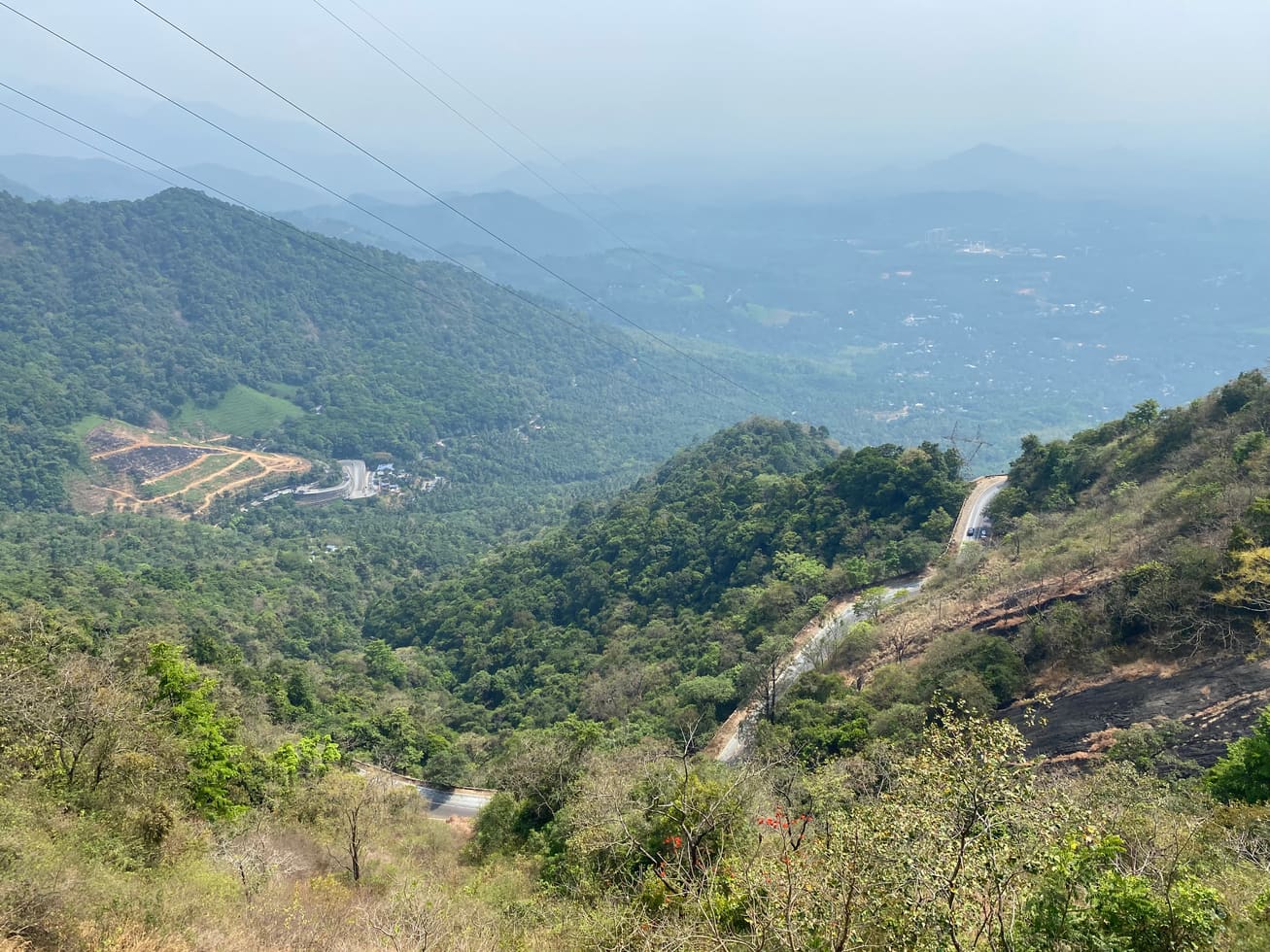
Climb through tea gardens and silver grassland to a lake shaped like a perfect heart, cupped in the flank of Wayanad’s highest mountain.
The story of Chembra Peak trek
The Chembra Peak trek begins where the plantations end — at the Forest Department check-post above Meppadi, roughly 8 km south of Kalpetta, where a mandatory guide checks your permit before the climb. The first stretch is deceptively gentle, a red-earth path threading between emerald tea bushes and the odd silver-oak shade tree, with the whole Meppadi valley opening up behind you. Then the plantation gives way to open grassland and the gradient bites. This is the Western Ghats stripped bare — rolling ridges of montane grass broken by dark pockets of shola forest, the kind of high, wind-scoured country that feels a world away from the palm-fringed Kerala of the coast.
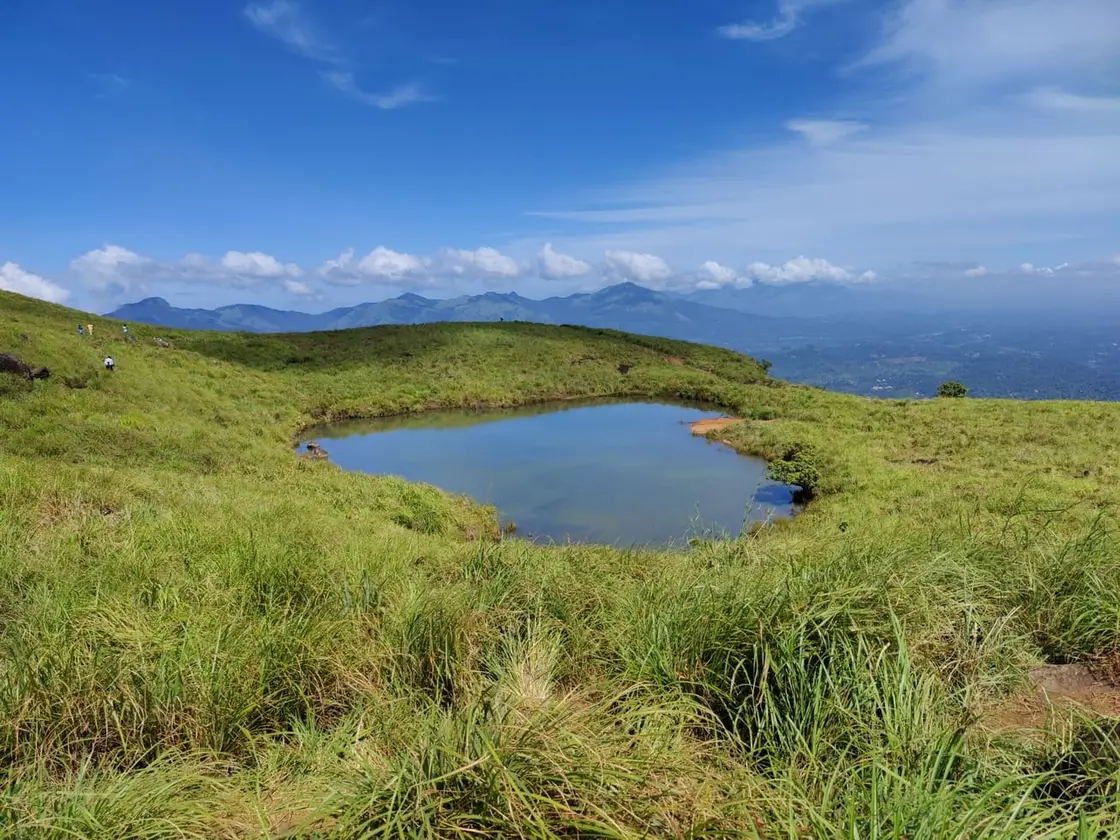
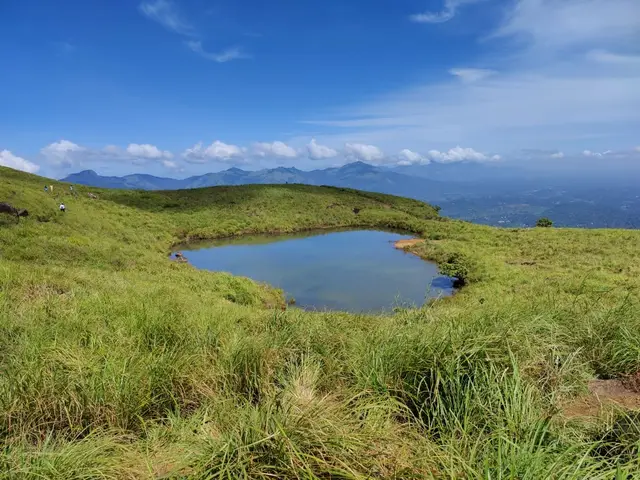
The reward that draws most trekkers is Hridaya Thadakam — the heart-shaped lake — a small natural tarn sitting in a fold of the mountain a little over halfway up, at around 1,650 m. Seen from the right angle on the slope above it, its outline is astonishingly, almost improbably, cardiac: two curved lobes tapering to a point, ringed by grass. Local tradition holds that it never runs dry, even at the height of the Wayanad summer, and it has become the emotional and photographic climax of the walk — a place couples come to, and where most permits now officially end.
For those able to continue, the trail beyond the lake rears up steeply toward the summit ridge, gaining height fast over grass and rock that can be slick with mist. The final section is a genuine leg-burner, part scramble in places, with rope handholds fixed on the sharpest pitches in some seasons. It is not technical mountaineering, but it is a real, sweaty, sustained climb — expect to be humbled if you arrive unfit.
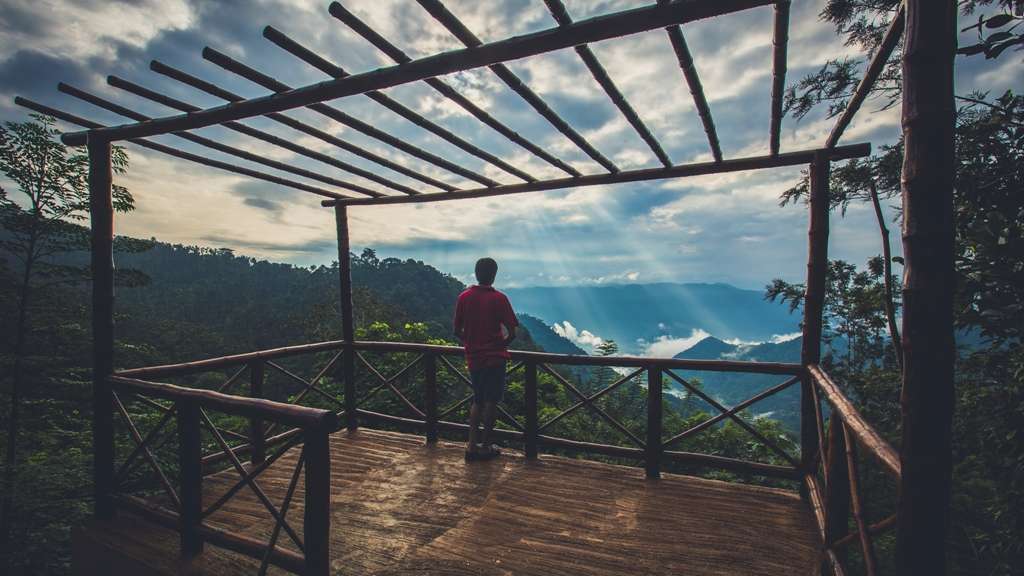
From the upper slopes, on a clear morning, the view is enormous. Chembra tops out near 2,100 m, the highest point in Wayanad and one of the loftier summits of the southern Western Ghats, and from up here the land falls away in every direction — the Nilgiri hills and Vellarimala to the east, tea estates quilting the valleys, and on the sharpest days a silver glint of distant plains. Cloud shadows race across the grassland; the wind is constant; the silence between gusts is total.
The mountain’s moods change by the hour. Mornings are usually the clearest, which is exactly why the Forest Department pushes trekkers to start early — by midday the summit can vanish into a fast-moving wall of mist, and the temperature drops sharply. The grassland that looks so soft and inviting is also tinder-dry in the hot months, which is the crux of why access here is so tightly managed.
Coming down is its own test — the grass slopes that were hard to climb are slippery to descend, and tired knees make the final tea-estate section feel longer than it was on the way up. Most trekkers are back at the check-post four to six hours after they set off, sunburnt, mud-flecked and grinning, having stood beside a heart-shaped lake on the roof of Wayanad.
Legend & myth
Local lore insists that Hridaya Thadakam, the heart-shaped lake, has never once been seen to dry up — that even through the fiercest Wayanad summers, when streams shrink and the grass turns to straw, the little heart-shaped tarn holds its water. Guides and villagers repeat the belief as a small everyday marvel, and it has helped turn the lake into a place of romance, with visiting couples treating the ‘heart that never empties’ as a quiet emblem of enduring love.
History
Chembra Peak is the crowning summit of the Wayanad plateau, rising to roughly 2,100 m (about 6,890 ft) in Vythiri Taluk of Wayanad district — the highest peak in the Wayanad hills and among the higher summits of the southern Western Ghats, adjoining the Nilgiri hills and the Vellarimala massif. Its lower slopes were folded into the great tea and cardamom plantation belt that the colonial and post-colonial economy stitched across these highlands, and the walk to the summit still begins by crossing that plantation edge above Meppadi.
Trekking on Chembra is not a free-for-all: it is organised and regulated. Access is managed by the Chempra Peak Vana Samrakshana Samithi (VSS), an eco-development committee working under the South Wayanad forest administration, with the District Tourism Promotion Council (DTPC) also involved in permits and guiding. Every trekking party must take a Forest Department guide, numbers are capped (commonly cited at around 200 trekkers per day, indicative — confirm locally), and there is a strict plastic ban and no-smoking rule on the trail.
That tight control exists for a hard reason: fire. The high grassland is dangerously flammable in the dry season, and Chembra has burned. A major forest fire in late February 2017 tore across the peak, reducing large areas of grassland and shola to ash, and fire risk has repeatedly forced the Forest Department to close or curtail the trek during the hottest, driest months. Bans imposed for fire safety have subsequently been lifted when conditions improved — access here has genuinely opened and closed over the years rather than staying constant.
In recent years the pattern has shifted toward permitting the trek only as far as the heart-shaped lake, with the final push to the true summit restricted — variously attributed to fire risk and to wildlife movement on the upper slopes. The catastrophic Wayanad landslides of 2024 in the wider Meppadi–Mundakkai–Chooralmala area added further disruption and safety review across the region. Because of all this, the exact endpoint permitted (heart-lake versus full summit) and whether the trek is open at all can change season to season.
The practical upshot for any traveller: treat Chembra’s access status as fluid. It is entirely realistic that you will be allowed only up to Hridaya Thadakam, or that the trek is closed for fire season or post-disaster review when you arrive. Confirm the current rules directly with the Meppadi Forest Office / DTPC Wayanad before you travel, and build a flexible day around the answer.
Why visit
Stand beside Hridaya Thadakam, the famous heart-shaped lake said never to dry up.
Summit — or lake-top — views over Wayanad’s highest ground and the wider Western Ghats.
A genuine, sweat-earned grassland trek, not a viewpoint you drive to.
A photogenic start through working tea estates above Meppadi.
Regulated, guided trekking with a real wilderness feel and a daily cap on numbers.
Cool, misty highland air a world away from lowland Kerala.