The story
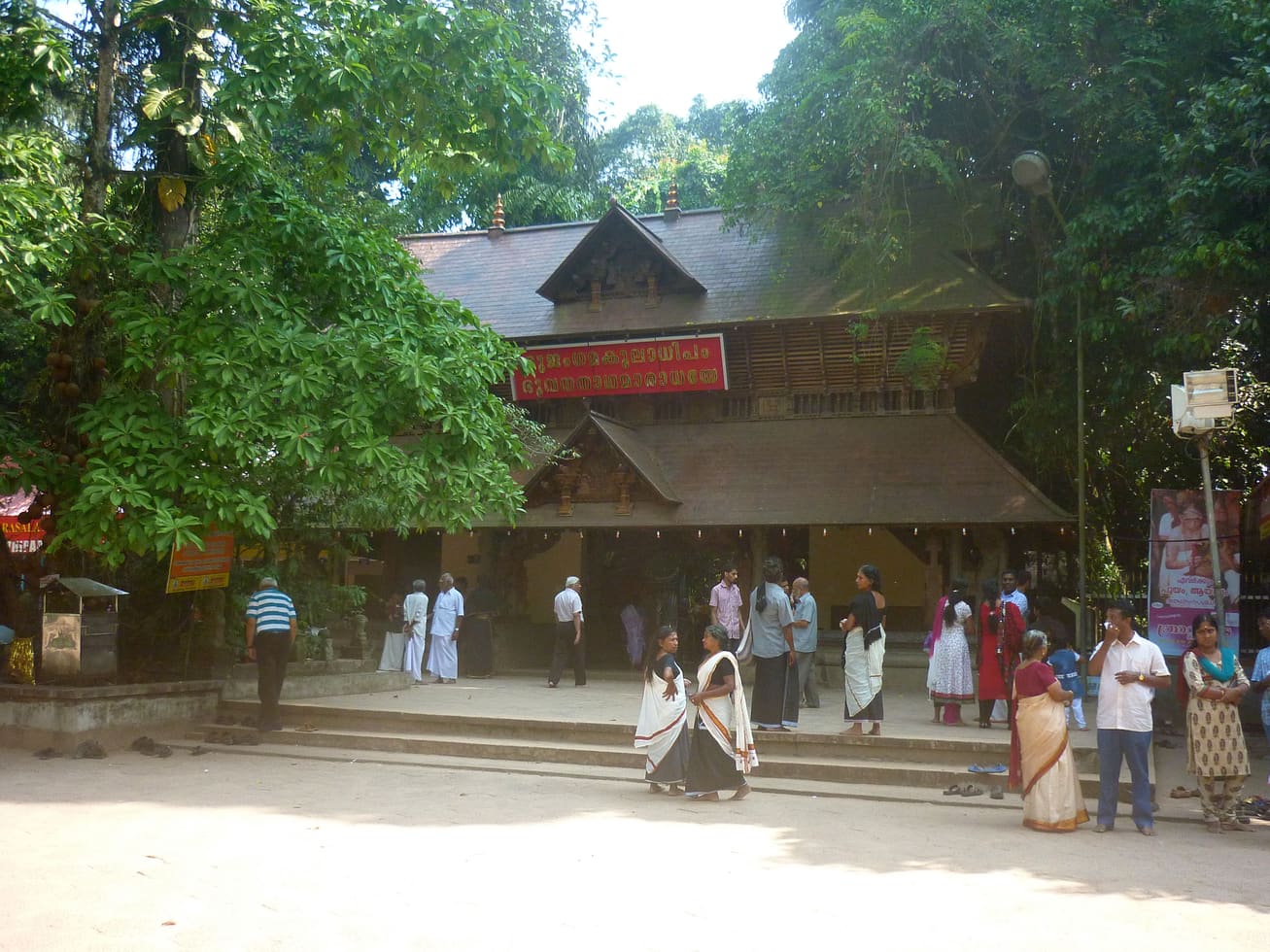
Rising from the paddy-flat heart of Onattukara near Mavelikkara, the Chettikulangara Sree Bhagavathy Temple is reckoned among the most renowned and richest Devi shrines in Kerala — a place where the Goddess is worshipped in three shifting faces through a single day, and where, once a year, whole villages raise towering horse and chariot edifices taller than the trees to lay before her.
The story of Chettikulangara Devi Temple
Chettikulangara sits about four kilometres west of Mavelikkara town in Alappuzha district, on the old Kayamkulam–Thiruvalla road, ringed by the thirteen karas (village territories) that have served the Goddess for centuries. To pilgrims across central Travancore she is simply Amma — the mother — and this is one of the great Bhagavathy temples of the coast, spoken of in the same breath as Kodungallur and Chottanikkara.
The presiding deity is Sree Bhadrakali, the fierce protective form of the Goddess born, in the tradition, from the third eye of Shiva to destroy the demon Daruka. Yet at Chettikulangara she is never worshipped as a single fixed face. The temple is famous for the belief that the Goddess reveals herself in three aspects across the day — as Maha Saraswati, giver of learning, in the morning; as Maha Lakshmi, giver of abundance, at noon; and as Maha Kali, the fierce destroyer of evil, in the evening (indicative tradition — confirm locally). Devotees time their prayers to the boon they seek.
Because she is honoured as goddess of knowledge, wealth and power in turn, students, householders and those seeking protection all find their hour here. Traditional offerings and the lighting of lamps fill the sanctum, and the temple’s reputation as one of the wealthiest under the Travancore Devaswom Board — second in income only to Sabarimala, by common repute (indicative — confirm locally) — speaks to the depth of devotion it commands.
The temple’s true fame, though, is its festival life. For one incandescent night each year around the Kumbha Bharani, the surrounding fields fill with the Kettukazhcha — gigantic horse effigies called Kuthira and pagoda-like temple cars called Theru, built by the karas over weeks and raised to dizzying heights of cloth, timber and gilt. Nothing else in Kerala looks quite like it.
Around this spectacle turns a whole calendar of ritual: the months-long Parayeduppu when the Goddess tours her lands, the ancient Kuthiyottam vow performed by young boys, the thirteen-day Ethirelpu festival, and the closing Aswathi procession that carries her, in belief, back towards her mother-shrine at Kodungallur. Chettikulangara is a temple that lives loudest not inside its walls but out in the fields and lanes of its villages.
Set amid green Onattukara paddy and coconut groves, easy to reach from Mavelikkara, Haripad and Kayamkulam, it rewards the ordinary-day visitor with calm and the festival-season visitor with one of the most staggering folk spectacles in South India.
Legend & myth
Legend traces the Goddess of Chettikulangara back to Kodungallur, the great mother-shrine of Kerala’s Bhagavathy worship. In the telling handed down here, the chieftains and people of these thirteen karas longed for the Goddess’s protection and set out to seek the blessings of Kodungallur Bhagavathy, praying that her power might come to dwell among them (recounted as legend).
One version speaks of a boatman who ferried a mysterious elderly woman across the Karippuzha river, only for her to vanish on the far bank. In another strand of the same story a Brahmin household, busy preparing the midday meal, beheld an old lady appear and then dissolve into thin air in a burst of bright light — a sign, the elders held, that the Goddess herself had chosen to settle in their midst. From that presence, the tradition says, the shrine at Chettikulangara grew.
The belief that the Devi shows three faces through the day — Saraswati at dawn, Lakshmi at noon, Kali at dusk — is woven into this same devotional imagination: that the single Goddess contains creation, sustenance and destruction, and turns each face to her children as the hours turn. These accounts are cherished sacred legend rather than documented history, and are best received in that spirit.
History
By tradition the temple is around twelve hundred years old, and one account holds that it was consecrated by the sage Padmapadacharya on the Uthrittathi day of the Makara month in 823 CE — a date honoured in local memory though debated by scholars (indicative — confirm locally).
The visible shrine is younger than the legend. Historians place the present temple structure at roughly four and a half to five centuries old, with the main hall understood to have been rebuilt around 1540 CE (indicative — confirm locally). What endures unbroken, more than any single wall, is the institution of the thirteen karas — the village territories, the oldest four clustered nearest the sanctum, that between them shoulder the temple’s ritual and its festivals.
That kara system is the engine of Chettikulangara’s civic and religious life. Each kara competes, generation after generation, to build the grandest Kuthira or Theru and to mount the finest processions — a rivalry that has kept craft traditions of bamboo-lashing, timber-framing and cloth-and-tinsel decoration alive across centuries when such folk arts have faded elsewhere.
Today the temple is administered by the Travancore Devaswom Board, the statutory body that manages many of the region’s major shrines, and it stands among the board’s highest revenue-earning temples. Its wealth, its scale of festival and its living community structure together make it not merely a place of worship but a repository of Onattukara’s cultural heritage.
Successive renovations, the steady growth of the Bharani and Kettukazhcha as a mass pilgrimage draw, and the endurance of the Kuthiyottam vow have carried Chettikulangara from a village shrine to one of the best-known Devi temples in Kerala, without ever losing its rootedness in the thirteen karas that made it.
Why visit
To stand before a Goddess worshipped in three forms in a single day — Saraswati, Lakshmi and Kali — a devotional idea unusual even among Kerala’s many Bhagavathy temples, and to time your own prayer to the face of the Devi you seek.
To witness the Kettukazhcha, if you can come at Kumbha Bharani: towering Kuthira horse-effigies and Theru temple-cars rising many storeys over the paddy fields, built and pulled by whole villages — one of the most breathtaking folk spectacles anywhere in South India.
To feel the intensity of the Kuthiyottam vow and the days of Parayeduppu, Ethirelpu and the Aswathi farewell procession, when the temple’s life spills out across lanes, fields and thirteen villages in a way few shrines still manage.
To visit one of the richest and most renowned Devi temples under the Travancore Devaswom Board, second in repute only to Sabarimala, yet set in green, unhurried Onattukara countryside rather than a crowded pilgrim town.
To pair it easily with the wider Haripad–Mannarasala circuit — the great Nagaraja serpent temple at Mannarasala and the Subrahmanya temple at Haripad lie within an easy drive, making a rich half-day of Alappuzha’s inland shrines.
To experience a temple where centuries-old craft traditions of building the giant effigies survive as a living, competitive village art, not a museum piece — heritage you can watch being made.