Krishnapuram Palace

Restored 18th-century Travancore palace at Kayamkulam, home to the huge Gajendra Moksha mural. This heritage guide is organized from Haripad and Mannarasala in Alappuzha district, with practical planning for routes, timing, nearby stays, food, operators and direct local inventory. Use it to compare what to see, how long to spend, when to go and which heritage stays, local guides, restaurants, shops, wellness options, transport and visitor services should be verified around Krishnapuram Palace.

Krishnapuram Palace, Haripad and Mannarasala
Practical guide

Plan Krishnapuram Palace

Typeheritage
Nearest baseHaripad and Mannarasala
Best timeNovember to February and early mornings are best for walking
Time needed1 to 3 hours
EntryA small entry ticket, commonly cited at roughly ₹25 for adults and less for children, with reduced or free entry sometimes applying for young children (indicative — confirm locally).
Nearest town/baseHaripad and Mannarasala
DistrictAlappuzha
Place typeheritage
Time needed1 to 3 hours.

Restored 18th-century Travancore palace at Kayamkulam, home to the huge Gajendra Moksha mural. This heritage guide is organized from Haripad and Mannarasala in Alappuzha district, with practical planning for routes, timing, nearby stays, food, operators and direct local inventory. Use it to compare what to see, how long to spend, when to go and which heritage stays, local guides, restaurants, shops, wellness options, transport and visitor services should be verified around Krishnapuram Palace.

Krishnapuram Palace belongs under Haripad and Mannarasala, one of the practical travel bases in Alappuzha district. Use Haripad and Mannarasala for stays, food, local transport and operators, then plan this place as a focused stop rather than an isolated pin.

The story

Behind a laterite gateway near Kayamkulam stands an 18th-century Travancore palace whose stairwell holds Kerala’s largest single-panel mural — a rescued elephant caught mid-prayer to a descending god.

The story of Krishnapuram Palace

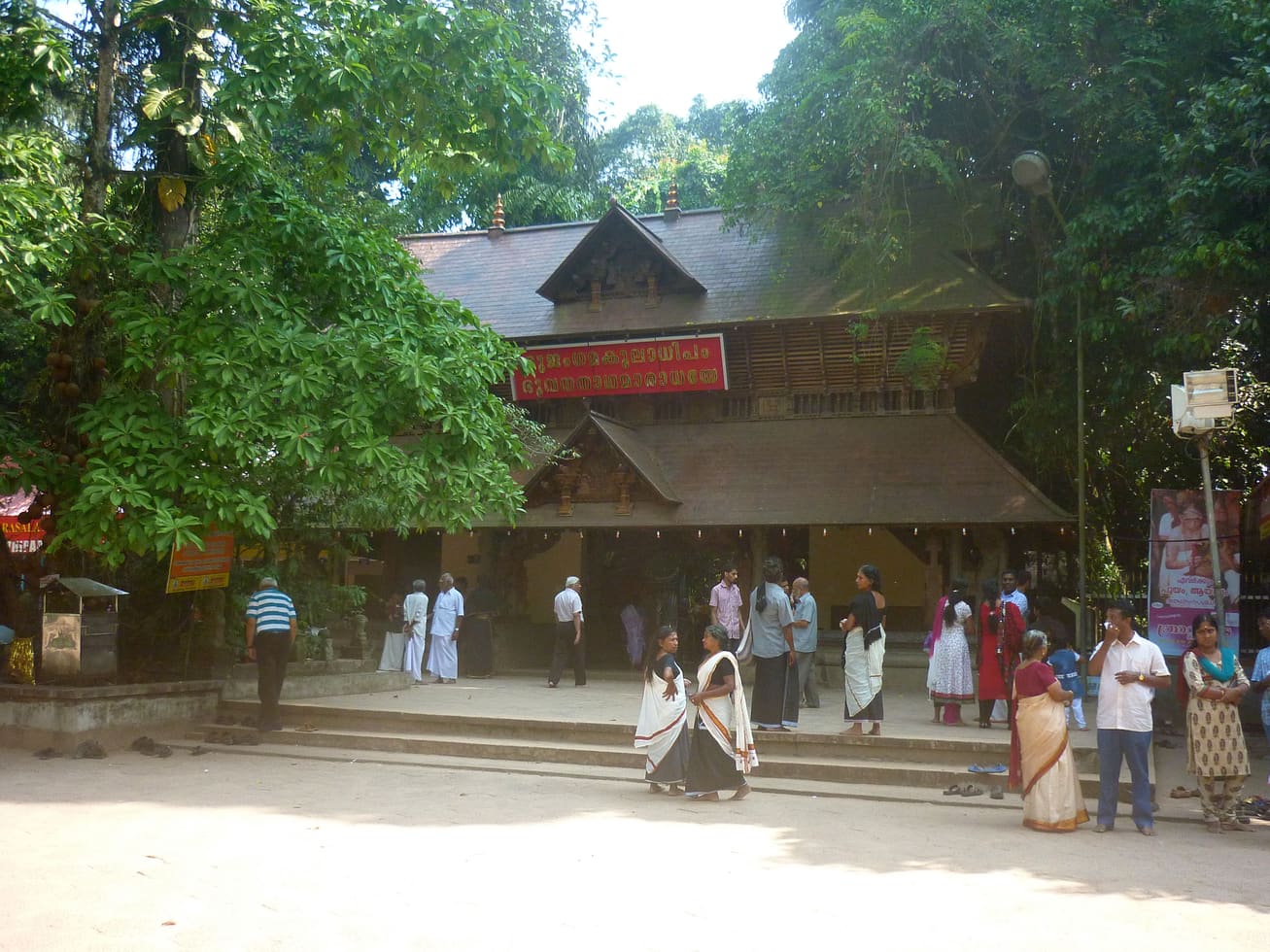
Krishnapuram Palace sits just off the coastal highway near Kayamkulam, a short hop from Haripad in Alappuzha district, and it rewards the traveller who slows down for it. From the road it reads as a modest tiled Kerala mansion, but step through the gate and you enter a two-storeyed maze of gabled roofs, low doorways, narrow corridors and dormer windows — the same austere, timber-and-laterite idiom that makes the far more famous Padmanabhapuram Palace so atmospheric. The building is built low and cool, teak and rosewood underfoot, Mangalore tiles overhead, laid out around courtyards that channel light and monsoon breeze in equal measure.

The palace is best known today as an archaeological museum run by Kerala’s Department of Archaeology, and its single most celebrated possession is the Gajendra Moksham mural. Painted directly onto a wall beside the staircase, it is widely described as the largest single-band mural painting so far discovered in Kerala — roughly fourteen feet by eleven, a little over 150 square feet (indicative — confirm locally). Up close it is a dense, glowing tangle of ochre, green and earth-red pigment: the great elephant king at the centre, Vishnu sweeping down on Garuda to save him, and a crowd of lesser gods, sages and forest creatures pressing in at the edges.

By tradition the mural was set here deliberately, near the tank, so that the Travancore kings could offer worship to the deity after their morning bath — art and ritual folded into the architecture rather than hung on a wall as decoration. That intimacy is part of the visit: you do not view the Gajendra Moksham across a rope in a grand hall, you meet it in a dim, human-scaled stairwell where the paint has survived two and a half centuries of coastal humidity.

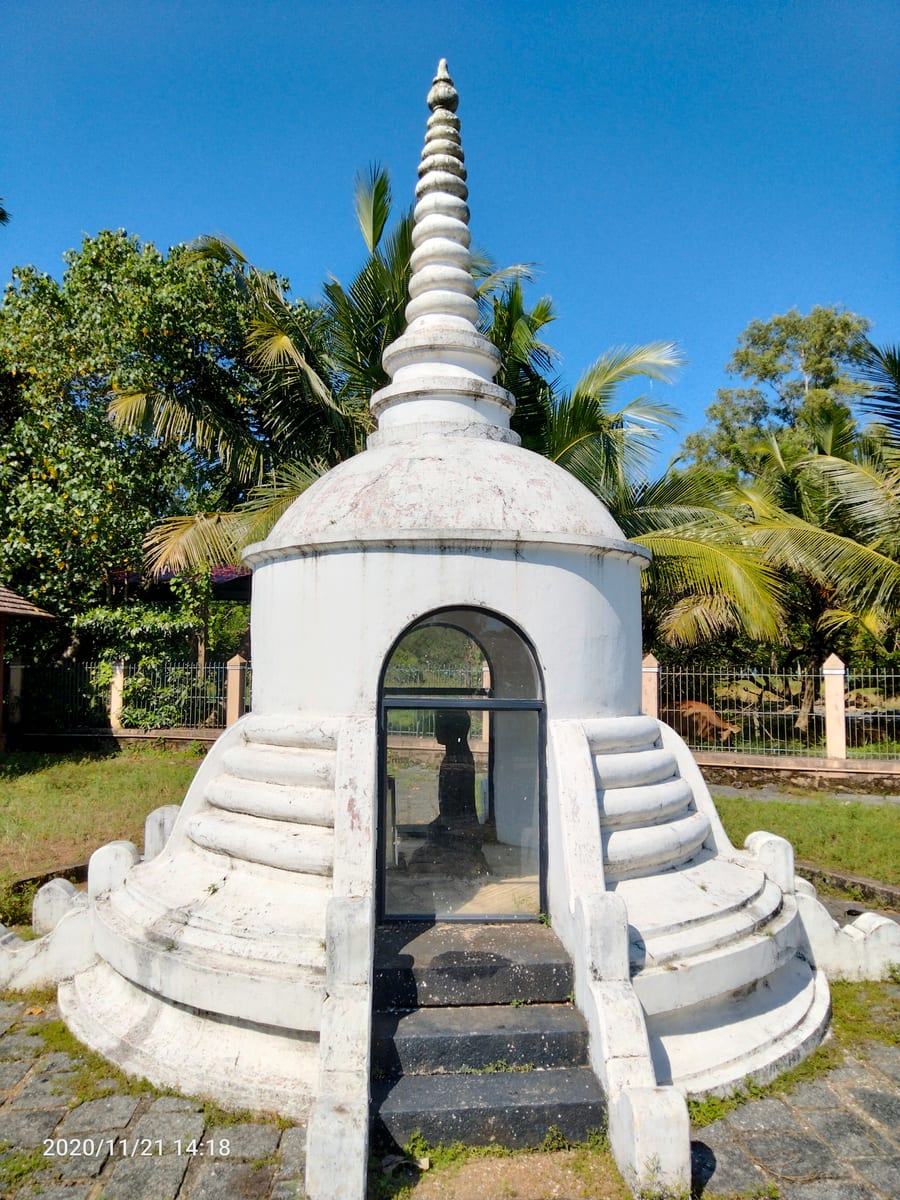
Beyond the mural, the rooms and grounds are a genuine treasure-box. There is a serene tenth-century stone Buddha, carved from a single block and housed in its own small mandapam — one of a handful of early Buddhist images recovered from around Alappuzha, and a reminder of a Buddhist past most visitors to Kerala never hear about. There is the celebrated Kayamkulam Vaal, a distinctive double-edged sword tied to the Kayamkulam rajas; an old stone horse trough; ceremonial vessels; antique bronzes and Panchaloha figures; coins; megalithic relics; and stone and wood sculpture gathered from across the region.

The garden itself is a quiet pleasure. A stepped bathing tank fed by a spring sits within the compound, its stone steps descending into still green water, and the surrounding lawns and old trees make the grounds a cool place to linger after the museum rooms. It is the kind of site where twenty minutes with a good guide turns an unassuming building into a layered story of dynasties, faiths and craftsmanship.

For a place of such historical weight, Krishnapuram Palace remains refreshingly uncrowded — a detour more than a set-piece, easily paired with the Mannarasala serpent temple, the temples of Haripad, or a break on the long drive between Kollam and Alappuzha. Come for the mural, but leave time for the Buddha, the sword and the tank; together they sketch the whole tangled history of this stretch of the Kerala coast.

Legend & myth

The mural takes its name from one of the best-loved stories in Hindu tradition, the Gajendra Moksha — the liberation of Gajendra, king of the elephants. Legend holds that Gajendra went down to a lake to bathe and was seized by the leg by a powerful crocodile lurking in the water. For a very long time the two struggled, neither able to win, until at last the exhausted elephant, sensing his strength failing, plucked a lotus with his trunk, raised it skyward and surrendered himself utterly to Vishnu.

By tradition, Vishnu heard the cry and came at once, riding the great bird Garuda, and with his discus he struck down the crocodile and drew Gajendra free — granting the elephant not merely rescue but moksha, release. The tale is read as a parable of total surrender: that liberation comes the moment the devotee stops relying on his own strength and calls out in complete trust. It is this instant of divine descent and deliverance that the palace mural freezes in pigment.

The palace stands near Kayamkulam, once the seat of an independent kingdom (Odanad) before Travancore’s Marthanda Varma annexed it, and local lore still gathers around relics such as the Kayamkulam Vaal, the sword linked by tradition to the Kayamkulam rajas and their fierce martial reputation. Such stories are best enjoyed as legend rather than documented history — colour woven into a place whose verified past is remarkable enough on its own.

History

The palace as it stands was raised in the 18th century by Anizham Thirunal Marthanda Varma (reigned 1729–1758), the ruler who forged the modern kingdom of Travancore. He built it after defeating and absorbing the neighbouring kingdom of Odanad, of which Kayamkulam was the centre, in the Odanad–Travancore war of the mid-1740s (indicative — confirm locally). The present structure is understood to have replaced an earlier palace on or near the site associated with the Odanad rulers.

Architecturally it belongs to the classic Kerala palace tradition and is repeatedly compared to Padmanabhapuram Palace, the grander Travancore royal seat. Both share the same vocabulary — steep gabled roofs, dormer windows, thick timber-framed doors, narrow stairways and shaded courtyards — and both were built largely of laterite, teak, rosewood and local hardwoods under tiled roofs, designed for the heat and heavy monsoons of the Malabar–Travancore coast.

The Gajendra Moksham mural is dated to the same broad period as the palace and is regarded by art historians as one of the outstanding surviving examples of Kerala’s indigenous mural tradition — the same lineage seen at temples and palaces across the region, worked in natural mineral and vegetable pigments. Its scale, filling a single band on the staircase wall, is what sets it apart and earns it the frequent description as the largest such mural yet found in Kerala.

The tenth-century Buddha image held here is historically significant in its own right. It is counted among a small group of early Buddhist sculptures unearthed in the Alappuzha region, testifying to a period when Buddhism had a real presence along the Kerala coast — long before the temples and dynasties that dominate the area’s later history.

Today the complex is maintained as a protected archaeological museum by the Government of Kerala’s Department of Archaeology, which has conserved the mural and gathered into its rooms a wide collection of coins, inscriptions, megalithic remains, sculpture in stone, wood and bronze, and everyday and ceremonial objects — turning the old royal residence into a compact record of the region’s dynastic, artistic and religious past.

Why visit

Stand before Kerala’s largest single-panel mural, the Gajendra Moksham, painted in glowing natural pigments.

Walk inside a genuine 18th-century Travancore palace built in the same style as Padmanabhapuram.

Meet a serene tenth-century stone Buddha carved from a single block — a glimpse of Kerala’s Buddhist past.

See the storied Kayamkulam Vaal sword and antique bronzes, coins and sculptures under one roof.

Wander a peaceful compound with a spring-fed stepped bathing tank and shaded old gardens.

Enjoy a rich, uncrowded heritage stop that pairs easily with Mannarasala and Haripad’s temples.

Visiting

Krishnapuram Palace — at a glance

TimingsOpen daily except Mondays (and typically national holidays); usual timings around 9.30 am to 4.30 pm, often with a short midday break (indicative — confirm locally).
Best timePleasant year-round as an indoor-and-garden site; the cooler, drier months from roughly October to February are most comfortable, while the monsoon makes the grounds lush but wet. Mornings are quietest.

Entry: A small entry ticket, commonly cited at roughly ₹25 for adults and less for children, with reduced or free entry sometimes applying for young children (indicative — confirm locally).

Photography: Still photography is usually allowed for a modest extra fee, with higher separate charges for video and for any commercial, documentary or feature-film shooting (indicative — confirm locally). Flash and tripods may be restricted around the Gajendra Moksham mural to help preserve it — check with staff.

Getting here

How to reach Krishnapuram Palace

  • ✈︎ By air The nearest airports are Thiruvananthapuram (Trivandrum) International, roughly 100 km south, and Cochin (Kochi) International, roughly 120 km north (indicative — confirm locally).
  • 🚆︎ By train Kayamkulam Junction, on the main Thiruvananthapuram–Ernakulam railway line, is the closest station, only a few kilometres away, with frequent trains up and down the coast.
  • 🚗︎ By road The palace sits just off the main coastal highway (NH66 corridor) between Kayamkulam and Haripad, well signposted and easily combined with a Kollam–Alappuzha road journey.
  • 🚌︎ By bus Frequent state and private buses on the Kollam–Kayamkulam–Alappuzha route stop near Krishnapuram; from the nearest stop it is a short autorickshaw ride or walk to the gate.
Do

Things to do

  • View the Gajendra Moksham mural beside the palace staircase.
  • See the tenth-century single-stone Buddha in its mandapam.
  • Find the Kayamkulam Vaal sword and other martial relics.
  • Browse the bronzes, Panchaloha figures, coins and inscriptions.
  • Walk down to the spring-fed stepped bathing tank in the grounds.
  • Look for the old stone horse trough and antique sculptures.
  • Relax in the shaded palace gardens after the museum rooms.

This is a compact heritage museum rather than a large palace complex — come for the mural and the antiquities, and consider hiring or joining a guide, as labelling can be limited and the history is what brings the objects alive.

What to expect

Highlights

  • Heritage experience at Krishnapuram Palace
  • Architecture, local stories and old trade/cultural routes
  • Good fit for guided walks and nearby cafes/shops
Getting there

How to visit

  • Base yourself in Haripad and Mannarasala or a nearby town in Alappuzha, then confirm the last-mile route locally before leaving.
  • Walkable heritage areas are best done slowly; combine nearby streets, museums, markets and food stops.
  • If the visit depends on forest, temple, boat, ferry, weather or seasonal access, check the official/local rule on the day before travel.

Distance by road

  • Kochi55 km
  • Thiruvananthapuram154 km
  • Kozhikode226 km
  • Coimbatore235 km
  • Madurai281 km

Road km to Alappuzha; ghat roads and traffic vary — allow extra.

Timing

Best time

November to February and early mornings are best for walking; avoid midday heat where possible.

Weather in Krishnapuram PalaceSeasonal guide

Live forecast loads in your browser.

Visitor notes

  • Use a local guide when the value is in stories rather than just the building.
  • Check closure days for museums or protected monuments nearby.
Safety

Good to know

  • Watch traffic on narrow heritage streets.
  • Keep valuables close in crowded markets.
On the map

Where Krishnapuram Palace is

Stay · eat · do · rent · see · shop

Stays, food & things to do near Krishnapuram Palace

Verified hotels, homestays, restaurants, experiences, sights, shops and rentals around Krishnapuram Palace — commission-free, with direct contact. Filter by what you need.

Mannarasala Sree Nagaraja Temple Official — Official temple source in Haripad and Mannarasala
Verified
Official temple source · Haripad and Mannarasala
Mannarasala Sree Nagaraja Temple Official

see option in Haripad and Mannarasala: Official Mannarasala Sree Nagaraja Temple record for darshan, rituals and temple-contact planning. Key details: Mannarasala P.O., Haripad, Alappuzha, Kerala 690514 · Price range: Check current temple rules locally · Amenities: Mannarasala, Haripad, Nagaraja temple. Use Mannarasala Sree Nagaraja Temple Official as a see option in Haripad and Mannarasala, Ernakulam, kerala, India. plan visit duration, crowd timing and transport links.

View guide
D
Drivequix Rent a car & Bike
Vehicle rental
Top pick Verified
Self-drive car rental · Haripad and Mannarasala
Drivequix Rent a car & Bike
5.0 (103)

Self-drive car rental in haripad and mannarasala — confirm vehicles, rates, documents and deposit directly. (vehicle rental option in Haripad and Mannarasala)

Commission-freeView details
R
ROAMSPACE RENT A CAR AND BIKE
Vehicle rental
Top pick Verified
Self-drive car rental · Haripad and Mannarasala
ROAMSPACE RENT A CAR AND BIKE
4.9 (29)

Self-drive car rental in haripad and mannarasala — confirm vehicles, rates, documents and deposit directly. (vehicle rental option in Haripad and Mannarasala)

Commission-freeView details
R
ROAMSPACE CAR AND BIKE RENTAL - VAZHUVADI,CHENGANNUR ,THIRUVALLA,
Vehicle rental
Top pick Verified
Bike & scooter rental · Haripad and Mannarasala
ROAMSPACE CAR AND BIKE RENTAL - VAZHUVADI,CHENGANNUR ,THIRUVALLA,
4.9 (28)

Bike & scooter rental in haripad and mannarasala — confirm vehicles, rates, documents and deposit directly. (vehicle rental option in Haripad and Mannarasala)

Commission-freeView details
R
Rental Logics Kerala – Rent a bike in Thiruvalla | Royal-Enfiled Bikes & Scooters Rental
Vehicle rental
Top pick Verified
Bike & scooter rental · Haripad and Mannarasala
Rental Logics Kerala – Rent a bike in Thiruvalla | Royal-Enfiled Bikes & Scooters Rental
4.6 (10)

Bike & scooter rental in haripad and mannarasala — confirm vehicles, rates, documents and deposit directly. (vehicle rental option in Haripad and Mannarasala)

Commission-freeView details
K
KSRTC Haripad Bus Station
Things to do
Top pick Verified
Official transport support · Haripad and Mannarasala
KSRTC Haripad Bus Station

do option in Haripad and Mannarasala: KSRTC Haripad Bus Station is a Official transport support option for do planning in Haripad and Mannarasala, Ernakulam, kerala, India. Use KSRTC Haripad Bus Station as a do option in Haripad and Mannarasala, Ernakulam, kerala, India. book timing, permits and local support before heading out. Key details: Office of the Assistant Transport Officer, KSRTC Haripad, Haripad, Kerala 690514 · Price range: Contact direct / check current rates · Amenities: do, Official transport support, KSRTC Haripad Bus Station.

Commission-freeView details
S
Sanchari by Chef Pillai Haripad
Where to eat
Verified
Kerala restaurant · Haripad and Mannarasala
Sanchari by Chef Pillai Haripad

eat option in Haripad and Mannarasala: Chef Pillai-linked multi-cuisine restaurant in Haripad for Mannarasala temple and town meals. Key details: M Lal Cineplex Complex, Madhava Junction Road, Haripad, Alappuzha, Kerala 690514 · Price range: Contact direct / check current rates · Amenities: eat, Kerala restaurant, Sanchari by Chef Pillai Haripad. Use Sanchari by Chef Pillai Haripad as a eat option in Haripad and Mannarasala, Ernakulam, kerala, India. compare menus, pricing and location against your route.

Commission-freeView details
L
Leela's 7th Heaven Resort Haripad
Place to stay
Verified
Resort and activity stay · Haripad and Mannarasala
Leela's 7th Heaven Resort Haripad

stay option in Haripad and Mannarasala: Direct-source Erickav/Haripad resort with stay, kayaking, fishing and booking-contact evidence. Key details: Erickav, Haripad, Alappuzha, Kerala 690516 · Price range: Contact direct · Amenities: Haripad, Erickav, Resort. Use Leela's 7th Heaven Resort Haripad as a stay option in Haripad and Mannarasala, Ernakulam, kerala, India. book your stay, transport and nearby food stops.

Commission-freeView details
M
Mandaram Guest House Mannarasala
Place to stay
Verified
Temple guest house · Haripad and Mannarasala
Mandaram Guest House Mannarasala

stay option in Haripad and Mannarasala: Mandaram Guest House Mannarasala is a Temple guest house option for stay planning in Haripad and Mannarasala, Ernakulam, kerala, India. Use Mandaram Guest House Mannarasala as a stay option in Haripad and Mannarasala, Ernakulam, kerala, India. book your stay, transport and nearby food stops. Key details: Mannarasala P.O., Haripad, Alappuzha, Kerala 690514 · Price range: Contact temple guest house · Amenities: Mannarasala, Guest house, Pilgrimage stay.

Commission-freeView details

Roampedia is commission-free — own or know a stay, eatery, guide or shop near Krishnapuram Palace? List it and it appears here once verified.

Add a nearby business
Nearby

What’s near Krishnapuram Palace

Thottappally Beach
beachThottappally Beach 23.2 km · ~39 min by cab
Edathua Church
churchEdathua Church 24.4 km · ~41 min by cab
Karumadikuttan
heritageKarumadikuttan 29.0 km · ~48 min by cab
Good to know

Krishnapuram Palace — frequently asked

When is the best time to visit Krishnapuram Palace?

November to February and early mornings are best for walking; avoid midday heat where possible.

What are the entry fee and timings at Krishnapuram Palace?

Entry: A small entry ticket, commonly cited at roughly ₹25 for adults and less for children, with reduced or free entry sometimes applying for young children (indicative — confirm locally).. Timings: Open daily except Mondays (and typically national holidays); usual timings around 9.30 am to 4.30 pm, often with a short midday break (indicative — confirm locally).. Fees and timings are indicative — confirm on site before you travel.

How do I reach Krishnapuram Palace?

Base yourself in Haripad and Mannarasala or a nearby town in Alappuzha, then confirm the last-mile route locally before leaving. Walkable heritage areas are best done slowly; combine nearby streets, museums, markets and food stops. If the visit depends on forest, temple, boat, ferry, weather or seasonal access, check the official/local rule on the day before travel.

How much time do I need for Krishnapuram Palace?

1 to 3 hours.

What else is near Krishnapuram Palace?

Nearby you can pair Chettikulangara Devi Temple (8.6 km), Haripad Sree Subramanya Swamy Temple (16.0 km), Mannarasala Sree Nagaraja Temple (17.0 km), Thottappally Beach (23.2 km).

What should I know before visiting Krishnapuram Palace?

Watch traffic on narrow heritage streets. Keep valuables close in crowded markets.

Image credits
  • Krishnapuram Palace:Noeljoe85 · CC BY-SA 3.0