On a low laterite rise above the town of Kanhangad, a cluster of squat, rounded turrets breaks the skyline — the unmistakable silhouette of Hosdurg Fort. Where most South Indian forts bristle with sharp angular ramparts, this one is a study in circles: a ring of stout round bastions, built to watch the coast rather than to storm it. Its name means simply “new fort”, and it belongs to a chain of laterite strongholds the Bedanore (Ikkeri/Keladi) Nayakas raised along this stretch of the Kasaragod coast — kin in stone to the mighty Bekal Fort a short drive north. Just beside it, on a green hillock, sits the celebrated Nithyanandashram with its labyrinth of man-made caves — so a single short walk here braids military history with living spirituality.
The story of Hosdurg Fort
The first thing that strikes you at Hosdurg is its shape. Instead of the star-angled bastions and pointed salients that define so many later forts, Hosdurg is dominated by rounded, drum-like observation turrets — a distinctive, almost unusual fort form on this coast. Local accounts describe a square watchtower flanked by a cluster of round bastions (often counted as around seven — indicative, confirm locally), positioned so that their fields of view, and their fields of fire, overlapped. Seen from a distance, the round bastion gives the fort a curiously gentle, wave-worn look, as though the sea itself had rounded off its edges.
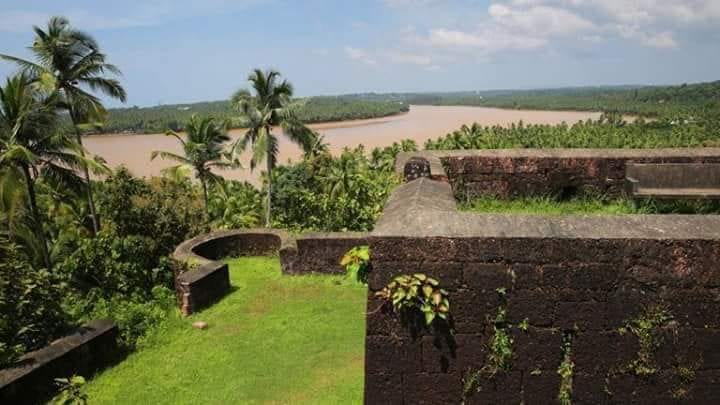
The whole structure is a hymn to laterite — the rusty, iron-rich stone of the Malabar coast that can be cut soft and wet from the ground and then hardens in the sun. The Nayaka builders dressed their laterite blocks finely and set them, by most accounts, in lime mortar, the same technique that raised Bekal and Kumbla forts nearby. Run a hand along the walls and you read the region in the stone: the porous, honeycombed texture, the warm ochre-to-purple hues, the way monsoon rain has stained and softened every course over three centuries.
Hosdurg sat in a shrewd strategic position. From its modest height the garrison could keep an eye on the coastal trade routes and the flat country inland, part of a network of forts through which the Bedanore Nayakas policed their newly won territory in what is now northern Kerala. This was never a lonely sentinel; it was one link in a coastal defensive chain, close enough to signal and support its neighbours, guarding the approaches to a coast thick with pepper, timber and the small ports that shipped them.
Time has been frank with Hosdurg. The fort is today largely in ruins, and its interior has been given over to the ordinary business of the town — parts of the grounds house a school and a few government offices (indicative — confirm locally), so the place hums with everyday life rather than solemn preservation. That candour is part of its charm: this is a working, lived-in ruin, not a ticketed monument, and you are as likely to share the ramparts with schoolchildren and evening walkers as with fellow travellers.
The real magic is the pairing. Step out of the fort and within minutes you are at the foot of the Nithyanandashram, founded here by the revered avadhuta saint Swami Nithyananda (Bhagavan Nithyananda) in the first half of the 20th century. He is remembered for having carved — with the help of local labourers — a remarkable series of some forty-five man-made caves (guha) into the hill slope, a feat still spoken of as an engineering marvel. Pilgrims arrive from across India and beyond, so the air around the fort carries both the silence of old stone and the low murmur of devotion.
Come at the end of the day and Hosdurg gives you its best face. Climb onto a bastion as the light goes amber, watch the Arabian Sea haze soften the western horizon, and the round turrets seem to lean into the breeze. It is an unhurried, slightly melancholy place — a fort that never won great battles, kept its watch quietly, and now shares its hill with a saint’s caves and a town that has simply grown up around it.
History
Hosdurg Fort is generally attributed to Somashekara Nayaka of the Ikkeri (also called Bedanore or Keladi) Nayaka dynasty, and dated broadly to the 17th–18th century — most accounts place its construction in roughly the early 18th century (dating indicative — confirm locally, as sources vary). The Nayakas raised it as they extended their authority down this coast, consolidating control over the north Malabar country after pushing against the older Kolathiri (Kolathunad) chieftains who had long held sway here.
The fort belongs to a family of Bedanore/Ikkeri military works strung along the Kasaragod coast. Its round bastions and watchtower share a clear architectural kinship with the far larger Bekal Fort and with Kumbla (Chandragiri and its neighbours), all built in dressed laterite in a comparable style and period. Reading them together, Hosdurg makes most sense not as a stand-alone castle but as one node in a coordinated coastal defence system engineered by the same dynasty.
Political control of the coast changed hands violently in the later 18th century. The forces of the Kingdom of Mysore under Hyder Ali swept over the region (accounts commonly cite around 1763 — indicative, confirm locally), bringing this and neighbouring forts under Mysore’s ambit, as was the fate of much of Malabar in that era of Hyder Ali and later Tipu Sultan.
With the defeat of Mysore at the close of the century (around 1799 — indicative), the English East India Company took over the coast, and Hosdurg passed into British hands. The Company is said to have used the fort for a time as a local administrative post before its military importance faded and the structure slid into decline through the mid-19th century.
Distinguish the fort from its famous neighbour. “Hosdurg” is also the name of a taluk/administrative area around Kanhangad, and the Nithyanandashram is a separate, adjacent attraction on a nearby hillock — a 20th-century spiritual foundation, not part of the Nayaka fort. The two simply share a setting: a medieval laterite fortress and a modern cave-ashram standing side by side above the same town.
Why visit
The bastions are the draw. Hosdurg’s cluster of rounded observation turrets is an unusual, photogenic fort form you will not see at most Kerala forts — a compact, human-scale ruin whose curved walls make it instantly recognisable and easy to explore in a single relaxed visit.
It is a hands-on laterite heritage lesson. The finely dressed, honeycombed laterite blocks — the same material and Nayaka craftsmanship behind Bekal — let you literally touch the building technique that shaped the north Malabar coast.
Two attractions, one hill. Few places let you pair a 17th–18th-century fort with a renowned cave-ashram in the same short outing. From the ramparts it is only a short walk to the Nithyanandashram and its roughly forty-five man-made caves, so history and spirituality sit side by side.
It is uncrowded and free-spirited. Because the fort is a lived-in ruin rather than a ticketed monument, it rarely feels touristy — you often have the walls largely to yourself, sharing them with local walkers as the day cools.
The setting and the light. The modest height, the coastal haze and the golden-hour glow on the laterite make Hosdurg a quietly rewarding spot for photographers and sunset-watchers, with the Arabian Sea shimmering off to the west.
It anchors a wider Kasaragod fort trail. Combine Hosdurg with grand Bekal Fort, Chandragiri and the beaches and backwaters around Kanhangad and Nileshwaram for a rich, under-visited slice of northern Kerala that most itineraries miss.