The story
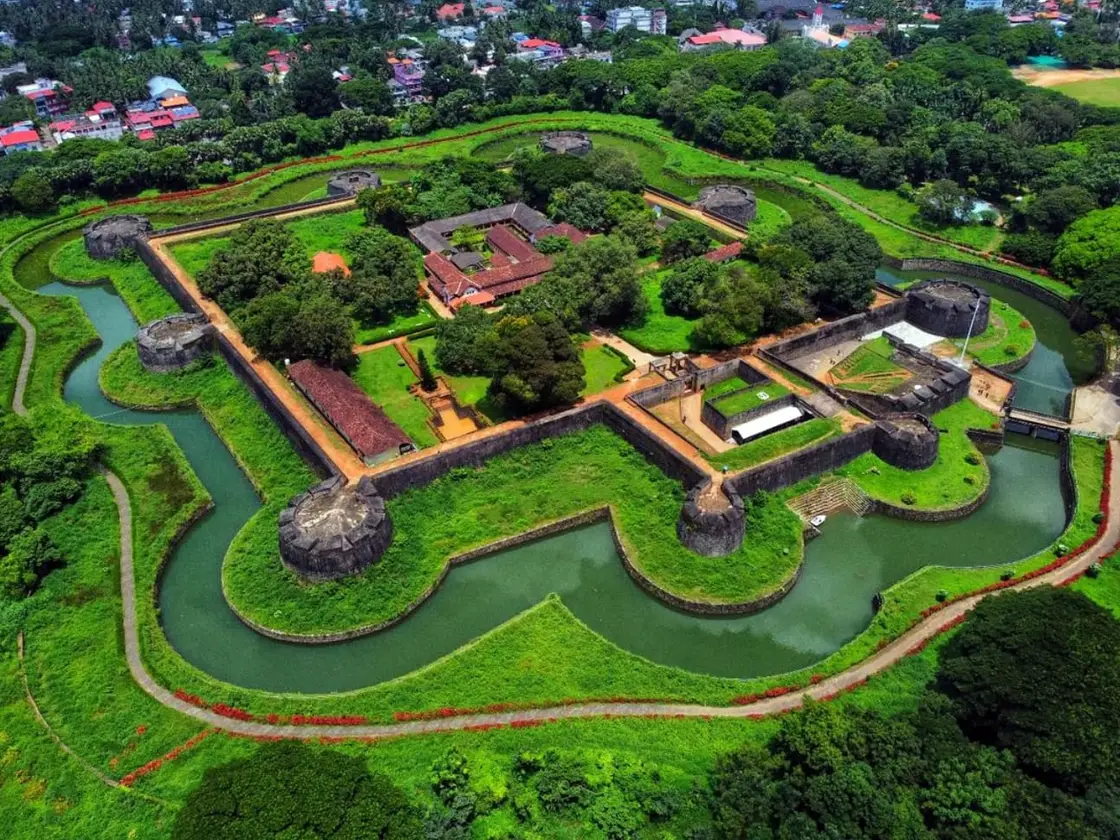
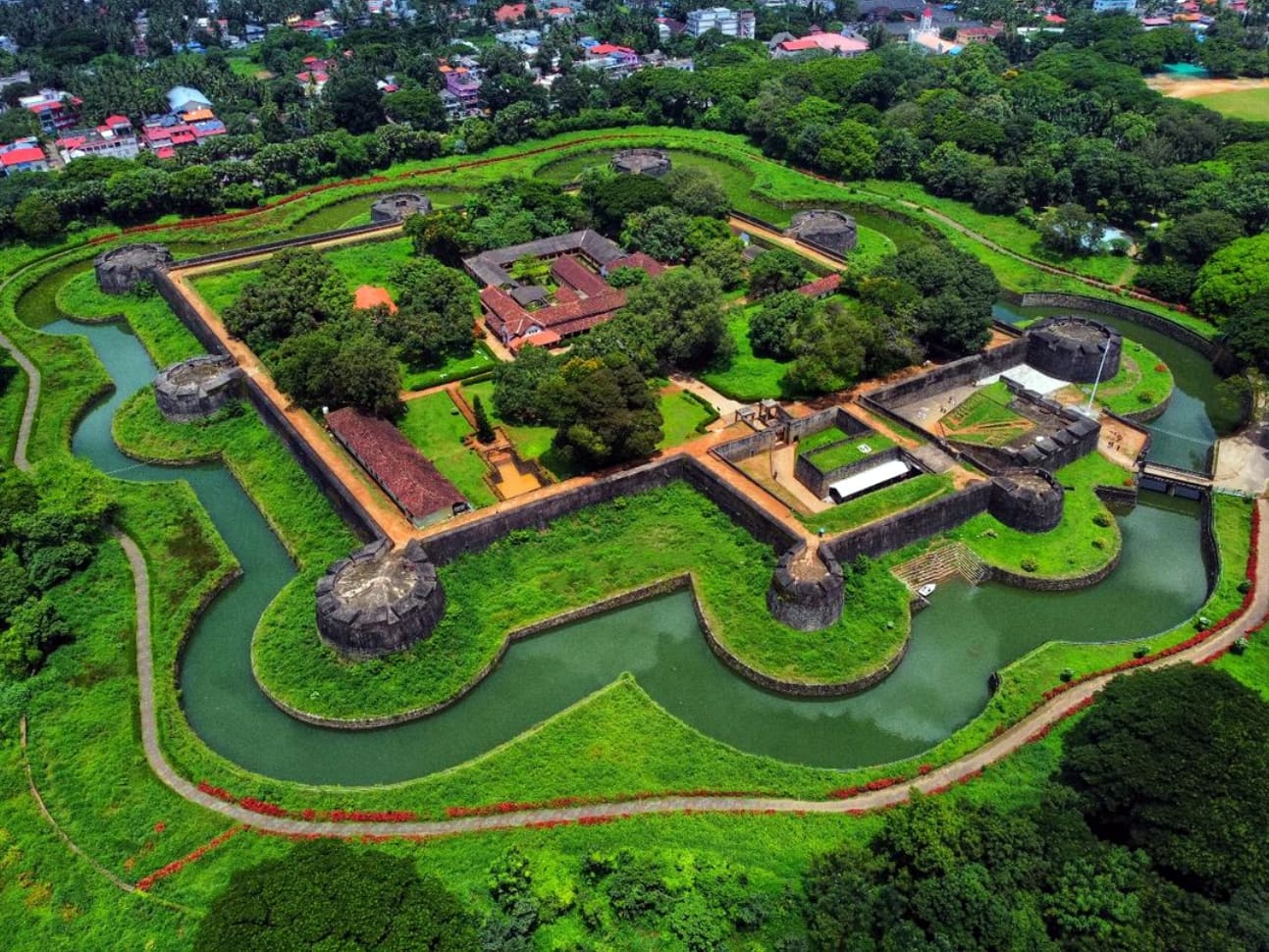
In the very heart of Palakkad town, ringed by lawns and rain-trees, stands one of Kerala’s best-preserved forts — a squat, square citadel of granite and laterite raised by Hyder Ali of Mysore in 1766 to lock down the Palghat Gap, the one great pass through the Western Ghats. Locals still call it Tipu’s Fort, after Hyder Ali’s son Tipu Sultan, and today it is an Archaeological Survey of India monument wrapped in a green civic park.
The story of Palakkad Fort
Walk in through the gateway and the first thing you notice is how solid everything is. The walls are built of massive granite blocks and laterite, laid up with such care that the fort has shrugged off two and a half centuries of monsoons and sieges. This is no romantic ruin — it is a working piece of eighteenth-century military engineering, square in plan, with squat bastions thrusting out at each corner and a broad moat (now mostly dry) tracing the perimeter, and it remains one of the best-kept forts anywhere in Kerala.
The reason this particular patch of ground was worth fortifying lies just to the east: the Palghat Gap. The Western Ghats run almost unbroken for hundreds of kilometres, walling Kerala off from the Tamil country — except here, where a gap roughly thirty to forty kilometres wide slices clean through the range. Every army, every merchant caravan, every trade route between the Malabar coast and the Mysore plateau had to funnel through it. Hold Palakkad and you held the door between two worlds. Hyder Ali understood that perfectly, which is why he planted his citadel exactly where the road narrows.
The fort you see is best explored slowly, on foot. You can climb the ramparts and walk the walls, looking down into the moat and out over the town; you can trace the thick curtain walls between the corner bastions and imagine cannon trained on the approaches. Inside the enclosure sits a Hanuman temple, the Anjaneya Swamy shrine often called the Kota Ambalam (the temple of the fort), where townspeople still come to pray — a reminder that the fort has never really stopped being part of everyday Palakkad life.
Around and within the walls, the ASI and the town have made the fort a genuine green lung for a busy junction town. There is a children’s park known as Vatika with a garden and play equipment, shaded lawns where families spread out in the evenings, and the nearby open-air auditorium called Rappadi, which hosts cultural performances against the backdrop of the old ramparts. Morning walkers, courting couples, school groups and history-minded travellers all share the same grassy glacis.
Come at the right hour and the fort turns golden. Late afternoon light rakes across the granite and the laterite glows warm-red; the moat greens over, egrets pick through the grass, and the bastions throw long shadows across the lawns. It is an easy, unhurried place — no long queues, no steep climbs — and one of those rare monuments where the history is grand but the visit is gentle, folded into the ordinary rhythm of a Kerala market town.
History
The story begins not with Hyder Ali but with the rivalries of eighteenth-century Malabar. Palakkad was ruled by its own line of rajas — the Palghat Achan — who found themselves squeezed by the powerful Zamorin (Samuthiri) of Kozhikode. When the Zamorin pressed down on Palakkad, the local raja looked north-east for a stronger ally and appealed to Hyder Ali, the rising military strongman of Mysore, for help. It was an invitation that would change the region forever.
Hyder Ali obliged, drove back the Zamorin’s forces, and then did what ambitious powers tend to do — he stayed. Having overrun the territories the Zamorin had held and asserted Mysore’s grip over Malabar, in 1766 he raised (or substantially rebuilt) the fort at Palakkad to consolidate that hold and to command the strategic Palghat Gap. The citadel became the nerve-centre of Mysore power on the Malabar side of the Ghats, first under Hyder Ali and then under his son Tipu Sultan.
The fort then changed hands repeatedly against the backdrop of the Anglo-Mysore Wars. The British first took it in 1768, when Colonel Wood seized it during operations against Hyder Ali’s strongholds, only for Hyder to recapture it within months. It was besieged again and taken by Colonel Fullarton in 1783 after a siege lasting some eleven days, but abandoned the following year. The back-and-forth mirrored the wider struggle between Mysore and the English East India Company (often in alliance with the Zamorin and other local powers) for control of the peninsula’s trade corridors.
The fort finally passed to the British in 1790, during the Third Anglo-Mysore War, and it was under British hands that it took much of its present form. With Mysore’s power in Malabar broken and Tipu Sultan later killed at Seringapatam in 1799, Palakkad Fort lost its front-line military role and settled into the long quiet of a garrison relic and administrative site.
In the modern era the fort has been protected as a monument of national importance under the Archaeological Survey of India, which maintains the walls, bastions and grounds. That stewardship is why it survives so intact — a granite-and-laterite record of the moment Mysore, the Zamorin and the British all fought for the key to the Palghat Gap, sitting today at the calm centre of the town that grew up around it.
Why visit
It is one of the best-preserved forts in Kerala — genuinely intact granite-and-laterite walls, corner bastions and a moat, not a scatter of ruins — and an ASI-protected monument of national importance.
The history is unusually rich and tangible: a fort built by Hyder Ali of Mysore, held by Tipu Sultan, and fought over by the British and the Zamorin across the Anglo-Mysore Wars, all readable in the stones you walk on.
You can actually explore it — climb the ramparts, walk the curtain walls between the bastions, and look down into the moat — which makes it far more engaging than a monument you can only view from outside.
The setting is a green civic park in the middle of town: shaded lawns, rain-trees and the Vatika children’s park, so it works as a family outing and an evening stroll as much as a heritage visit.
Layers of living culture sit inside and beside the walls — the Hanuman (Anjaneya Swamy) temple within the enclosure and the Rappadi open-air auditorium nearby, which stages performances against the ramparts.
It stands at the Palghat Gap, the single great pass through the Western Ghats between Kerala and Tamil Nadu — so a visit doubles as a lesson in why this town has mattered to armies and traders for centuries.