Soaring over the heart of Thrissur town, the Basilica of Our Lady of Dolours — known to everyone locally as Puttanpalli, the “new church” — is one of the tallest and most spectacular churches in India, a cathedral-scale sweep of Indo-Gothic spires, stained glass and painted biblical murals crowned by its famous Bible Tower.
The story of Basilica of Our Lady of Dolours
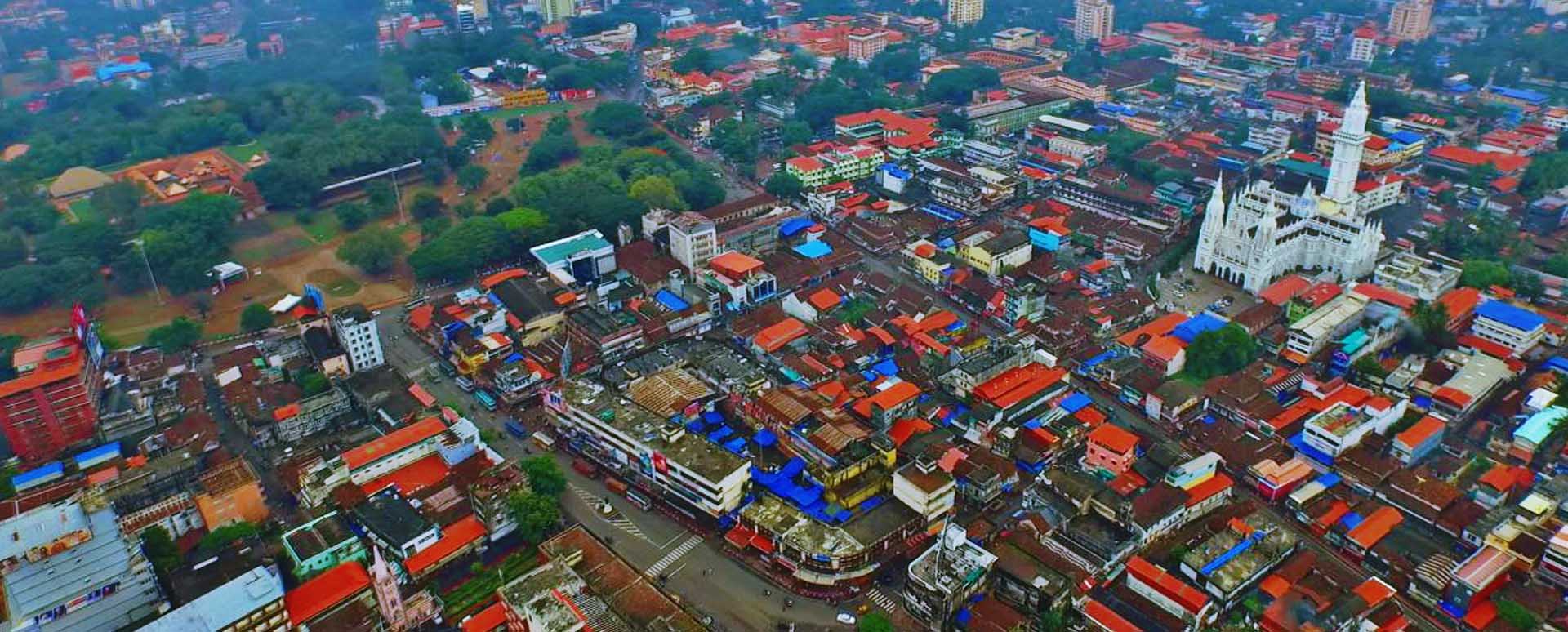
Walk into the centre of Thrissur and you cannot miss it. Where the temple town clusters around the green Thekkinkadu Maidan and the ancient Vadakkunnathan shrine, a very different silhouette rises a few hundred metres away — three pale Gothic towers, pointed arches and a great octagonal dome, looking for all the world as though a slice of a European cathedral had been set down in the middle of Kerala. This is the Basilica of Our Lady of Dolours, and it is widely described as the tallest church in India by both height and floor area, and among the tallest in Asia (indicative — confirm locally).
Everyone in Thrissur calls it simply Puttanpalli — literally the “new church” in Malayalam — a nickname that has stuck for so long it now names one of the town’s best-loved landmarks. The name distinguishes this grand later church from the older parish it grew out of, and it carries a note of civic pride: the Catholic community of Thrissur built something here that they meant to be seen from across the town.
Step inside and the scale takes over. The nave runs for the length of a football pitch beneath rows of tall marble-finished pillars; galleries wrap the upper level, and the walls and ceilings are covered in an extraordinary programme of murals and painted decoration — the Stations of the Cross, the Seven Sorrows of Mary from which the church takes its name, scenes from the life of Christ, and the four Evangelists. Light filters through coloured stained glass, and side chapels hold statues, a replica of Michelangelo’s Pietà, and a perpetual adoration chapel.
The single most talked-about feature stands at the rear: the Bible Tower, a slender campanile that climbs to around 79 to 80 metres (roughly 260 feet) and is often called the tallest church tower in India and Asia (indicative — confirm locally). Inside it, murals and displays trace episodes from scripture, and a lift carries visitors up through the levels to a viewing gallery. From the top you look out over the whole spread of Thrissur — the maidan, the temple, the town’s rooftops rolling to the hills.
The two front towers, each around 45 metres (about 146 feet), frame the main facade, so the church presents a balanced trio of spires from the square below (indicative — confirm locally). Eight bells, said to have been brought from Germany, hang in the towers and ring out over the town on feast days and Sundays.
For all its grandeur, Puttanpalli remains a living parish church rather than a museum piece. Masses are said daily in Malayalam, the adoration chapel keeps its quiet vigil, and the great September feast of Our Lady draws pilgrims from across central Kerala. Visitors are welcome to step in between services, wander the aisles quietly, and ride the tower — but it is first and foremost a place of worship, and that ordinary devotional life is part of what makes a visit here feel so alive.
History
Christianity runs deep in Thrissur. The town sits at the historic heart of Kerala’s St Thomas Christian tradition, and Catholic worship has been part of its life for centuries. The present basilica grew out of that older community, and the church that stands today was raised, in stages, on the site and legacy of earlier parish churches — the “new church” of its nickname replacing what had come before.
The great building visitors see now was begun in 1929 and took roughly eleven years to complete, rising in a confident Indo-Gothic style — the fusion of European Gothic forms, pointed arches and ribbed vaults with Indian craftsmanship that flourished across the subcontinent in that era (indicative — confirm locally). The result covers around 25,000 square feet, with a cruciform plan, rows of tall pillars, an octagonal dome over the crossing and a long, high nave.
The church belongs to the Syro-Malabar Catholic tradition and is today the cathedral-scale shrine of the Syro-Malabar Archdiocese of Thrissur, which administers it. It stands as one of the most important Marian centres in the region, dedicated to Our Lady of Dolours — Our Lady of Sorrows — with the Seven Sorrows of Mary woven through its art and dedication.
The church’s stature was recognised at the highest level of the Catholic world. Pope John Paul II visited Thrissur in 1986, and the episcopal throne and pulpit he used are kept in the basilica (indicative — confirm locally). A few years later, on 25 April 1992, the same pope elevated the church to the rank of Minor Basilica, the title it carries today (indicative — confirm locally).
Decade by decade the interior has been enriched — the perpetual adoration chapel established in the late 1980s, statues blessed and added, the murals maintained — so that the basilica has continued to grow as a devotional and artistic landmark. It now sits firmly on Thrissur’s heritage trail alongside the Vadakkunnathan temple and the Thrissur Pooram circuit, a symbol of the town’s layered religious history.
Why visit
See one of the tallest and largest churches in India — a genuinely cathedral-scale building in Indo-Gothic style right in the centre of Thrissur town.
Ride the lift up the landmark Bible Tower to a viewing gallery for sweeping views over Thrissur, the Thekkinkadu Maidan and the Vadakkunnathan temple (subject to tower opening — confirm locally).
Take in the vast programme of interior murals, painted ceilings, relief work and stained glass — the Stations of the Cross, the Seven Sorrows of Mary and scenes from the life of Christ.
Feel the atmosphere of a living Marian shrine and pilgrimage centre, with daily Mass and a perpetual adoration chapel, rather than a static monument.
Pair it easily with Thrissur’s other headline sights — the Vadakkunnathan temple, the maidan and, in season, the world-famous Thrissur Pooram — all within walking distance.
Admire the three-tower facade and hear the German-cast bells; the whole ensemble is one of the most photographed pieces of architecture in central Kerala.