The story
Crowning the wooded hillock of Thekkinkadu Maidan in the very heart of Thrissur, the Vadakkunnathan Temple is among the oldest and most revered Shiva shrines in Kerala — a serene, elephant-grey world of circular sanctums, copper-clad roofs and centuries-old murals that gives the city its name and its soul.
The story of Vadakkunnathan Temple
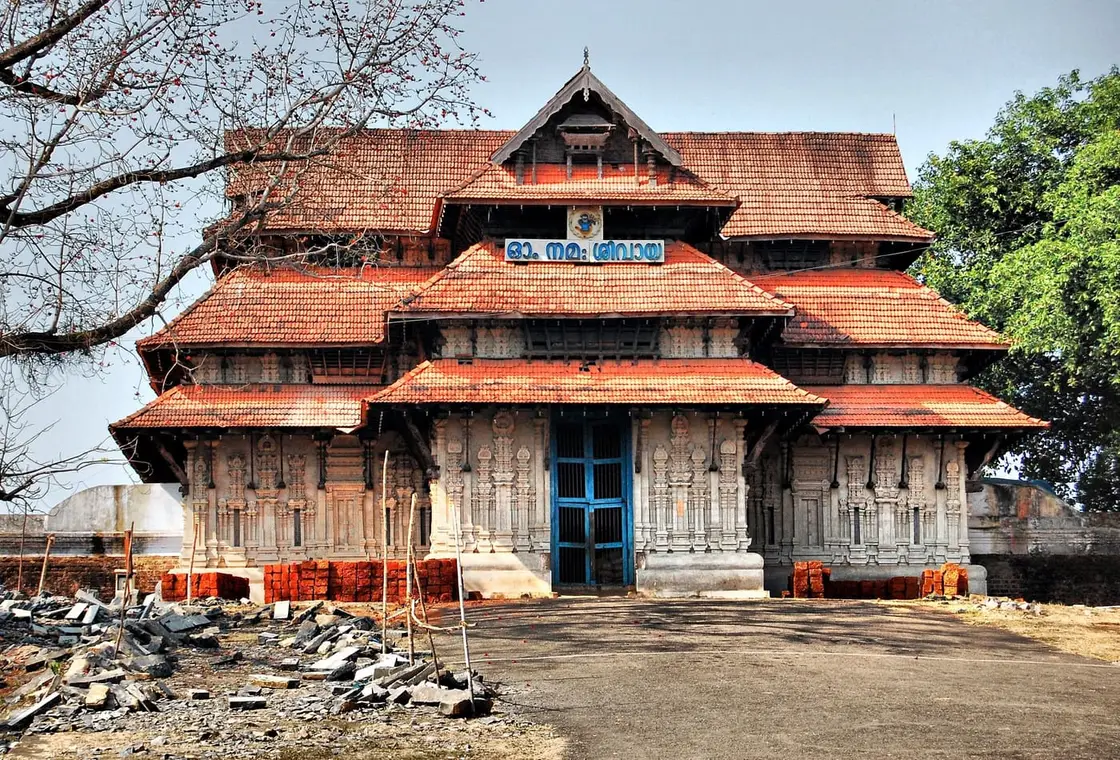
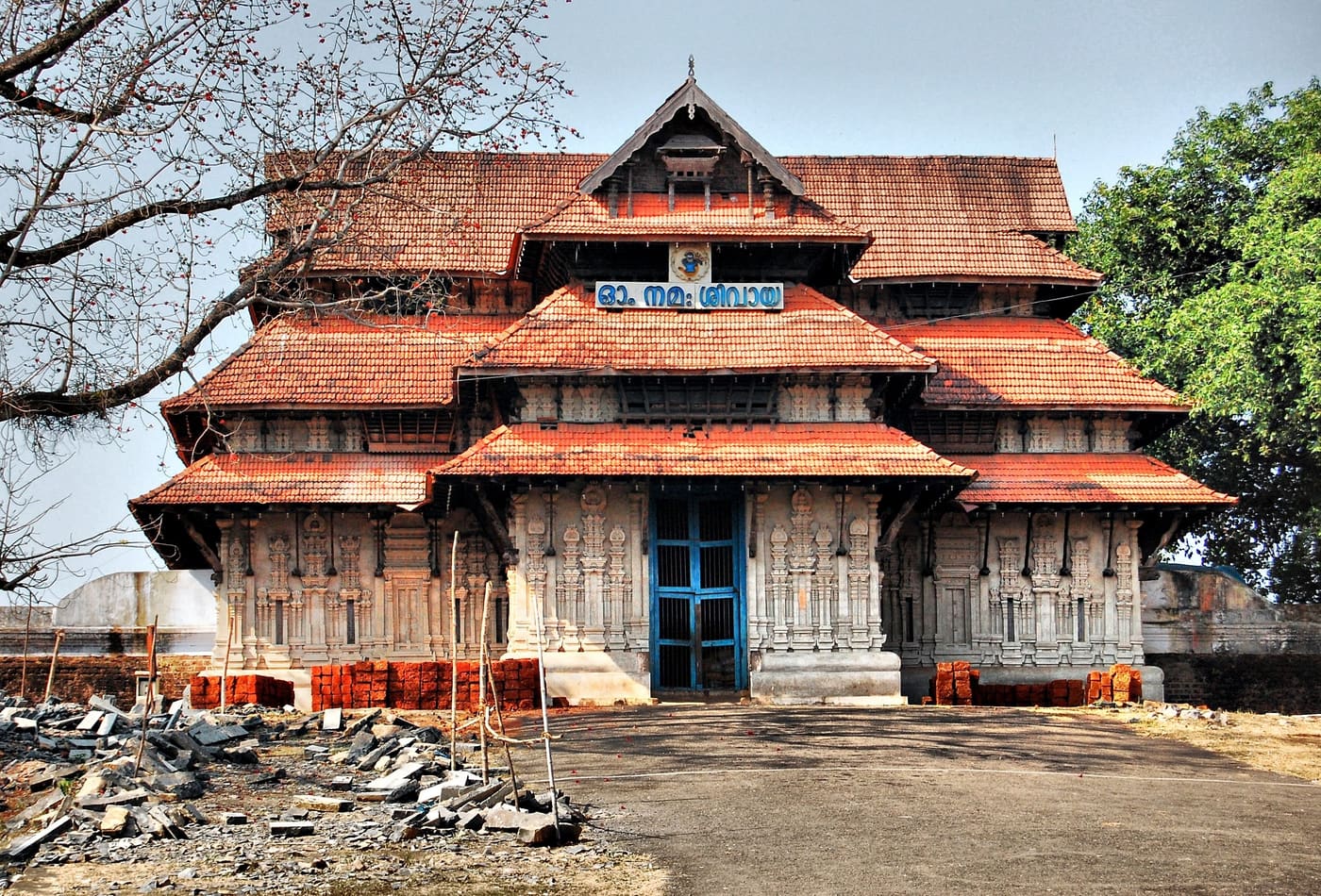
Walk up through one of the four great gopurams and the noise of Thrissur falls away. The Vadakkunnathan Temple sits on a low, tree-shaded rise once cloaked in teak forest, ringed by a massive stone wall that encloses roughly nine acres of open courtyard, shrines and sacred silence. This is not a single spire but a whole walled temple-town in miniature, and it is widely regarded as one of the finest surviving examples of the classical Kerala temple style.
At its centre stands the presiding deity, Shiva — worshipped here as Vadakkunnathan, the ‘Lord of the North’. What the pilgrim actually sees is not a bare stone lingam but a tall, rounded mound of ghee. Over countless generations, devotees have poured ghee over the lingam in abhishekam, and the offering has built up into a towering form said to evoke the snow-clad slopes of Mount Kailash, Shiva’s Himalayan abode. The lingam itself is hidden within this ‘ghee mountain’, and locals marvel that the accumulated ghee stays firm and does not turn rancid even through the Kerala heat.
Behind Shiva, facing the opposite way, is enshrined the goddess Parvati, so that the divine couple stand back to back at the temple’s core — a quiet expression of the Ardhanarishvara idea, Shiva and Shakti as one. Around them, within the walled compound, are further shrines to Sankaranarayana (the fused form of Shiva and Vishnu), Rama, Krishna, Ganapati and other deities, giving worshippers of many devotions a home under one sacred roof.
The temple is inseparable from the identity of Thrissur itself. By local tradition the city’s very name is a contraction of ‘Thri-Shiva-Perur’ — the town of the sacred Shiva, or the place named for the three-eyed lord — so that to speak of Thrissur is already to invoke Vadakkunnathan. For the townsfolk the shrine is less a monument to be visited than the living heart around which the whole city is arranged.
Part of the temple’s fame rests on its art. The inner walls carry Kerala murals of great age — among them celebrated panels worshipped daily — painted in the warm ochres, reds and greens of the traditional Kerala school, alongside intricately sculpted woodwork on pillars and ceilings. In a corner of the compound stands the koothambalam, a grand wooden theatre hall built for the temple’s ritual arts, one of the most admired structures of its kind in Kerala. A painstaking conservation of the complex earned it a UNESCO Asia-Pacific Award for Cultural Heritage Conservation in 2015.
Though the sprawling maidan just outside its walls famously hosts the great Thrissur Pooram each year, the temple has its own steady rhythm of daily worship, of ghee poured and lamps lit, that has continued for many centuries. To sit in its cool stone courtyard at dusk, as the oil lamps come alive and the crowds thin, is to feel the deep, unhurried devotion that has made this the mother-shrine of central Kerala.
Legend & myth
The best-loved legend traces the temple back to Parashurama, the axe-wielding sixth avatar of Vishnu who, by tradition, raised the land of Kerala from the sea. Having asked Varuna, lord of the ocean, to yield up new earth, Parashurama is said to have invited Shiva to dwell in the fresh-made country and bless it. Shiva, so the story goes, took his abode at this very spot, and the shrine that arose here is remembered as the first of the 108 Shiva temples that Parashurama is believed to have created across Kerala — making Vadakkunnathan, in the telling, the ‘first temple’ of the land.
Because Shiva faces west from his hill in the north of the old sacred landscape, devotees explain, he came to be called Vadakkunnathan — the ‘Lord of the North’. The name of the city is woven into the same lore: Thrissur is said to descend from ‘Thri-Shiva-Perur’, the place of the sacred three-eyed Shiva, so that the god and the town share a single name.
Around the ghee lingam, too, a devotional legend has grown. The great mound of ghee is said to have formed slowly over the ages from the ceaseless abhishekam of pilgrims, and the ghee that is offered here is held by the faithful to carry healing power — traditionally sought by those suffering long illness. Such beliefs are cherished as devotion and legend rather than established fact, but they are inseparable from how the shrine is loved.
A further strand of local tradition links the temple to Adi Shankara, the eighth-century philosopher-saint of Advaita, whose birthplace of Kalady lies not far away; devotees connect his life closely with worship at this shrine. These stories, passed down through generations, are best received in the spirit in which they are told — as sacred memory rather than documented history.
History
Vadakkunnathan is unmistakably ancient, though its exact origins are lost in time. The shrine is woven into the early cultural memory of the region, with traditions reaching back into Kerala’s Sangam-age and later Perumal-era past, and its association with the nearby birthplace of Adi Shankara underlines how deep its roots run in the religious life of central Kerala.
The temple came through turbulent times in the late eighteenth century, when the forces of Tipu Sultan campaigned through Thrissur around 1789–90. While many shrines in the area suffered, a well-remembered local account holds that Vadakkunnathan was spared serious harm — one story even recalling that vessels borrowed from the temple were later returned. Whatever the precise events, the shrine survived the upheavals of that age largely intact.
The temple’s modern setting owes much to Sakthan Thampuran (Raja Rama Varma), the redoubtable late-eighteenth-century ruler of Cochin, who reorganised Thrissur as a planned town around the shrine. He is credited with clearing the dense Thekkinkadu teak forest that then surrounded the hill — the name Thekkinkadu still means ‘teak forest’ — opening up the great maidan that girdles the temple, and with giving structure to the celebrated Thrissur Pooram gathering that assembles on that ground.
Within the walls, the temple preserves an exceptional artistic heritage. Its Kerala murals — including revered panels regarded as several centuries old — rank among the finest of the traditional Kerala school of painting, while the wooden koothambalam, the ritual theatre hall attributed in legend to the master craftsman Perumthachan, is prized as one of the great examples of Kerala temple woodcraft.
In recent times the temple has been recognised as a monument of national importance and is cared for with support from the Archaeological Survey of India, while its day-to-day worship is administered by the Cochin Devaswom Board. A major, tradition-respecting conservation of the complex was honoured with the UNESCO Asia-Pacific Award for Cultural Heritage Conservation in 2015, affirming its standing as a heritage treasure of Kerala.
Why visit
Stand before the ghee lingam — one of the most unusual sights in Indian temple worship, where centuries of poured ghee have built the deity into a tall, rounded mound likened to snow-clad Kailash, with the Shiva lingam hidden within.
Experience a textbook masterpiece of classical Kerala temple architecture: circular srikovils under sweeping copper-plated roofs, four monumental gopurams, and a serene walled compound of around nine acres in the middle of a busy city.
See the celebrated Kerala murals — glowing ochre, red and green wall paintings of great antiquity — and the intricately carved woodwork that has helped make this temple a landmark of Kerala’s sacred art.
Admire the koothambalam, the grand wooden ritual-theatre hall built for temple arts and, by legend, associated with the master carpenter Perumthachan — one of the finest such structures in Kerala.
Feel the pull of a shrine that names an entire city: revered as the first of Parashurama’s 108 Kerala Shiva temples and as the ‘Thri-Shiva-Perur’ from which Thrissur takes its name.
Sit in the cool, lamp-lit courtyard at dawn or dusk, when the ghee abhishekam and the flicker of oil lamps give the whole compound a deep, unhurried devotional calm — a UNESCO-recognised heritage sanctuary at the heart of Thrissur.