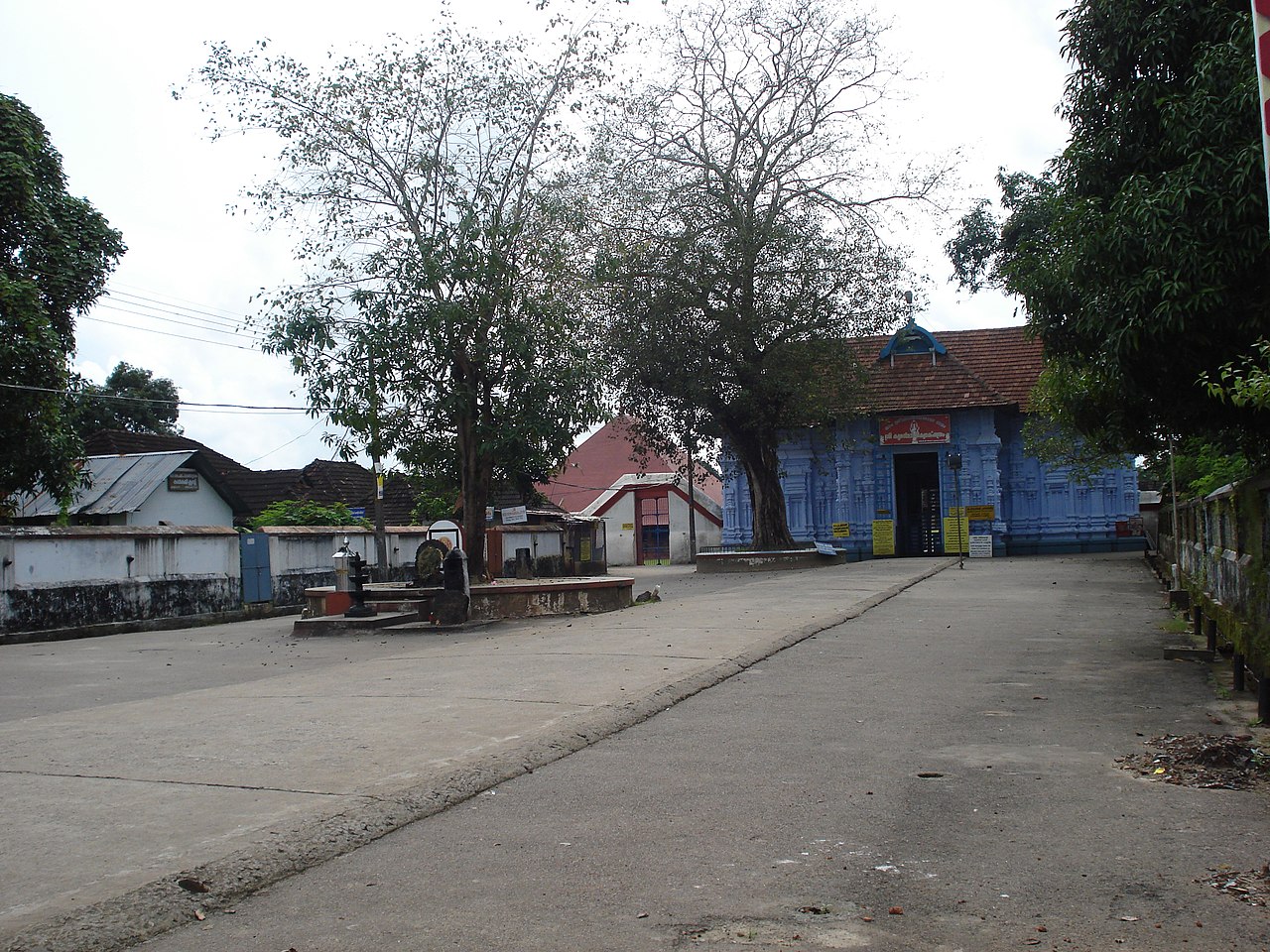
The story
One of the oldest and most revered Shiva temples in Kerala, Peruvanam Mahadeva Temple at Cherpu near Thrissur is famed for its towering square sanctum, its two distinct forms of Shiva, and its role as the ancient heart of the Peruvanam–Arattupuzha Pooram — a festival tradition older than the celebrated Thrissur Pooram.
The story of Peruvanam Mahadeva Temple
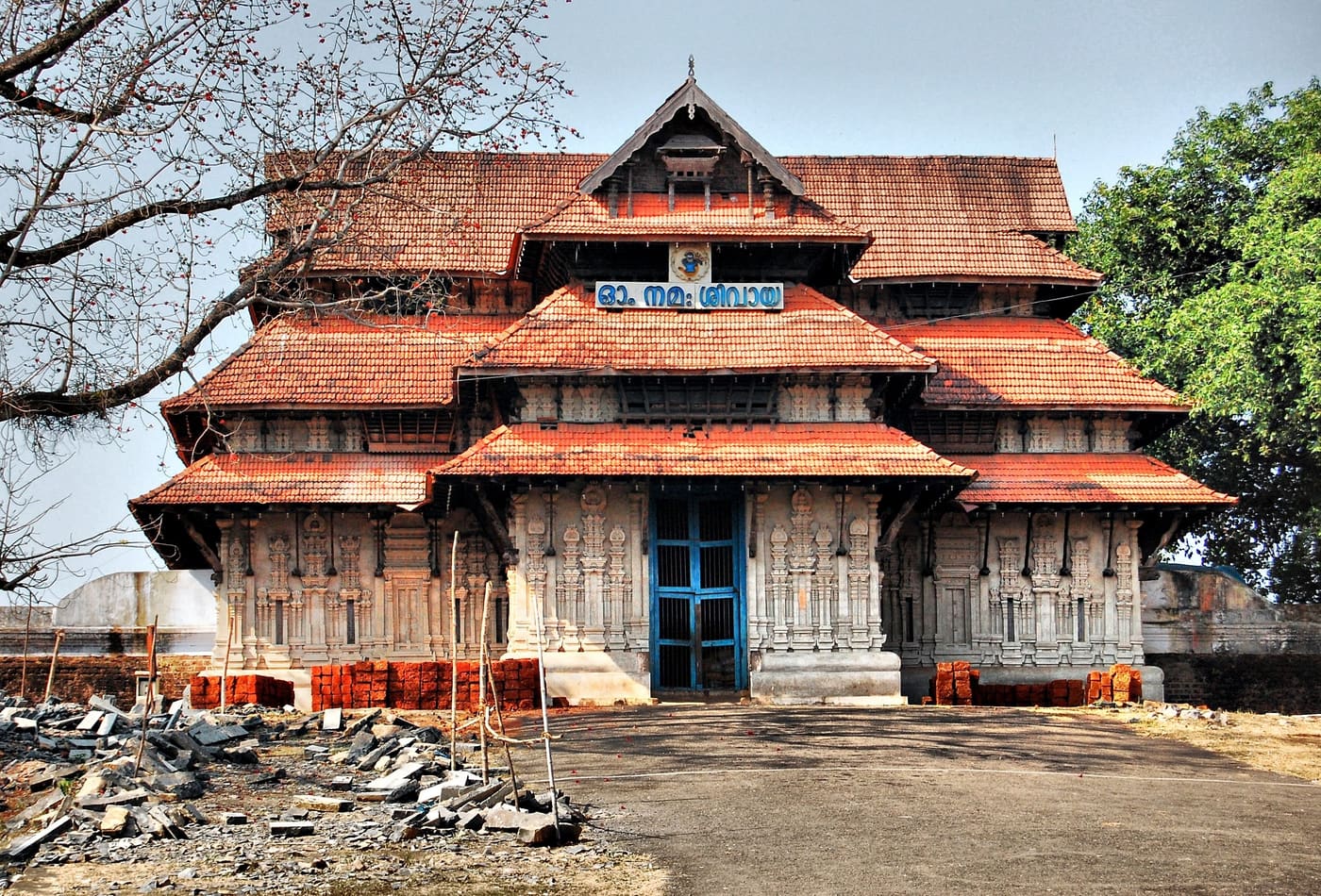
Set on a broad, wall-girdled compound of some seven acres in the paddy country of Cherpu, a short drive south of Thrissur town, Peruvanam Mahadeva Temple is one of those places where Kerala’s temple culture feels genuinely archaic — not restored antiquity but living antiquity. It is counted among the fabled 108 Shiva temples of Kerala, and by local reckoning its origins reach back well over a thousand years, to the age of the early Chera kingdom and, in devotional tradition, to the very shaping of the land itself.
What sets Peruvanam apart from almost every other Shiva shrine in the region is that it holds not one but two forms of the god. The presiding form is known as Irattayappan — literally the twin lord — because the sanctum enshrines two Shiva lingams together, one larger than the other, an unusual double consecration from which the name derives. Goddess Parvati is worshipped in the same sanctum, behind the lord, so that the shrine is understood as complete in itself.
A short distance away within the same complex rises the second sanctum, that of Madathilappan, and it is this structure that most visitors remember. Its sreekovil is a tall, square, multi-storeyed tower — widely described as among the tallest temple sanctums in South India — reached by a broad flight of steps and fronted by a large pillared hall. Where most Kerala sreekovils are low, circular and shaded, this one soars, giving the temple a silhouette quite unlike its neighbours.
The temple sits at the centre of a ring of older shrines — a Bhadrakali and a Subramanya temple to the west, a Sastha temple to the north, a Vishnu temple to the east and a Durga temple to the south — a layout that hints at how important the Peruvanam precinct once was as a cluster of village shrines, or gramam, bound together in shared ritual. In its great days, a confederation of temples looked to Peruvanam as their ceremonial anchor.
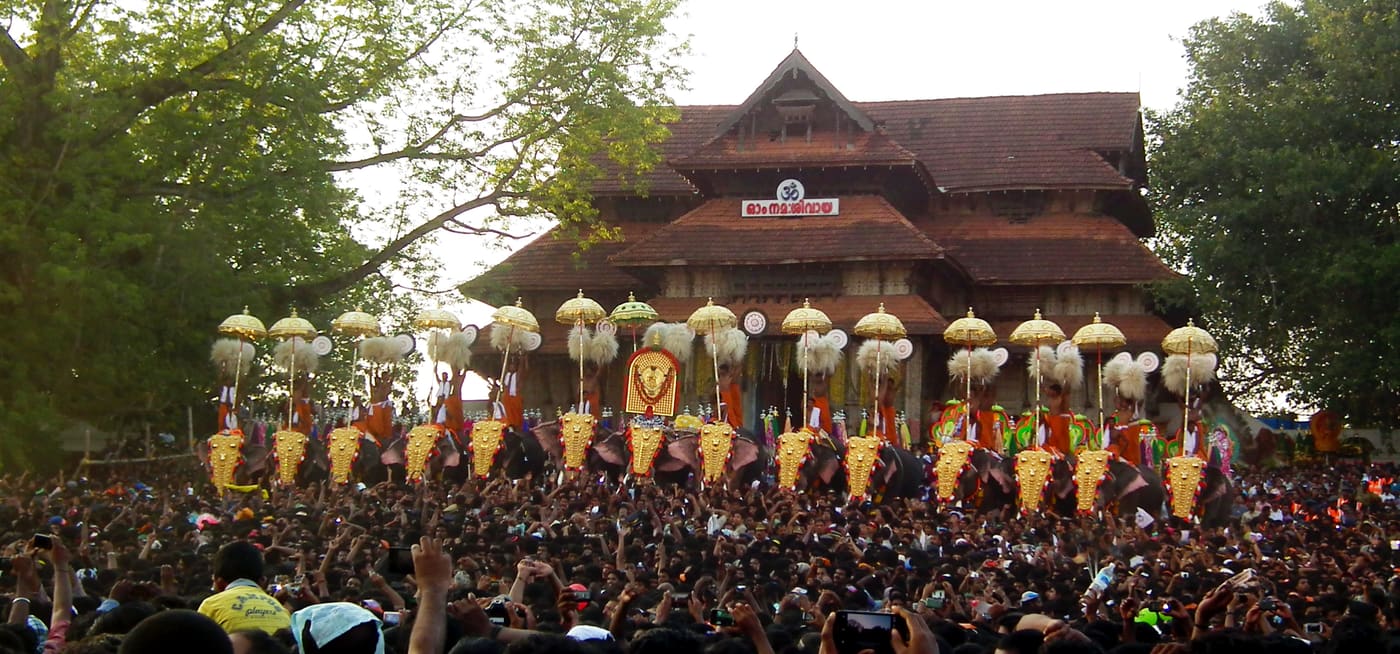
For the traveller, the quiet of an ordinary morning here — the smell of oil lamps, the cool granite underfoot, the tall shadow of Madathilappan’s tower — gives little hint of what the place becomes once a year, when the surrounding villages converge on it in one of the oldest and most stirring percussion festivals in the world. Peruvanam is, above all, the ancestral home of Kerala’s temple-drumming tradition, and the ground on which the panchari melam is said to have first been beaten.
It is also a place of genuine artistic lineage. The village gives its name to Peruvanam Kuttan Marar, the Padma Shri chenda maestro whose family has led the rhythm ensembles of the region for generations — so that to stand in the temple yard is to stand at the source of a musical tradition that echoes through every major pooram in central Kerala.
Legend & myth
Tradition frames the temple as belonging to the very origins of Kerala — to the age when, in legend, the sage Parashurama is said to have raised the land from the sea and dotted it with shrines to Shiva, of which Peruvanam is counted among the greatest 108. Such stories are told as sacred lore rather than dated history, and are cherished as much for their meaning as for any claim to fact.
A much-loved local legend explains the second sanctum. It is said that a great Shiva lingam was being carried down from the far Himalayan shrine of Badrinath towards this land, and that on the way it became lodged — caught, in one telling, in the branch of a tree at Peruvanam and refusing to be moved further. Reading this as the lord’s own choice of abode, the devotees are said to have raised the towering Madathilappan sanctum on that very spot. Like all such origin tales, it is offered as legend, a story that gives the tall tower its meaning.
The double form of Irattayappan, too, gathers its own devotional explanations — the twinned lingams understood as an expression of the fullness of the divine presence at Peruvanam, worshipped alongside the goddess. These are matters of faith and folklore rather than record, and are best received in that spirit.
History
Historically, Peruvanam is remembered as a centre of temple culture from a very early period of Kerala’s past. Its most secure chronological anchor comes not from the building but from its festival: the earliest reference associated with the Peruvanam Pooram is dated to around AD 583, which makes the tradition here one of the oldest continuously remembered temple observances anywhere, older by centuries than the famous Thrissur Pooram that eclipsed it.
The temple flourished under the patronage of the region’s early rulers, in the broad era of Chera and later chieftain power, when Peruvanam served as the ritual head of a wide confederation. As many as 108 temples of the Peruvanam precinct, or sanketham, are traditionally said to have gathered for the joint festival, converging at the Arattupuzha Sastha temple — a scale of assembly that speaks to the extraordinary standing the shrine once held.
The present temple architecture is generally attributed to a later medieval phase of building, with the completed stone structure often placed around the twelfth century, in classic Kerala style — square granite sanctums, a large pillared mandapam and, historically, murals and fine woodwork of the kind for which the region’s temple craftsmen were renowned. The soaring square sreekovil of Madathilappan remains its most distinctive architectural feature.
By roughly five centuries ago the great confederated pooram is said to have faltered, and in the eighteenth century the initiative in the region passed to Thrissur, where Sakthan Thampuran organised the Thrissur Pooram that would become world-famous. Yet Peruvanam and its sister festival at Arattupuzha endured, keeping alive the older, statelier tradition from which the newer spectacle had grown.
In recognition of its antiquity and importance, the temple has been recognised as a protected monument, listed under the Archaeological Survey of India since the early 1980s — a formal acknowledgement of a place that had already been sacred to the surrounding villages for well over a millennium.
Why visit
To see one of Kerala’s genuinely ancient Shiva temples — a shrine counted among the great 108, with roots reaching back to the early Chera age and a festival tradition documented from the sixth century.
For the rare architecture: two separate sanctums holding two forms of Shiva, including the towering multi-storeyed square sreekovil of Madathilappan, unlike the low circular shrines of most Kerala temples.
For the unusual Irattayappan form — the twin lord, with two Shiva lingams enshrined together and Parvati worshipped alongside — a consecration you will find almost nowhere else.
To stand at the birthplace of the panchari melam and the heartland of Kerala’s chenda-drumming tradition, the home village of Padma Shri percussion maestro Peruvanam Kuttan Marar.
To experience, if your visit falls in the Malayalam month of Meenam, the ancient Peruvanam–Arattupuzha Pooram — a slower, older cousin of the Thrissur Pooram, with caparisoned elephants, deities gathering to honour Irattayappan and all-night processional drumming.
For the atmosphere of an unhurried village temple away from the tourist trail — cool granite, oil lamps and a ring of older shrines — where Kerala’s temple past feels close at hand.