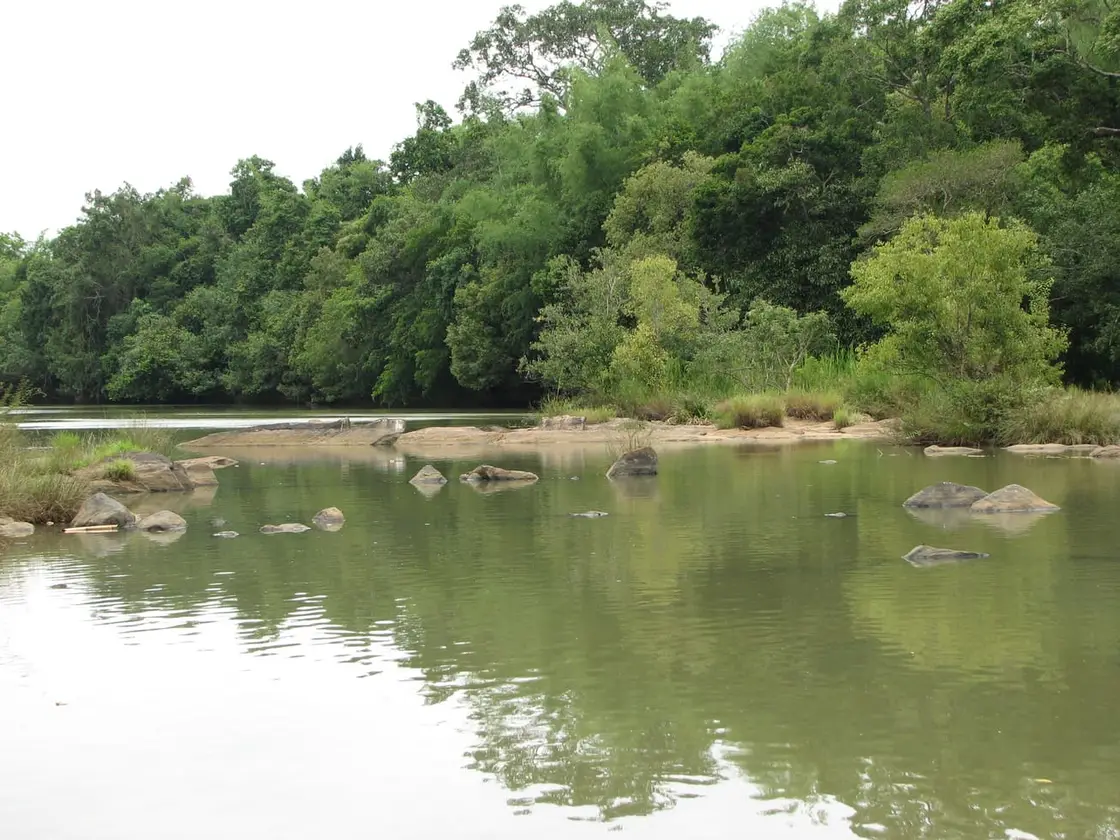
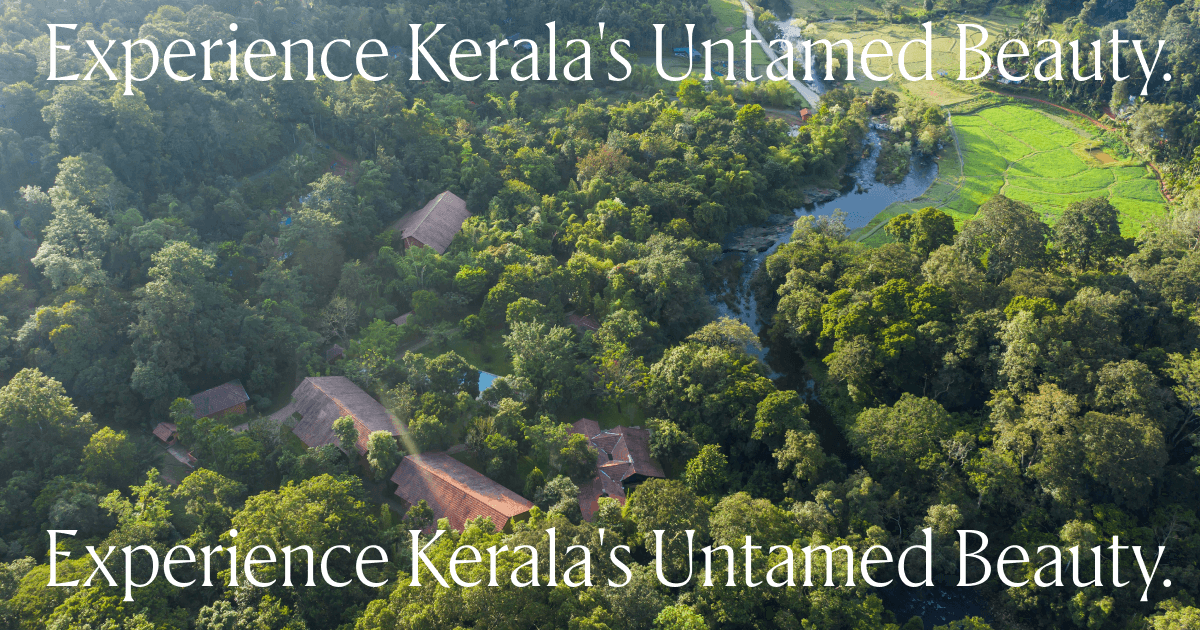
Kuruva Island — Kuruvadweep to Malayalis — is a cluster of three uninhabited, densely wooded islets marooned in the braided channels of the Kabini river, some 17 km east of Mananthavady in northern Wayanad. Spread across roughly 950 acres of evergreen forest, orchid-hung trees and bamboo groves, it is one of Kerala’s most fragile eco-tourism sites, reached only by fibre boat or bamboo raft and locked shut through the monsoon when the river runs high.
The story of Kuruva Island
You do not so much arrive at Kuruva Island as cross over to it. The road from Mananthavady ends at a wooded landing on the Kabini, and beyond the water lies a green wall of forest with no bridge, no jetty of concrete, no shortcut. Visitors gather at the bank, wait their turn, and are ferried across in small fibre boats or poled over on bamboo rafts. That short crossing — a few minutes of dark, slow-moving water — is the whole point. It draws a line between the ordinary world and the hush on the far side.
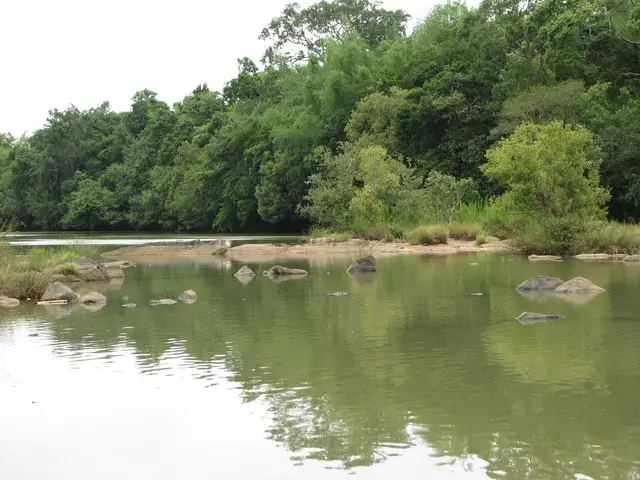
The name Kuruvadweep simply means Kuruva island, and what most people call a single island is in fact a scatter of three main islets and countless smaller sandbars, threaded by the shifting channels of the Kabini and its tributaries. In the dry months the river separates into clear, shallow streams that braid between the wooded banks; in the rains they swell and merge, and the delta rearranges itself. This is a living, moving landscape, which is part of why it can never be tamed into a conventional park.
Step off the raft and the canopy closes overhead almost at once. The forest here is evergreen and layered — tall trees draped with epiphytic orchids, thickets of bamboo, ferns and medicinal herbs underfoot, mossy trunks and the constant sound of water. Narrow trails, kept deliberately rough, lead through the interior to quiet pools and rocky stretches of stream where the current slows. There are no shops inside, no vendors, no loudspeakers — only birdsong, the creak of bamboo and the occasional splash of a kingfisher.
Birdwatchers come here for good reason. The islets shelter Malabar hornbills, parrots, a dazzle of kingfishers and, for the patient, the shy Malabar trogon flitting through the mid-canopy. Butterflies drift across the light-gaps in clouds, and the streams host their own small world — including rare dragonflies recorded on the delta. Because so few people are allowed across at any one time, the forest keeps its nerve; wildlife carries on largely as if the visitors were not there.
The experience is deliberately kept simple and slightly wild. You wade a little, you walk a little, you sit on a rock and watch the water go by. Families picnic at the marked spots near the crossings; naturalists disappear down the trails with binoculars. The forest department caps the numbers each day and clears everyone off well before dusk, so the island is never crowded and never lit up at night — it belongs, after hours, only to the birds and the river.
That fragility is also the island’s discipline. Kuruvadweep closes completely through the monsoon, roughly from June, when the Kabini rises and the crossings become dangerous. Even in season, plastic is banned, swimming in the deeper channels is discouraged and every trail is meant to be walked lightly. Kuruva rewards the visitor who treats it as a guest treats a borrowed room — quietly, carefully, and with the understanding that this green delta survives precisely because it has never been allowed to become easy.
History
Kuruvadweep is a natural river delta rather than a built monument, and its story is really the story of the Kabini — locally the Kabani — one of the few east-flowing rivers of the region, which drains the Wayanad plateau towards Karnataka and eventually the Kaveri. Over long stretches of time the river split and rejoined around resistant ground, depositing silt and sand to form the low, wooded islets that make up the delta. Left uninhabited and hard to reach, they held on to a dense evergreen forest long after much of the surrounding plateau was cleared for cultivation.
The wider Wayanad forests carry a proud rebel history. In the closing years of the eighteenth and start of the nineteenth centuries these hills were the theatre of the guerrilla resistance of Pazhassi Raja against the British East India Company, in which the local Kurichiya and Kurumba tribal communities — famed archers and forest fighters — played a decisive part. While the specific islets of Kuruvadweep are not tied to a single documented episode, the remoteness that makes the delta a sanctuary today is the same remoteness that once made these jungles a stronghold for those who knew them intimately.
For most of the modern era Kuruva remained an obscure local secret, visited by fishermen, herders and the occasional naturalist. Its transformation into a named destination came when the Kerala Forest Department, working with the state tourism department and the district tourism authorities, developed it as a controlled eco-tourism site. Rather than build roads and resorts across the water, they chose the opposite path: keep the island uninhabited, ferry visitors across by boat and raft, cap the daily numbers and issue entry through the forest department.
Ecologically the delta is treated as a protected pocket of biodiversity. It is documented as harbouring rare orchids and medicinal plants among its flora, and a distinctive fauna that includes the Malabar trogon and uncommon dragonfly species recorded on its streams. The management model — limited access, seasonal closure, a ban on plastic and swimming, and reliance on non-motorised bamboo rafts within the delta — is deliberately restrictive, an attempt to let a small, sensitive island absorb tourism without being consumed by it.
That caution has been tested by nature itself. Landslide-prone Wayanad has seen repeated disasters and floods in recent years, and Kuruvadweep, sitting in the path of a river that can rise fast, is opened and closed at the forest department’s discretion — sometimes beyond the usual monsoon dates when conditions in the district are unsafe. The island’s whole recent history is therefore a negotiation between access and protection, in which the river, not the visitor, always has the final word.
Why visit
It is one of Kerala’s rare car-free forest sanctuaries: you cross a river by fibre boat or bamboo raft to reach it, which instantly sets it apart from any roadside sightseeing stop.
The setting is genuinely uncommon — roughly 950 acres of evergreen forest on a braided river delta, with clear shallow channels you can wade in and quiet trails through orchid-hung, bamboo-thick woodland.
It is a serious birding and nature destination: Malabar hornbills, kingfishers, parrots, the elusive Malabar trogon, butterflies and rare dragonflies, all in a habitat kept calm by strict daily visitor caps.
The bamboo-raft crossing and gentle river paddling are simple, low-impact experiences that suit families, couples and solo naturalists alike, without the noise of a conventional theme attraction.
Because the forest department limits numbers and forbids plastic, the island stays clean, uncrowded and quiet in a way that popular Kerala spots rarely manage — the appeal is stillness, not spectacle.
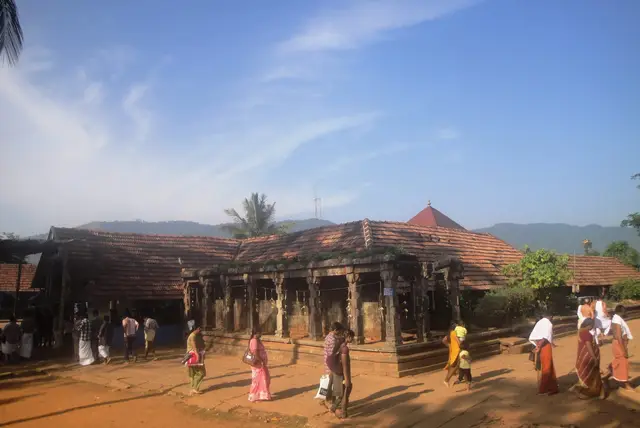
It pairs naturally with the wider northern-Wayanad circuit around Mananthavady — Thirunelli temple, Pakshipathalam and the Kabini backwaters — making it an easy, memorable half-day within a longer hill-country trip.