The story
High on Ambukuthi Mala, above the tea and coffee country near Sulthan Bathery, a fallen boulder wedged between two rock faces has sealed a cleft where people scratched pictures into stone more than six thousand years ago. The Edakkal Caves are not really caves at all but a rift in the hill, and their weathered petroglyphs — human figures, animals, wheels, and symbols still argued over by scholars — make this one of the very few places in the world where you can stand inside the Stone Age and read messages left by hands that vanished before written history began.
The story of Edakkal Caves
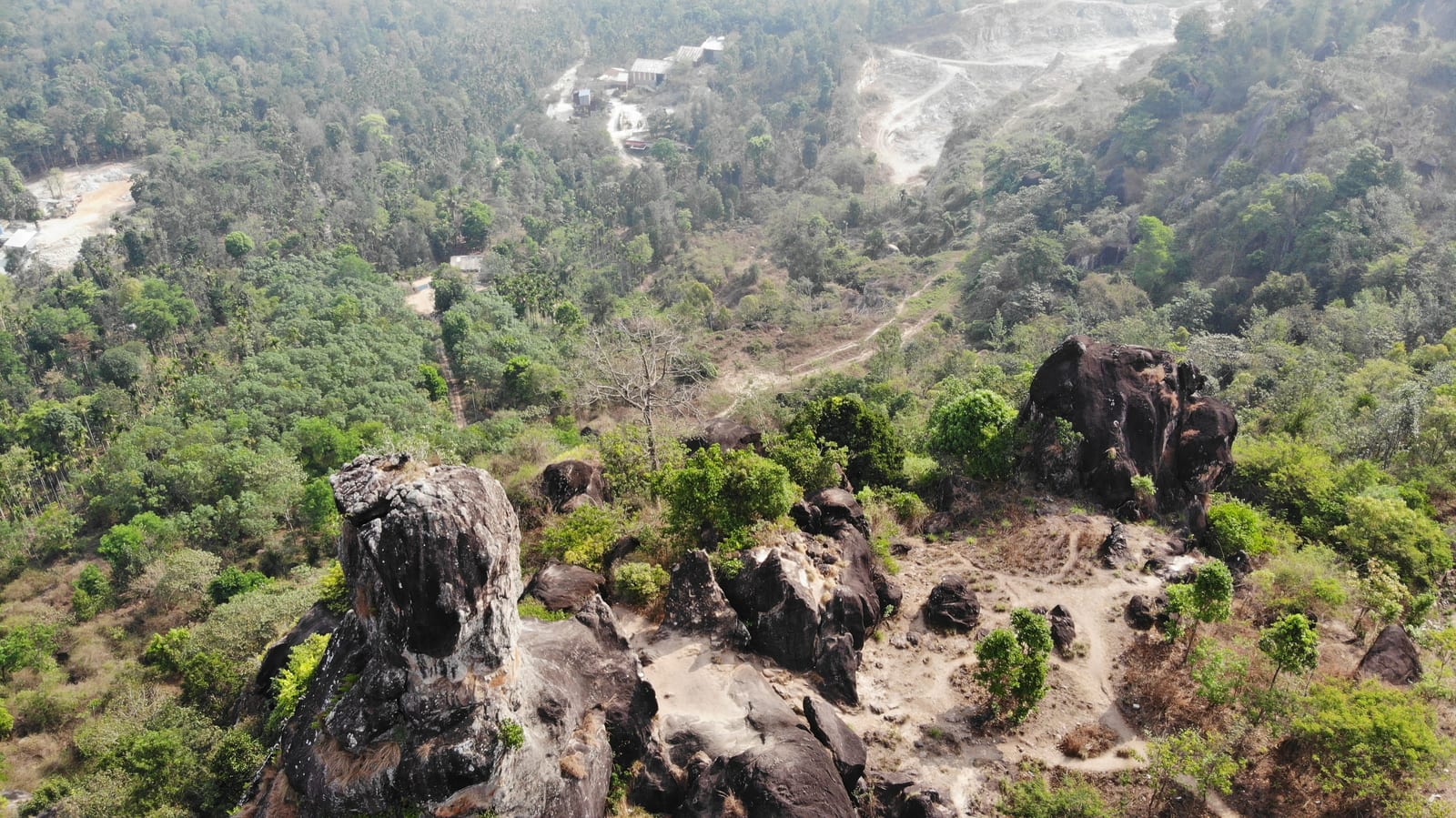
The visit begins as a climb. From the base of Ambukuthi Mala, a steep track of roughly a kilometre and a half rises through boulder-strewn slopes and shade trees, part paved steps, part rough rock, with hand-railed stretches near the top. It is the kind of ascent that leaves you breathing hard and grateful for the tea stalls along the way, and it filters out the merely curious — everyone who reaches the cleft has earned it. As you gain height the plantations of Wayanad open below you, and the air cools with every switchback.
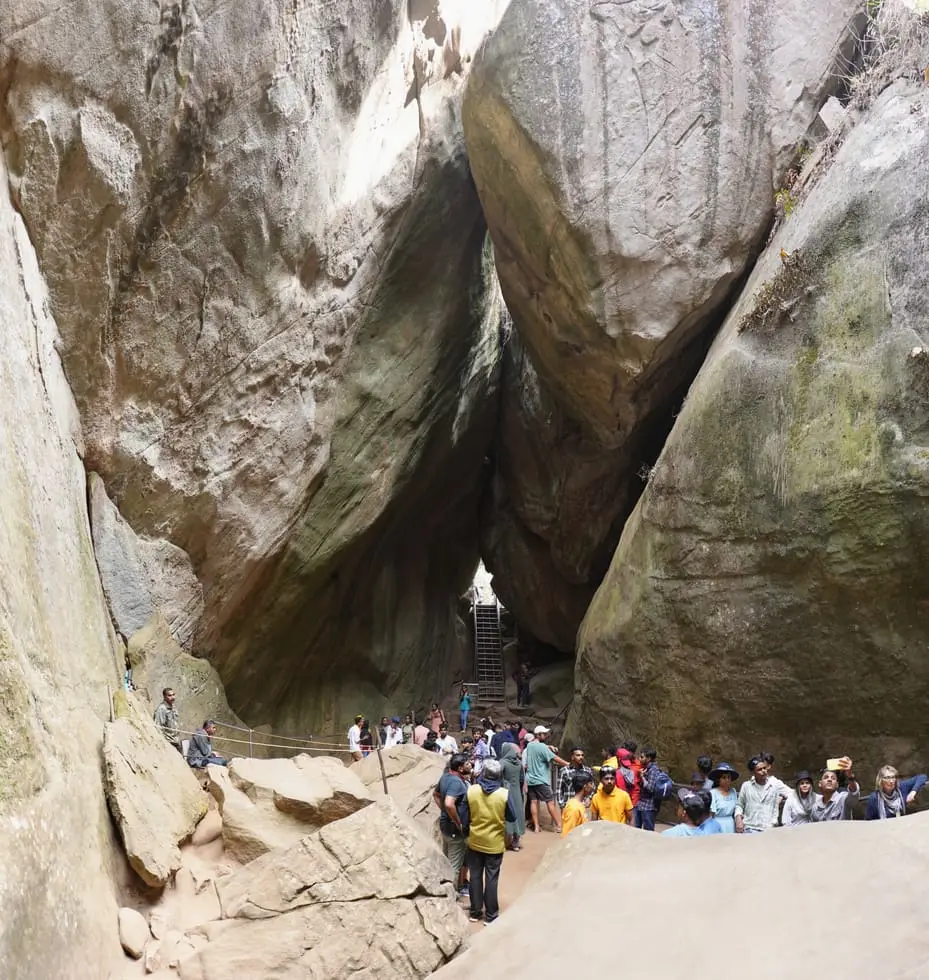
Near the summit the path squeezes into the thing itself. Edakkal is not a hollowed cavern but a cleft, a deep fissure where a slab of rock split away from the hillside, and a single enormous boulder — weighing several tons — dropped across the gap to form a natural roof. The Malayalam name captures it exactly: a stone lodged in between. You climb an iron stairway up through the lower chamber and emerge into the upper cleft, roofed by that suspended boulder, light slanting in from the open ends. It feels less like entering a room than slipping into a crack in the earth.
Then you see the walls. Across the rock faces, engraved rather than painted, are hundreds of figures: stick-limbed humans with elaborate headdresses, animals, wheels and spoked circles, tools, and geometric symbols whose meaning is lost. Some are crisp, some almost erased by six thousand monsoons. The carvings crowd together and overlap, older marks half-buried under newer ones, so that the wall reads like a palimpsest scratched by many generations who each found this cleft worth marking.
What lingers is the sense of deep time. These are among the oldest human engravings in South India, and standing before a 'man with jar cup' or a wheeled figure you are looking at the direct handiwork of Neolithic people — not a reconstruction, not a museum cast, but the actual stone they cut. There is no glass between you and them. The realisation that the same slanting light fell on someone doing this work eight thousand years ago tends to silence even chattering tour groups for a moment.
Step to the open lip of the cleft and the reward switches from ancient to vast. The hill falls away to a green sweep of Wayanad — plantations, forest, and distant blue ridges of the Western Ghats folding toward Mysuru. Ambukuthi sits near what was once a trade route linking the high country of Mysore to the ports of the Malabar Coast, and from up here you understand why: this is a natural lookout, a place that commanded the land long before it commanded the imagination of archaeologists.
Coming down, the caves rearrange themselves in your mind. What looked from the car park like a modest hilltop attraction turns out to be a rift you can walk into, a roof made by a single dropped boulder, and a gallery of the earliest art in the region — all reached on your own two feet. Few sites in Kerala fold together a hard, honest climb, a geological freak of nature, and genuine prehistory quite like this one.
Legend & myth
Local legend gives the hill its name through an arrow. Ambukuthi is popularly read as 'the place the arrow struck' (from ambu, arrow), and folklore holds that the great cleft was opened by arrows loosed by Lava and Kusha, the twin sons of Lord Rama — the split rock supposedly marking where their shafts pierced the hillside. It is told as a story rather than history, but it is the tale the hills carry.
Another strand of local lore links the cleft to Kutti Chathan and the goddess sometimes named Mudiampilly, folk deities of the region, weaving the caves into the older devotional imagination of Wayanad's communities. Like the arrow legend, this belongs to living folklore, not to the archaeological record of the site.
History
The caves were brought to scholarly attention in 1890 by Fred Fawcett, a police official of the erstwhile Malabar administration, who recognised at once their anthropological and historical importance and wrote about them, drawing the notice of researchers. The site had of course long been known to local and tribal communities; Fawcett's account moved it from local knowledge into the world of formal study.
The engravings are petroglyphs — figures cut and pecked into the rock rather than painted on it — and they are of at least three distinct types laid down over a very long span. The drawings range from the Neolithic, as early as around 6,000 BC, down to roughly 1,000 BCE, and some scholars judge the oldest markings to be over 8,000 years old, placing Edakkal among the earliest human engravings yet found in South India.
The carvings show human and animal figures, tools, wheels, and a set of enigmatic symbols that remain undeciphered. Their layering matters: because newer engravings overlie older ones, the panels record not a single moment but successive waves of people using the same cleft across millennia, which is part of why the site is treated as a window onto continuous prehistoric habitation rather than a one-off shrine.
The most debated find came in September 2009, when historian M. R. Raghava Varier of the Kerala State Archaeology Department identified one motif as a 'man with jar cup' — a symbol strongly associated with the Indus Valley civilisation. Scholars including the eminent epigraphist Iravatham Mahadevan called it very significant and a major discovery, and the Edakkal version was argued to resemble the Indus motif even more closely than comparable signs known from Tamil Nadu and Karnataka, feeding theories of contact between the Harappan world and the far south. The link remains a scholarly hypothesis, not settled fact, and the symbols themselves are still not fully deciphered.
Edakkal is not only prehistoric. The site also preserves a much later inscription — a Prakrit Grantha record attributed to the Kadamba ruler Vishnuvarman of around the 5th–6th century CE — showing that the cleft continued to draw people, and rulers, long after its Stone Age artists were gone.
Why visit
It is one of the very few places anywhere in India where you can walk inside a prehistoric rock shelter and stand face to face with Neolithic petroglyphs — the actual engraved stone, over 6,000 years old, with nothing between you and it.
The formation itself is a natural wonder: a deep cleft in the hill roofed by a single several-ton boulder wedged across the gap, so the 'cave' is really a rift you climb up into.
The climb up Ambukuthi Mala is a genuine short trek that rewards effort — an experience in its own right, not just a photo stop — and it keeps the site feeling earned rather than packaged.
The 'man with jar cup' motif and its debated Indus Valley connection give the site a live intellectual mystery: you are looking at symbols scholars are still arguing about.
From the upper cleft the views open across the plantations, forests and distant ridges of Wayanad and the Western Ghats — a sweeping panorama over an ancient hill-to-coast trade corridor.
It pairs naturally with the rest of a Wayanad itinerary from Sulthan Bathery, combining prehistory, a hill walk, and scenery in a single half-day outing.