The story
Hidden deep in the deciduous forest east of Meppadi, Meenmutty is Wayanad’s biggest and most dramatic waterfall — a three-tiered giant that spills down a rocky mountain face reached only on foot, by a couple of kilometres of jungle trek off the Kalpetta–Ooty road.
The story of Meenmutty Waterfalls
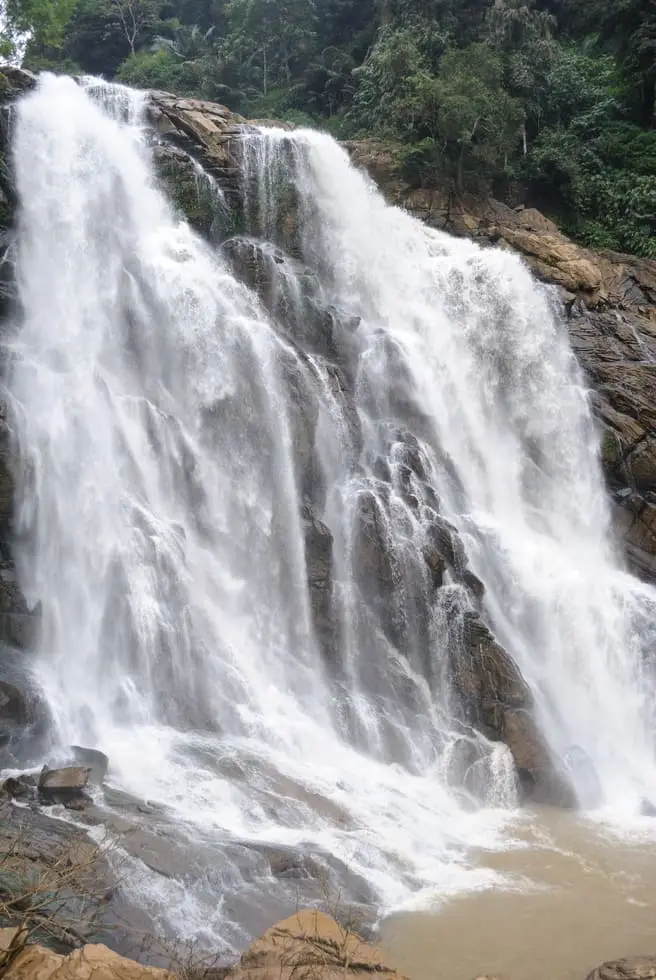
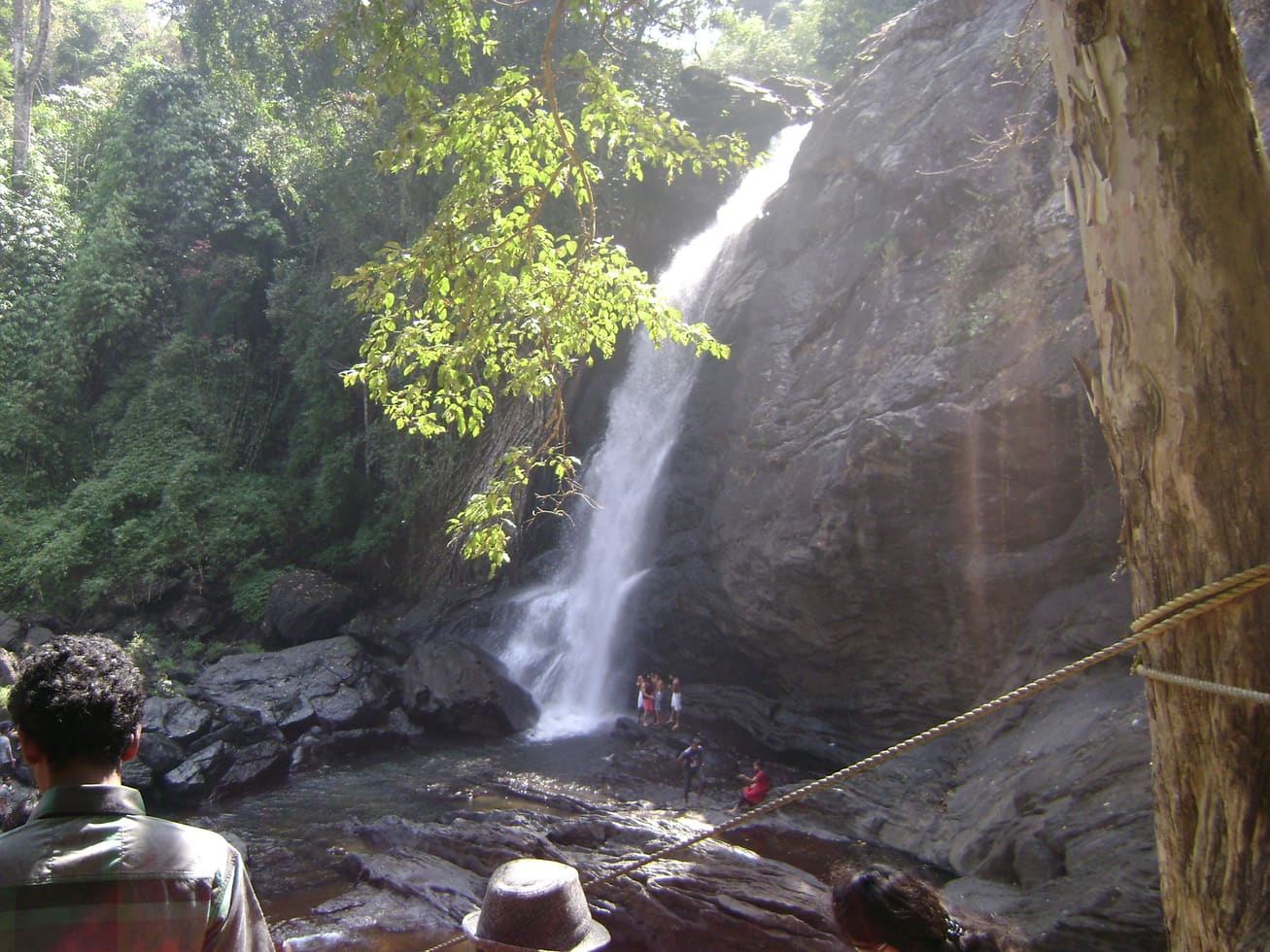
Meenmutty does not reveal itself easily, and that is precisely its appeal. There is no viewpoint you can drive to, no railing to lean on. From the forest gate near Meppadi you set off on foot, following a rough path that climbs through shola forest and old plantation edges, and only after a couple of kilometres of walking does the roar in the distance resolve into water. The reward is one of the largest waterfalls in Wayanad, a broad curtain of white tumbling in three great steps down a dark rock wall — a sight most casual tourists never see, because most casual tourists never make the walk.
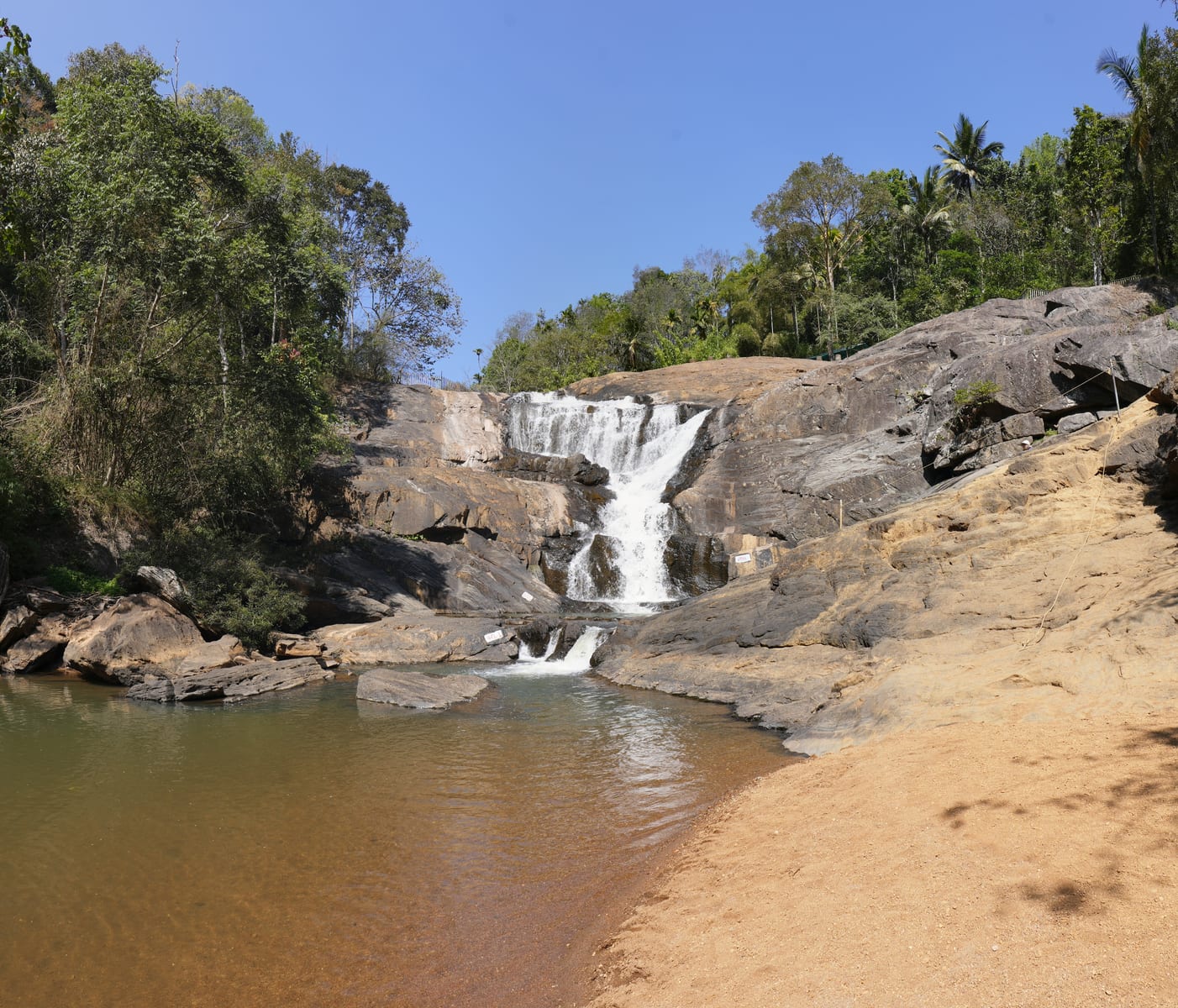
The falls are arranged in three distinct tiers, and reaching each one is a small expedition in itself. The first tier comes after roughly half a kilometre of walking, and here the stream pools into a comparatively gentle basin where trekkers stop to cool off. To reach the second tier you climb further, picking your way up boulder steps beside the rushing channel, and the forest closes in around you. The third and highest tier is the toughest of all — a steep scramble over slippery, spray-soaked rock, in places aided by ropes, that many visitors choose not to attempt at all.
Sources disagree on exactly how tall Meenmutty is, and the figures thrown around — anywhere from around three hundred metres of total descent to headline numbers of nearly a thousand feet — should be treated with caution rather than taken as gospel. What is not in dispute is the scale of the thing: the water spreads out across a wide rocky face, the three tiers together running to a considerable spread, and standing at the base you feel very small indeed. It is routinely described as the biggest waterfall in the district, and on a full-flow day it is easy to believe.
The name itself tells a quiet story. In Malayalam, meen means fish and mutty means blocked, and the falls are said to mark the point where migrating fish, swimming up the stream, are finally stopped by the sheer rocky wall and cannot travel any further upstream. It is a plain, practical name given by people who knew this water intimately — the tribal and farming communities of these hills — long before it appeared on any tourist map, and it captures something true about the place: this is where the river turns from a climbable stream into an impassable cliff of falling water.
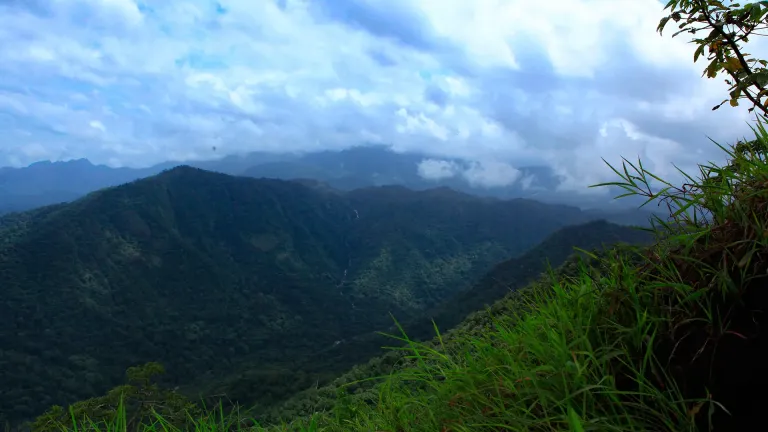
The trek is as much a part of the experience as the falls. The path runs through a genuine forest, part of the wider Wayanad wilderness on the flank of the Western Ghats, and it is alive — butterflies over the stream, the calls of hornbills and barbets overhead, the constant possibility of larger animals moving unseen through the trees. In the wetter months the same forest brings leeches, and the rocks turn treacherous. This is why a local guide is not a luxury but sensible practice; the route is not always obvious, and the forest does not forgive carelessness.
For all its beauty, Meenmutty carries a sober reputation. During the monsoon the volume of water becomes enormous and the rocks lethally slippery, and the falls have claimed lives over the years — drownings have been recorded here since the early 1990s. The site is frequently closed outright in heavy rain, and even in the dry season the upper tiers demand respect. Those who come in the right season, walk carefully, and treat the water with caution carry away the memory of one of Kerala’s great hidden cascades; those who take it lightly can come to grief. It is a place that rewards effort and punishes complacency in equal measure.
Legend & myth
There is no grand temple legend attached to Meenmutty, but the falls do carry a piece of folk naming-lore worth telling. Local tradition holds that this is the spot where fish swimming up the stream are turned back — meen, fish, and mutty, blocked — because the towering, spray-slicked rock face simply cannot be climbed by any creature of the water. Whether or not the fish ever truly gathered here in numbers, the story survives in the name, a small legend of the natural world rather than of gods, passed down by the hill communities who named the place.
History
Meenmutty belongs to the deep human and natural history of Wayanad, the highland district that sits where Kerala meets the Western Ghats. For centuries these forests were the domain of Adivasi communities — the Paniyar, Kurichiyar, Kattunayakan and others — who lived by and knew every stream and ridge of this country, and it was almost certainly they who first named the falls after the fish that could climb no higher. The plainness of the name, describing exactly what happens at the spot, is itself a marker of that old, intimate, working relationship with the land.
The wider landscape around the falls was reshaped in the nineteenth and twentieth centuries, when British planters opened up the Wayanad highlands for tea, coffee and cardamom. The estates around Meppadi and Chembra date to this plantation era, and the approach to Meenmutty still runs past the green geometry of tea before it plunges into the wilder forest. The Kalpetta–Ooty road along which the falls are approached was itself a product of this opening-up of the hills, linking the plantations of Wayanad to the Nilgiris beyond.
As a destination for outsiders, Meenmutty is a relatively recent arrival. For most of its history it was simply a feature of the forest, known to those who lived and worked nearby but visited by almost no one else. Only as Wayanad grew into one of Kerala’s most popular hill destinations, from the late twentieth century onward, did the falls begin to draw trekkers and adventure-minded travellers willing to make the walk — and even now it remains far less crowded than Wayanad’s roadside attractions precisely because it cannot be reached without effort.
That growing footfall has brought a harder chapter too. The falls have a documented record of fatal accidents, with drownings noted here since the early 1990s, almost always tied to the monsoon and to visitors underestimating the power of the swollen water. In response the Forest Department has brought the site under managed access — with defined timings, entry formalities and closures during dangerous conditions — reflecting a wider shift across Wayanad toward controlling and protecting fragile, and sometimes deadly, wild spaces.
Today Meenmutty sits within the protected forest fabric of Wayanad, and its story is increasingly one of balance: keeping the trek open to those who want the genuine wilderness experience, while guarding both the visitors and the ecosystem. The leech-filled monsoon forest, the elephants and hornbills of the surrounding jungle, and the sheer scale of the three-tiered falls are all reminders that this is a working piece of the Western Ghats — a UNESCO-recognised biodiversity hotspot — and not a manicured tourist set-piece.
Why visit
It is the biggest waterfall in Wayanad, and one of the largest in Kerala — a genuine three-tiered giant rather than a modest roadside cascade, and seeing it in full flow is a memorable payoff.
The journey is the point: a couple of kilometres of real jungle trek through Western Ghats forest, past tea plantations and along a rushing stream, delivering an adventure that Wayanad’s drive-up attractions simply cannot match.
Because it can only be reached on foot, it stays far quieter and wilder than famous nearby falls — you earn a sense of solitude and discovery that is increasingly rare at popular hill stations.
The three tiers offer three different experiences — a gentler lower pool, a boulder-stepped middle section, and a steep, rope-assisted upper climb — so you can go as far as your fitness and nerve allow.
The surrounding forest is richly alive, with a real chance of spotting hornbills, eagles, langurs, butterflies and the signs of larger wildlife, making the walk a nature outing as much as a waterfall visit.
For fit, prepared travellers who want the authentic wild side of Wayanad — and who respect the trek and the season — Meenmutty is one of the district’s most rewarding and least commercialised experiences.