Weathered over untold millennia into the likeness of a giant human skull, Phantom Rock — locally Thalappara or Cheengeri Mala — crowns a breezy hill near Ambalavayal in eastern Wayanad, drawing trekkers, photographers and the plain curious to one of Kerala's strangest natural sculptures.
The story of Phantom Rock
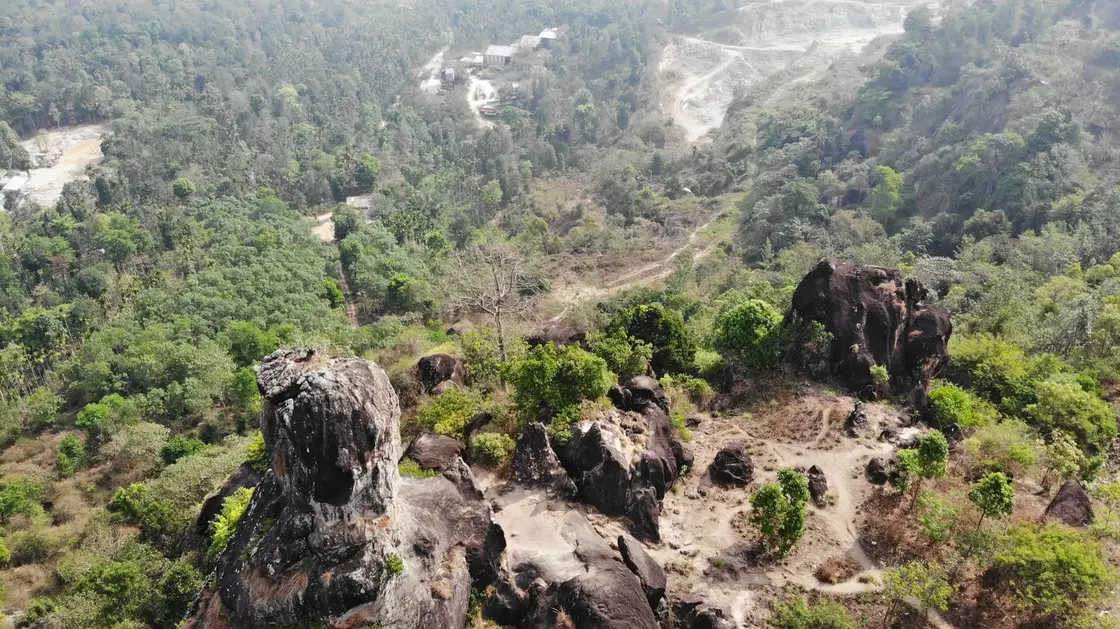
Some rocks are simply rocks; Phantom Rock is a face. Stand at the right angle on the grassy shoulder of Cheengeri Mala and the granite outcrop resolves, unmistakably, into a hollow-eyed skull staring out over the Wayanad plateau. It is this eerie, almost theatrical resemblance that earned the formation its English nickname — a nod to the masked comic-book hero 'the Phantom', whose own legend is bound up with a Skull Cave. To Malayali locals it has long been Thalappara or Thalakkallu, the 'head rock', and to the wider hills it is Cheengeri Mala, after the hill it sits upon.
The approach is half the pleasure. Phantom Rock lies just a couple of kilometres from the small town of Ambalavayal, reached by tidy plantation roads that thread through coffee, pepper and areca before the tar runs out. The last stretch — roughly the final five hundred metres (indicative — confirm locally) — is covered on foot, up a narrow lane and grassy path that climbs gently onto the ridge. It is an easy, rewarding walk rather than a hard slog, which is precisely why families, casual walkers and serious trekkers all find their way here.
At the top the reward is space and silence. The rock stands at around 2,600 feet above sea level (indicative — confirm locally), and from beside the skull the land falls away in every direction: tea and coffee estates stitched across the slopes, tribal hamlets tucked into the folds, and a horizon of blue-green hill ranges — Ambukuthimala, Manikunnu, Kolagappara, Arattupara — fading into haze. On clear mornings the glint of the Karapuzha Dam catchment shows to the south.
The formation has become something of a set-piece for adventurous visitors, who scramble carefully onto the crown of the skull for that vertiginous 'standing on the Phantom's face' photograph. It is not a technical climb, but the exposed granite can be slick, and a cool wind almost always combs the ridge. Sunrise and late-afternoon light are when the rock is at its most dramatic, the low sun deepening the hollows that read as eye-sockets.
Because the surrounding land is working plantation and estate country rather than a fenced-off monument, Phantom Rock still feels refreshingly offbeat — there are no ticket queues at the rock itself, no crowds jostling for the viewpoint, just the hill, the wind and that extraordinary weathered face. Nearby, the Cheengeri hills have been developed by the District Tourism Promotion Council into a small adventure-tourism zone, adding a longer ridge trek and rope-assisted scrambles for those who want more than the short walk to the rock.
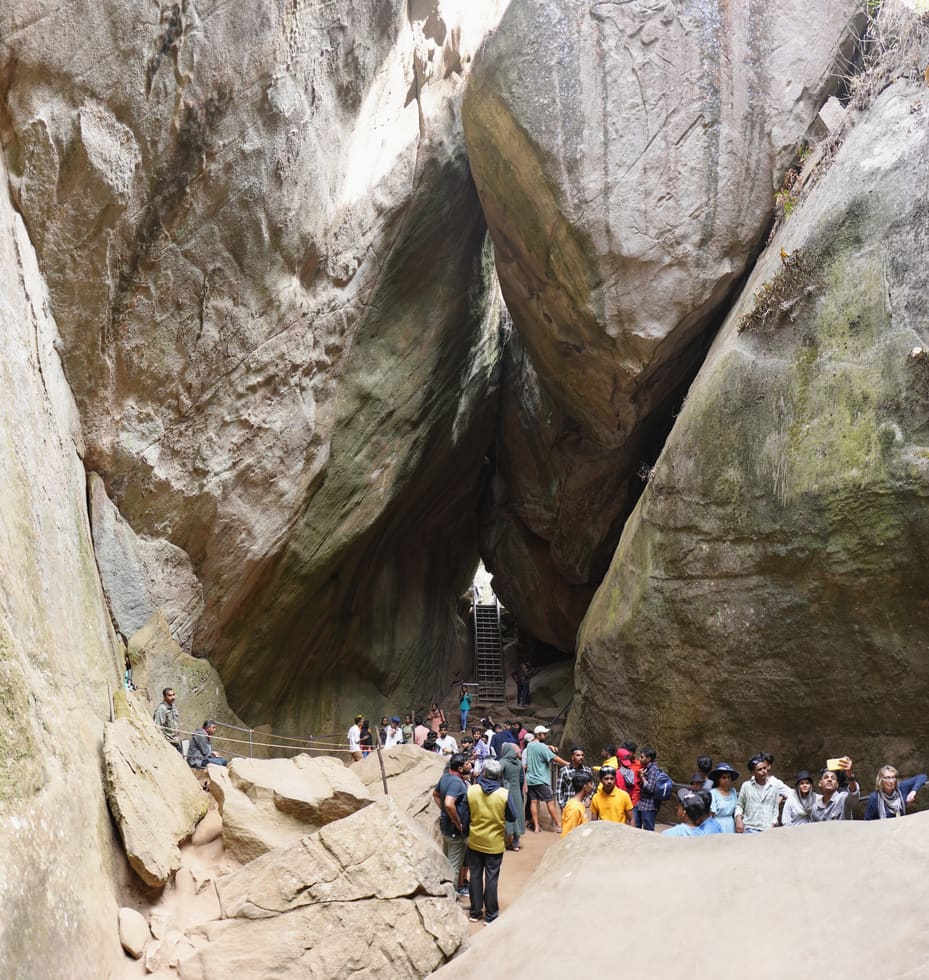
For most travellers Phantom Rock is a half-morning or late-afternoon detour rather than a full day, easily paired with the famous Edakkal Caves, the Ambalavayal Heritage Museum or the Karapuzha Dam, all within a short drive. But it is the kind of place that lingers — an accident of geology so precise in its resemblance that it feels, briefly, deliberate.
History
Geologically, Phantom Rock is a hard, ancient outcrop of the Precambrian crystalline basement that underlies the Wayanad plateau — described variously as a metamorphic and granitic rock formation. It was never carved or placed by human hands; its skull-like silhouette is the work of deep time and weathering alone.
The shape is a textbook, if uncommonly vivid, example of differential erosion. Over many thousands of years wind, rain and the daily heating and cooling of the exposed stone have prised apart the rock along its joints and weaker mineral bands, rounding some surfaces and hollowing others. The two great cavities that read as eye-sockets, and the domed 'cranium' above them, are simply where softer or more fractured rock has weathered away faster than the resistant granite around it — a process geologists call spheroidal and cavernous weathering.
Sitting on a breezy, well-drained ridge at around 2,600 feet, the rock has been especially exposed to these forces. Wayanad's pronounced wet-and-dry monsoon cycle — heavy south-west monsoon rains followed by long dry spells — accelerates the flaking and granular disintegration of the surface, which is why the formation is often called a natural sculpture that is still, imperceptibly, being carved.
The Ambalavayal area around the rock is one of the most historically layered corners of Wayanad. Just down the road, the Edakkal Caves preserve Neolithic petroglyphs thousands of years old, and the district as a whole was a frontier of tribal settlement, spice cultivation and, later, colonial-era plantation development. Phantom Rock itself has no recorded ancient monument status, but it stands amid this deep human landscape of estates and Adivasi hamlets.
The formation is not without threat. Conservationists and reporting have flagged unregulated granite quarrying in the vicinity as a danger to the fragile outcrop — a reminder that a rock which took millennia to shape could be damaged in a fraction of that time. The surrounding forest patches still shelter medicinal plants used by local communities and birds such as the Malabar Grey Hornbill and White-bellied Treepie.
Why visit
The skull itself: a genuinely uncanny, naturally weathered rock face that looks so much like a human skull it has to be seen to be believed — one of the most photographed natural oddities in Wayanad.
Panoramic Wayanad views: from the ridge you get a sweeping 360-degree outlook over coffee and tea estates, tribal villages and a wall of blue hill ranges, with the Karapuzha catchment glinting in the distance.
An easy, family-friendly trek: unlike Wayanad's tougher summits such as Chembra Peak, the walk to Phantom Rock is short and gently sloping, so casual walkers and children can reach the top and still feel they have 'climbed' something.
That hero photograph: carefully standing on the crown of the skull for a shot over the valley is a rite of passage here — dramatic, offbeat and unlike anything at Wayanad's more conventional viewpoints.
Sunrise and sunset drama: low-angle light pools in the rock's hollows and sets the surrounding hills glowing, making the early-morning and late-afternoon visits especially rewarding.
Offbeat and uncrowded: with no big ticket gate at the rock itself and a location off the main tourist circuit, it retains a quiet, exploratory feel, and pairs neatly with the nearby Edakkal Caves and Ambalavayal Heritage Museum.