On a breezy laterite hill at Illikkunnu, a red-tiled colonial bungalow looks out over the Arabian Sea — the very rooms where a young German missionary quietly gave Malayalam its first great dictionary.
The story of Gundert Bungalow
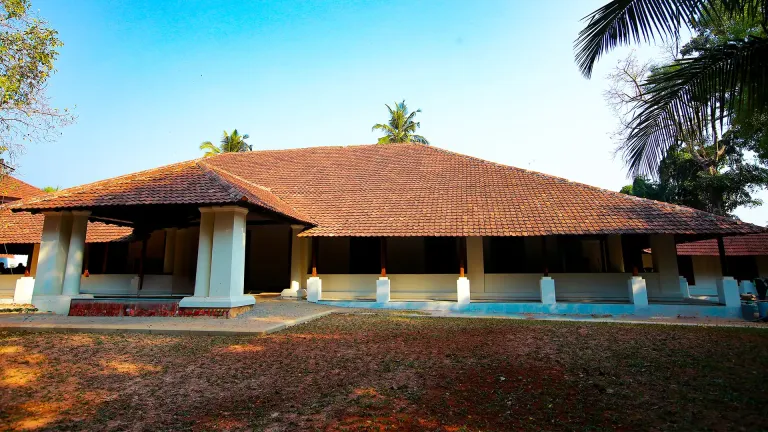
Perched on the little hill of Illikkunnu, a few kilometres from Thalassery (old Tellicherry) town and close to the Kuyyali river, the Gundert Bungalow is one of Kerala’s most understated but consequential landmarks. From the outside it is a graceful old Malabar house — thick laterite walls, deep shaded verandahs running on every side, tall wooden doors and shuttered windows, high ceilings and a sweeping sloped roof of red clay tiles. From the verandah the land falls away towards the sea, and the light and the salt air are much as they were when a scholarly German in his twenties sat here with a pen and an impossible task.
That German was Dr Hermann Gundert (1814–1893), a Basel Mission missionary and linguist who lived and worked at Thalassery for roughly twenty years, from about 1839 until ill health forced him home to Germany in 1859. He came as a preacher and educator, but it is as a scholar of the Malayalam language that he changed history. Immersing himself in the tongue of the Malabar coast, he set out to describe and codify it with a rigour that no one had attempted before — and he did much of that monumental work in and around this hilltop house.
The achievement that towers over the rest is his Malayalam–English dictionary, a scientifically compiled lexicon widely regarded as the first modern Malayalam dictionary and still consulted today (it was published in 1872, by C. Stolz for the Basel Mission press at Mangalore). He also produced an influential Malayalam grammar, the Malayalabhasha Vyakaranam (1851), translated large parts of the Bible, and — a small detail with huge consequences — helped introduce Western-style punctuation into Malayalam prose. Through Gundert’s hands the language acquired reference tools, standardised prose and a scholarly foundation that generations of writers would build on.
From Illikkunnu, Gundert also midwifed Malayalam journalism. In June 1847 he edited and issued Rajyasamacharam, generally counted as the first Malayalam newspaper, and followed it that October with Paschimodayam, a magazine of general knowledge. That these pioneering periodicals were set and printed in the Thalassery neighbourhood makes this quiet hill, in a real sense, a birthplace of the Malayalam press. Gundert wrote around a dozen Malayalam books during his Kerala years, and started a school here too.
There is a literary footnote that delights visitors: Gundert’s daughter Marie married into the Hesse family, and his grandson was Hermann Hesse — the German novelist and 1946 Nobel laureate who wrote Siddhartha. The scholar who spent two decades listening to Malayalam on this coast is thus grandfather to one of world literature’s best-loved names, and the museum today honours that thread with a Hermann Hesse library.
For decades the bungalow drifted quietly through private hands and near-obscurity, cherished mostly by scholars and by Thalassery locals who knew what had happened here. In 2022 the Government of Kerala restored the heritage building and reopened it as the Gundert Museum under the Thalassery Heritage Tourism Project, so that the story of one German’s devotion to Malayalam — and of the language’s coming-of-age — could finally be told in the place where it unfolded.
History
Hermann Gundert was born on 4 February 1814 in Stuttgart, in the German kingdom of Württemberg, and died on 25 April 1893 in Calw. He trained for missionary and scholarly work and joined the Basel Mission, the Swiss-German Protestant society then active on the Malabar coast. He married Julie Dubois, from French-speaking Switzerland, in 1838, reached India in the late 1830s, and settled at Tellicherry (Thalassery) from around April 1839, living there roughly two decades with Julie until poor health took the family back to Germany in 1859.
During those Thalassery years Gundert turned himself into arguably the finest European scholar of Malayalam of his age. His Malayalabhasha Vyakaranam (Malayalam grammar) appeared in 1851, and his crowning work, A Malayalam and English Dictionary, was published in 1872 by C. Stolz for the Basel Mission Book and Tract Depository at Mangalore. Prepared with unusual scientific care and drawing on classical and colloquial usage alike, it is regarded as the first advanced Malayalam dictionary and remains a reference point for scholars. (Some sources cite 1871–1872 for the printing; the widely used edition is dated 1872.)
Gundert was also a pioneer of Malayalam publishing and journalism from Thalassery. Rajyasamacharam, considered the first Malayalam newspaper, was launched under his editorship in June 1847, and Paschimodayam, a knowledge and news magazine, followed in October 1847 — both associated with the Illikkunnu neighbourhood. He translated scripture from Hebrew and Greek into Malayalam, wrote around thirteen Malayalam books during his residence, and is credited with helping bring modern punctuation into Malayalam prose. After returning to Germany he directed the Calw Publishing House from 1862.
The literary lineage is genuine and often retold: Gundert’s daughter Marie Gundert (1842–1902) was the mother of the novelist Hermann Hesse, making the Malayalam lexicographer the maternal grandfather of the 1946 Nobel laureate in literature. Hesse grew up steeped in his grandfather’s missionary-scholar world, and the family’s Indian connection echoes through parts of his work.
The bungalow itself is a 19th-century Malabar heritage building of laterite and timber under red clay tiles, standing on the Illikkunnu hill near the Kuyyali river (some tourism accounts give a construction date in the 1860s, so the exact building history is best treated as approximate — confirm locally). Long in private/lesser-known status, it was restored by the Government of Kerala at a cost of about Rs 2.21 crore under the Thalassery Heritage Tourism Project and opened to the public as the Gundert Museum on 7 May 2022, with zones on Gundert’s life and work, rare books, a Julie Gundert hall, a Hermann Hesse library, a Gundert statue and a digital book archive.
Why visit
Stand in the actual rooms where Malayalam got its first great dictionary and its first newspaper.
A rare, atmospheric slice of Malabar heritage architecture — laterite, timber and red tiles on a sea-facing hill.
The surprising Hermann Hesse twist: the German scholar here was grandfather to a Nobel laureate.
A properly restored 2022 museum with rare books, a digital archive and dedicated exhibition zones.
Sweeping Illikkunnu hilltop views towards the Arabian Sea and the Kuyyali river.
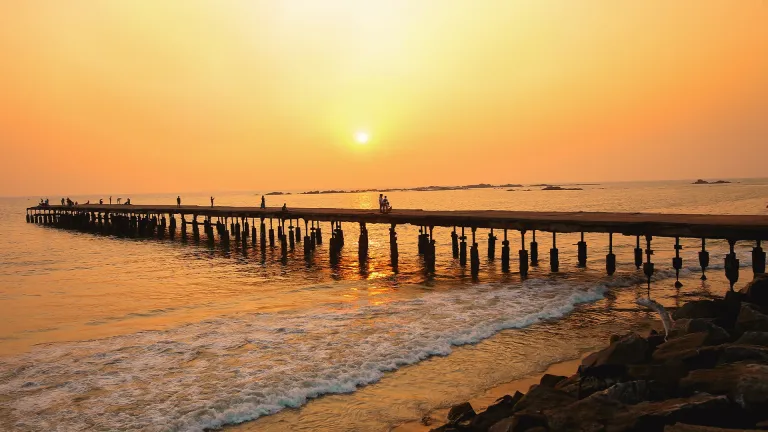
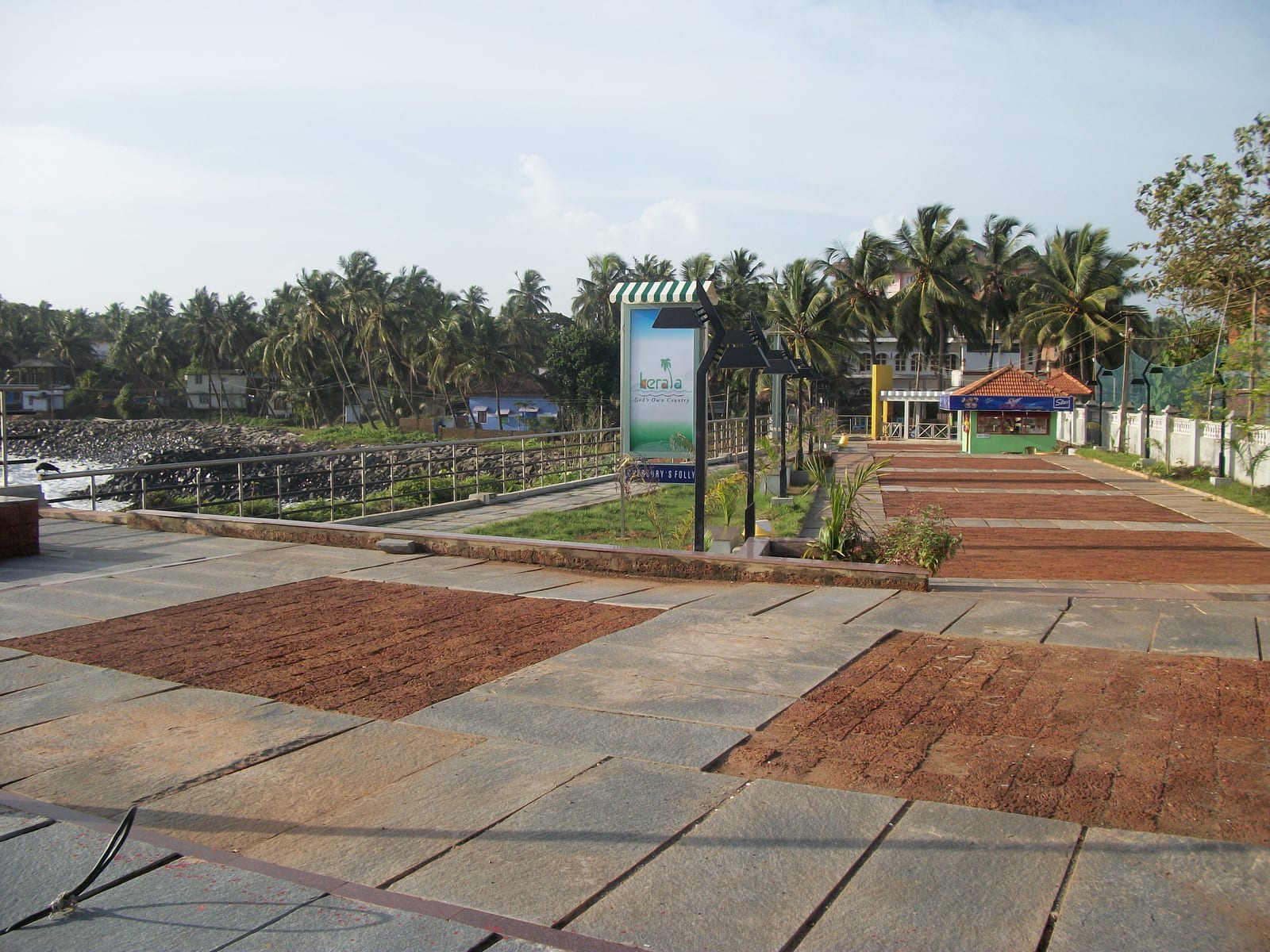
Pairs perfectly with Thalassery’s other landmarks — the fort, the pier and Overbury’s Folly — for a full heritage day.