The story
On a low, wind-scoured cape where the Arabian Sea gnaws at Kollam’s western edge, a tall red-and-white striped tower rises above coconut palms and the crumbling stone of a forgotten European enclave. This is Thangassery — Tangasseri on older maps — one of the most atmospheric heritage corners on the entire Kerala coast, where a British-built lighthouse of 1902 keeps watch over the ruins of a Portuguese fort, Dutch graves, an ancient spice port, and a breakwater lashed by surf. Climb the tower and the whole story of Kollam’s trading past unspools below you.
The story of Thangassery Lighthouse
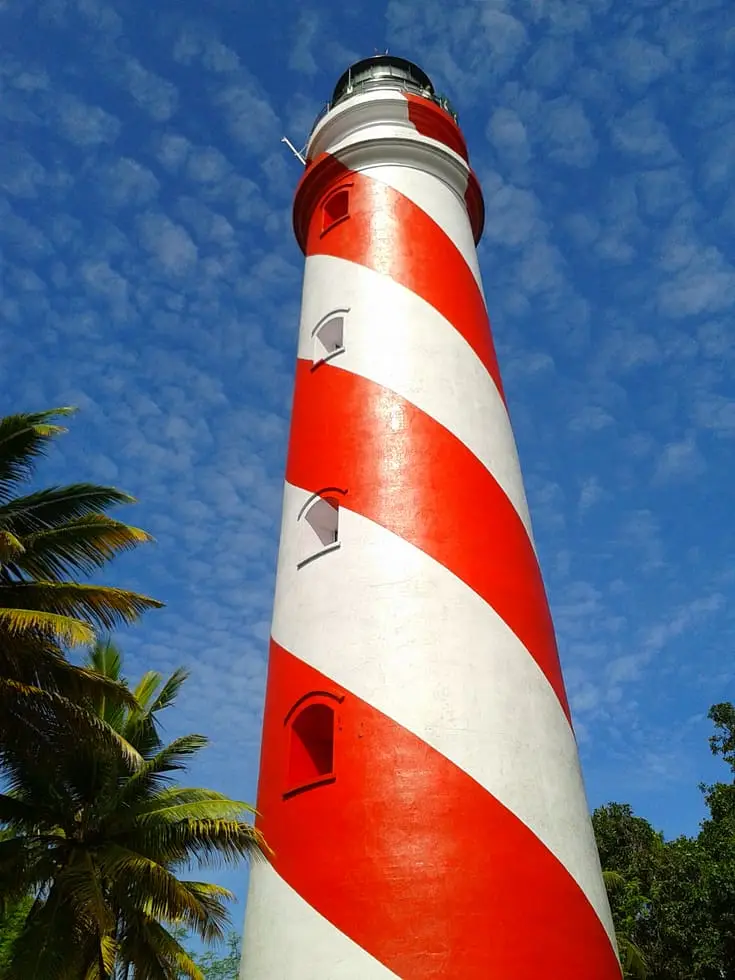
Thangassery is not a single monument but a layered coastal landscape, and the lighthouse is its exclamation mark. The tower stands roughly 41 metres tall (indicative — confirm locally; some accounts quote a little higher), a cylindrical masonry column banded in bold diagonal red-and-white stripes, one of the tallest and most recognisable lights on the Kerala coast. From the seafront it reads almost cartoonishly cheerful; up close it is a serious piece of colonial engineering, its whitewash streaked by decades of salt spray and monsoon.
The magic of the place is the compression of history into a short walk. Within a few hundred metres of the tower you can trace the outline of a Portuguese-built fort begun in the early sixteenth century, wander a walled cemetery of moss-dark Portuguese and Dutch tombstones, glimpse the eighteenth-century churches of the old European quarter, and stand at the edge of the ancient port of Quilon that once drew Arab dhows and Chinese junks across the ocean for pepper. Few Kerala sites braid so many empires into one cape.
Climbing the lighthouse is the headline experience, and it earns its ticket. A tight internal spiral staircase winds up through the tower to a gallery balcony, where the reward is a sweeping panorama — the Arabian Sea running silver to the horizon on one side, the tiled roofs and church spires of Kollam town on the other, the breakwater arms and fishing boats below, and on a clear evening the sun dropping straight into the water. It is an unhurried, breezy, deeply satisfying view that most visitors remember longer than any museum.
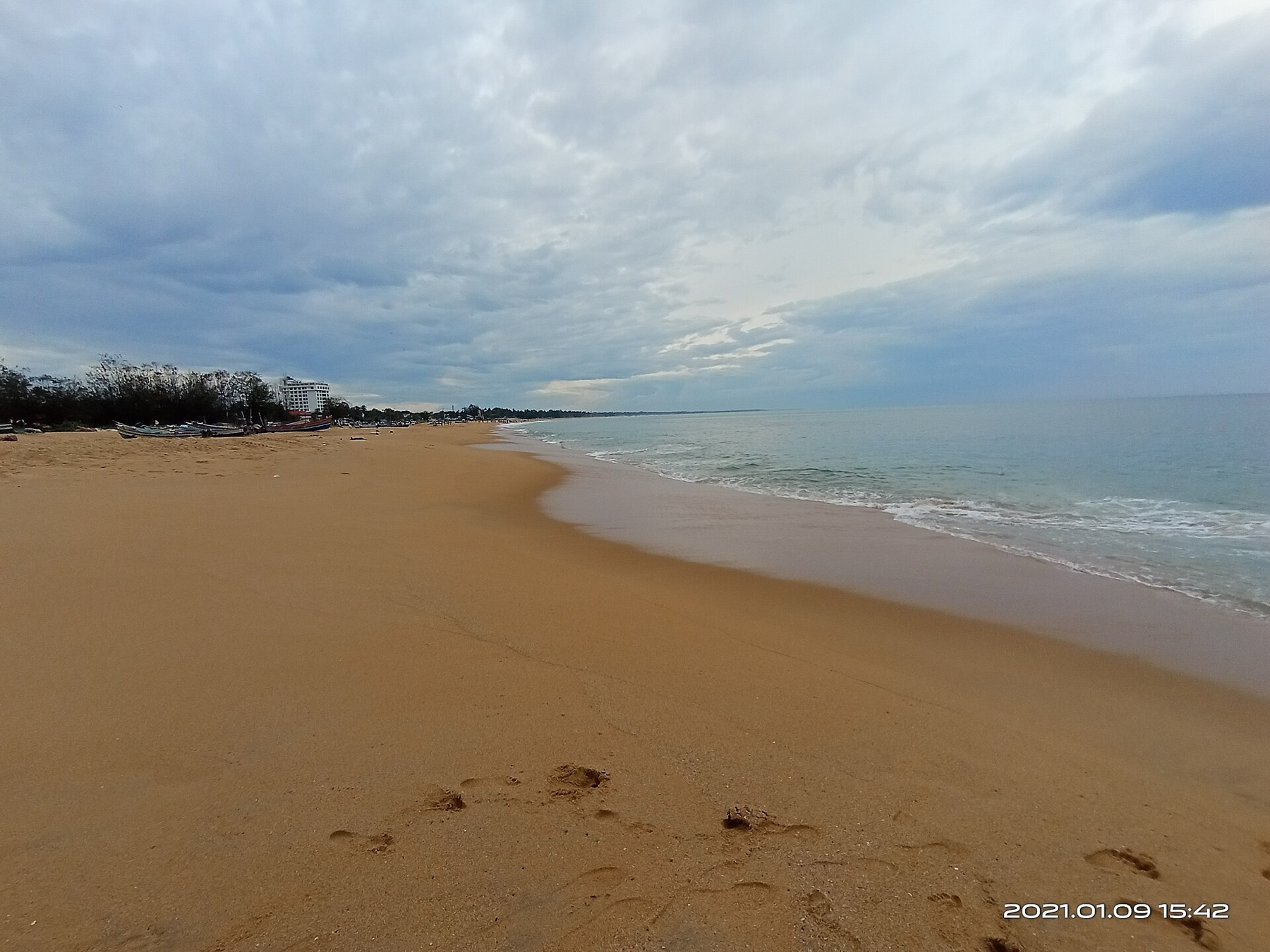
Around the base, the cape has the melancholy beauty of a place the sea keeps trying to reclaim. The Thangassery breakwater and its scatter of tetrapods hold back the surf; the shoreline here is rocky and dramatic rather than a soft resort beach, with fishermen mending nets and the occasional group of local families out for the sea breeze. The light itself still works as a genuine aid to navigation — this is a living lighthouse, not a museum piece, and its beam still sweeps far out over the shipping lanes at night.
The wider neighbourhood carries a distinct identity within Kollam. Thangassery grew up as a European enclave and long retained an Anglo-Indian and Latin Catholic character, its lanes lined with old bungalows, churches, and the surnames of a mixed colonial past. Kollam is also the beating heart of Kerala’s cashew country, and a visit here folds naturally into the flavour of the region — cashew factories, backwater edges of the great Ashtamudi Lake nearby, and the salt tang of a working coast.
Put together — the climbable striped tower, the fort ruins, the colonial graves, the ancient port, and the raw seafront — Thangassery is best understood as a heritage cape rather than a single attraction. Come in the golden light of late afternoon, give yourself time to wander as well as climb, and the place delivers something rare in Kerala: a coastline where you can physically read four centuries of Indian Ocean history in an hour.
History
Kollam — Quilon to European traders, Kollam or Coulão in various tongues — is one of the oldest continuously important ports on India’s south-western coast. Long before Europeans arrived, it was a celebrated node of the Indian Ocean spice trade, drawing Arab, Persian and Chinese merchants in search of pepper and other Malabar produce; Chinese fleets and Arab dhows are recorded calling here in the medieval centuries, and the port’s antiquity even anchors a traditional Malayalam era. Thangassery is the seaward tip of that ancient trading world.
The Portuguese arrived in the sixteenth century and, seeking to control the pepper trade, built a fortified trading base on this cape — the fort christened St Thomas, generally dated to around 1519 (indicative — confirm locally). In its early form it is described as having several towers and bastions with its entrance facing the sea, and under the Portuguese the surrounding settlement became a significant centre for the export of pepper, the black gold that first pulled Europe to Malabar.
Control then passed with the tides of empire. The Dutch East India Company took the fort in 1658, and after the Portuguese briefly clawed back ground it was recaptured by the Dutch around 1661, who used Thangassery as a warehouse hub gathering goods from along the coast. In 1795 the Dutch ceded Thangassery to the British, and the cape became a small British enclave — a status that shaped its churches, cemeteries and Anglo-Indian community, and that would later give it its lighthouse.
The lighthouse itself is a British-era addition, commissioned to make this busy but hazardous stretch of coast safer for shipping. It was put into service in 1902 (widely cited as commissioned on 1 March 1902 — indicative, confirm locally), replacing an earlier, simpler light said to have been an oil lamp on a tower maintained by the British East India Company. Built as a masonry tower on a reinforced-concrete foundation and painted in its signature diagonal red-and-white bands, it was engineered to throw a beam far out over the Arabian Sea, reportedly visible for the order of two dozen nautical miles (indicative — confirm locally).
In the decades after construction the tower reportedly developed cracks and had to be strengthened with additional jacketing masonry in the early twentieth century, and it has been maintained and modernised since as an active navigational light. Meanwhile the fort it overlooks was left to decay — today St Thomas Fort survives only as fragmentary ramparts and stonework, and the adjacent Portuguese and Dutch cemeteries, with their weathered European tombstones, stand as the most poignant surviving witnesses to the four empires that passed through this small cape.
Why visit
You can actually climb it. Unlike many working lighthouses, Thangassery opens its tower to visitors (during limited hours — see logistics), and the spiral climb to the gallery balcony delivers one of the finest coastal panoramas in southern Kerala: open Arabian Sea, Kollam town, the breakwater and the fishing fleet, all in one sweep.
It is a genuine four-empire heritage site. Within a short walk you move between an ancient Indian Ocean spice port, a Portuguese fort, Dutch graves, and a British lighthouse — a density of layered history that very few coastal spots in Kerala can match, and all of it walkable in an afternoon.
The tower is a photographer’s gift. The bold red-and-white diagonal stripes against a blue sky or a burning sunset sky make Thangassery one of the most photogenic landmarks on the coast, whether shot from the beach, the breakwater, or the balcony looking back down.
The seafront is raw and real. This is a working coast of rock, surf, breakwater tetrapods and fishing boats rather than a manicured resort beach — atmospheric, breezy, and free, and especially beautiful in the golden hour when the sun sets straight into the sea.
It pairs perfectly with Kollam’s other draws. The lighthouse sits within easy reach of the fort ruins, the old colonial churches and cemetery, the ancient port, and — a little further out — Ashtamudi Lake, the backwaters, and Kerala’s famous cashew country, making it an easy, rewarding half-day in Kollam.
It rewards the curious traveller. Thangassery is not overrun with tour buses; it retains a lived-in, slightly faded, deeply characterful sense of place — an Anglo-Indian and Latin Catholic enclave where history is still legible in the lanes, surnames and stones.