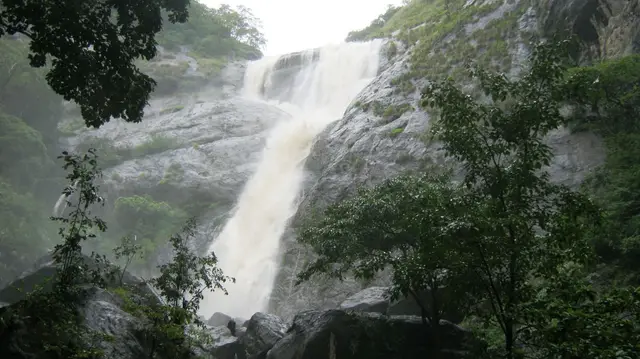
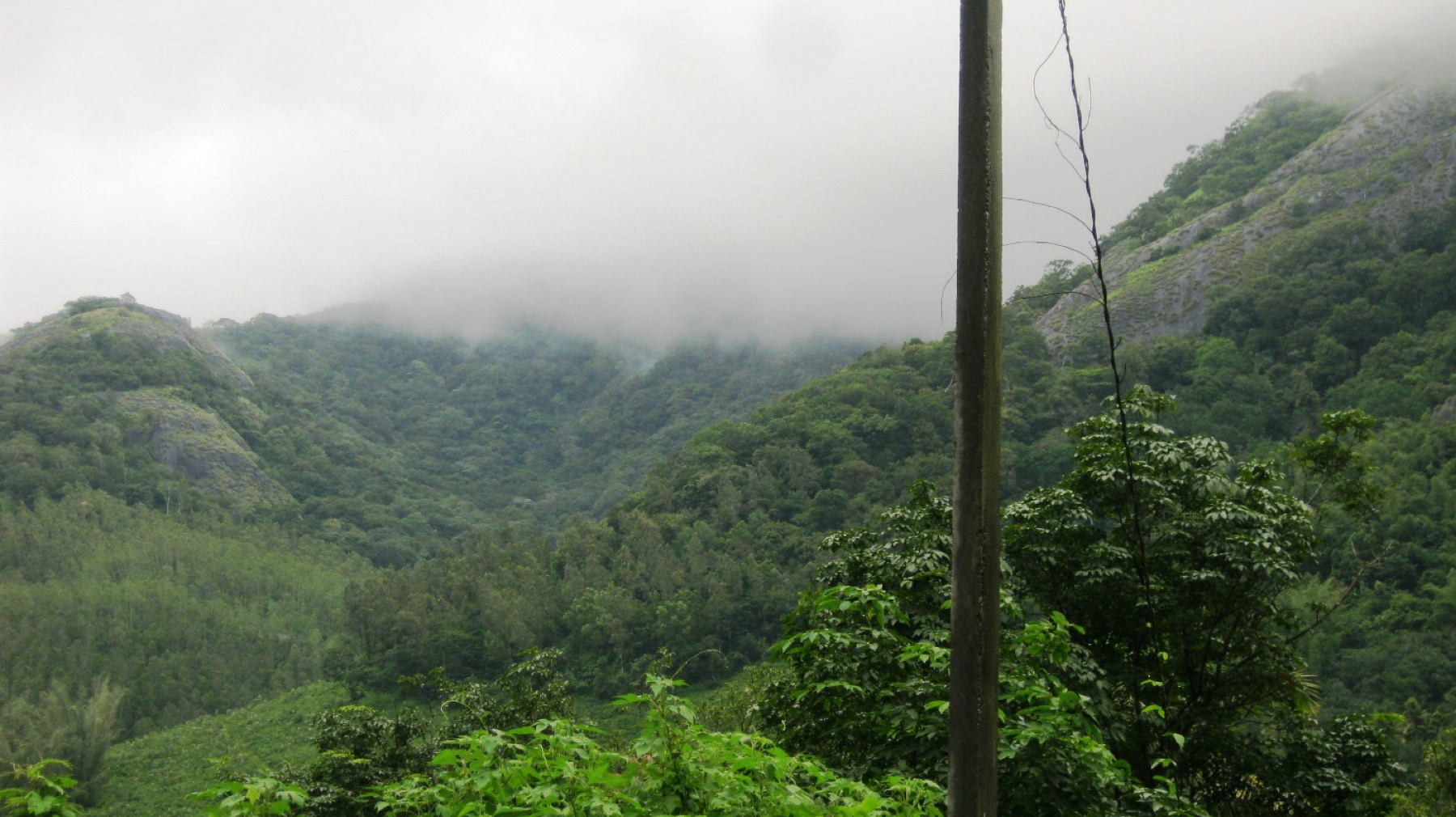
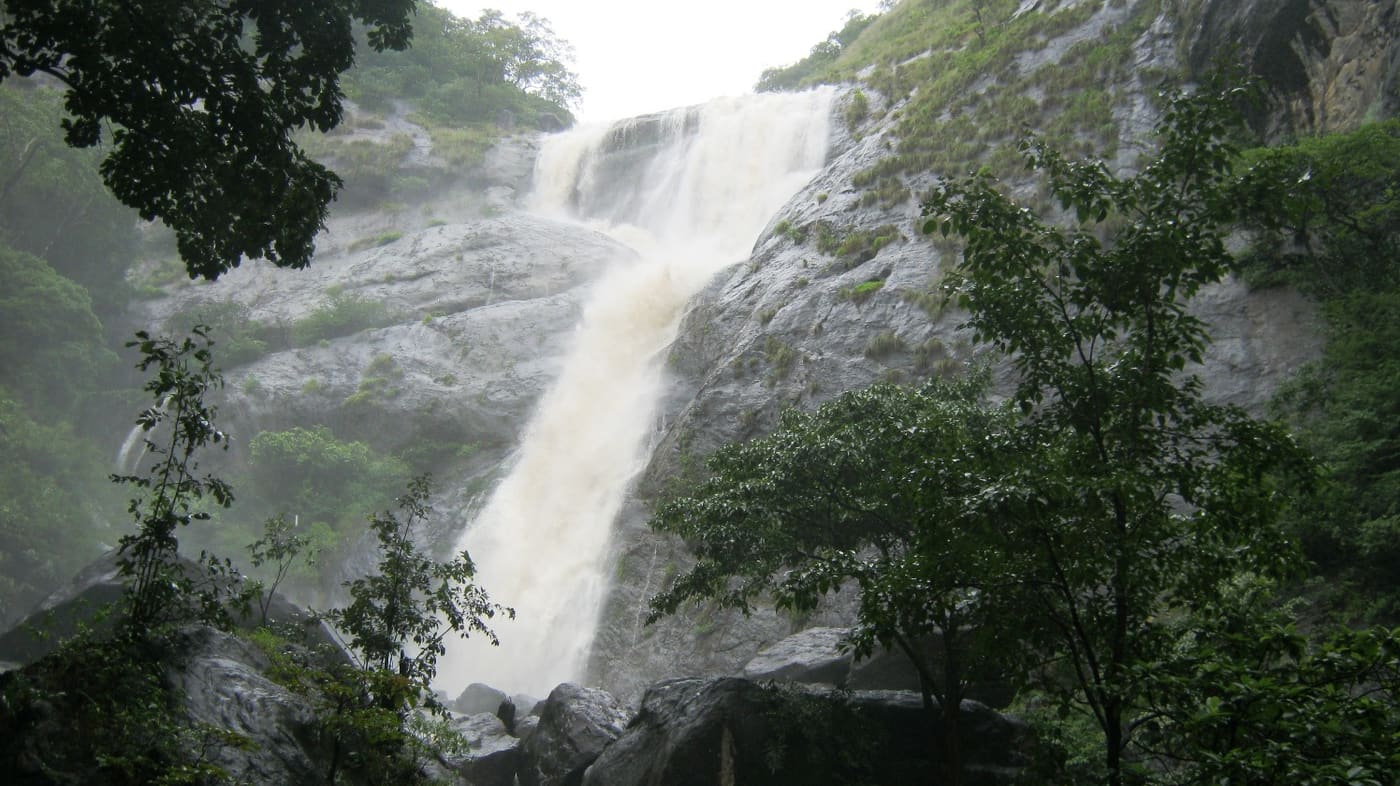
A two-tiered forest cascade on the Achankovil River, tucked deep in the Western Ghats reserve forest of eastern Kollam near Aryankavu and Achankovil — a misty, less-crowded cousin to nearby Palaruvi, reached by a short trek through thick jungle.
The story of Kumbhavurutty Waterfalls
Kumbhavurutty is one of those Kerala waterfalls that rewards the traveller willing to leave the highway behind. It sits in the far-eastern folds of Kollam district, close to where Kerala presses up against the Tamil Nadu border, in a belt of evergreen reserve forest fed by the Achankovil River. Unlike the postcard giants of the state, it stays comparatively quiet, and that solitude is half its charm — for long stretches you may share the pool with nobody but dragonflies and the occasional forest bird.
The falls drop in two clear segments over dark, weather-stained rock, tumbling roughly 25 metres (about 82 feet) before gathering in a shallow rock pool at the base. The water strikes a central shelf and throws up a fine, drifting mist that hangs in the canopy shade, keeping the whole glade cool even at midday. In good flow the sound of it carries well before you reach the clearing, a steady white roar swallowed by the surrounding green.
Getting there is part of the experience. From the nearest motorable point the falls are reached on foot along a short forest trail — commonly described as roughly half a kilometre — that threads past boulders, root-tangled slopes and narrow streams. It is rated medium-to-moderate rather than gentle, so sturdy shoes matter, but it is well within the reach of a reasonably fit day-tripper and the payoff comes quickly.
The pool at the foot is shallow — knee-to-waist deep in many spots, sometimes cited at around a metre or less — which makes it inviting for a paddle or a careful dip when the river is calm and clear. In the drier months families wade and sit on the flat rocks; in spate, the same water turns fast and unpredictable, and the shallow pool is best admired from the bank rather than entered.
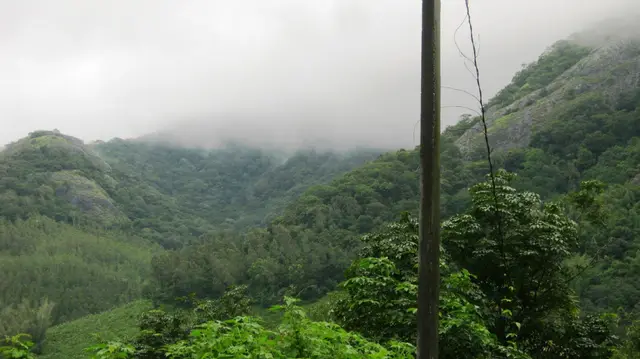
All around, the setting is classic Western Ghats: thick foliage, a tangle of endemic plants, butterflies working the sunlit gaps, and birdsong layered over the water. The falls sit within the broader Konni–Achankovil forest tract, so short nature walks and birdwatching are as much the draw as the cascade itself. This is a place to slow down, breathe damp forest air and let the noise of the water do the talking.
Kumbhavurutty is best understood as one bead on a string of highland attractions in this corner of Kollam. Palaruvi Waterfalls lies only a few kilometres off, the Ayyappa shrine and forest village of Achankovil is close by, and the whole zone falls under the umbrella of Thenmala — India's first planned eco-tourism destination. Pair it with those and you have a full day of forest, water and pilgrimage country along the old Kollam–Shencottah ghat route.
History
The falls themselves are a natural feature of the Achankovil River, a roughly 128-kilometre west-flowing river that rises from the confluence of the Rishimala, Pasukidamettu and Ramakkaltheri streams high in the Western Ghats before coursing through Kollam, Pathanamthitta and Alappuzha to join the Pamba. Kumbhavurutty lies in the river's upper forest reaches, a short distance — commonly cited as around 6.5 km — from the remote temple village of Achankovil.
This whole eastern edge of Kollam is old ghat country. The nearby settlement of Aryankavu sits astride the Aryankavu Pass, also called the Shencottah Gap, one of the historic low breaches in the Western Ghats that linked Travancore with the Tamil plains. For centuries this gap carried trade, pilgrims and, from the colonial era, the Kollam–Shencottah rail and road route; the falls lie in the forested hinterland just off that ancient corridor.
The broader region is anchored by faith as much as by forest. Achankovil is home to a celebrated Ayyappa (Dharmasastha) shrine, one of the important temples associated with the Sabarimala pilgrimage circuit, and Aryankavu too has its own well-known Sastha temple. An eco-pilgrimage linking the shrines of Kulathupuzha, Aryankavu and Achankovil has long been arranged through the area, so these forests have carried devotees for generations.
Kumbhavurutty gained wider recognition as part of Thenmala, launched around 1998–1999 as India's first planned eco-tourism destination. Conceived by the Kerala forest and tourism authorities around the Thenmala (Parappar) dam and reservoir, the project was organised into themed Culture, Leisure and Adventure zones and served as the nerve-centre of a chain of satellite eco-tourism sites scattered across the Thiruvananthapuram, Kollam and Pathanamthitta hills.
Today the falls are managed within that community-led eco-tourism framework, with local forest communities running basic facilities and access. Because it sits inside reserve forest, entry, timings and activities are governed by forest and eco-tourism rules rather than run as a free-for-all — part of the model that made Thenmala a template for regulated, low-impact hill tourism in Kerala.
Why visit
A genuinely uncrowded forest waterfall — you trade the easy access of the marquee falls for solitude, mist and the sense of having a Western Ghats glade largely to yourself.
The short but atmospheric trek: roughly half a kilometre through jungle, over boulders and past little streams, which turns the visit into a mini-adventure rather than a car-park photo stop.
A shallow rock pool at the base that, in calm season, is inviting for a careful paddle or dip — a rare cascade where the water gathers gently enough to enjoy.
Rich birdlife and butterflies in a biodiverse evergreen forest setting, making it as much a nature walk and birdwatching spot as a waterfall.
Its position amid a cluster of highland attractions — Palaruvi Waterfalls, the Achankovil and Aryankavu Ayyappa shrines, and the Thenmala eco-tourism zone — so it slots neatly into a fuller day out.
The chance to experience India's first planned eco-tourism belt firsthand, with community-managed, low-impact access that keeps the forest feeling wild rather than commercialised.