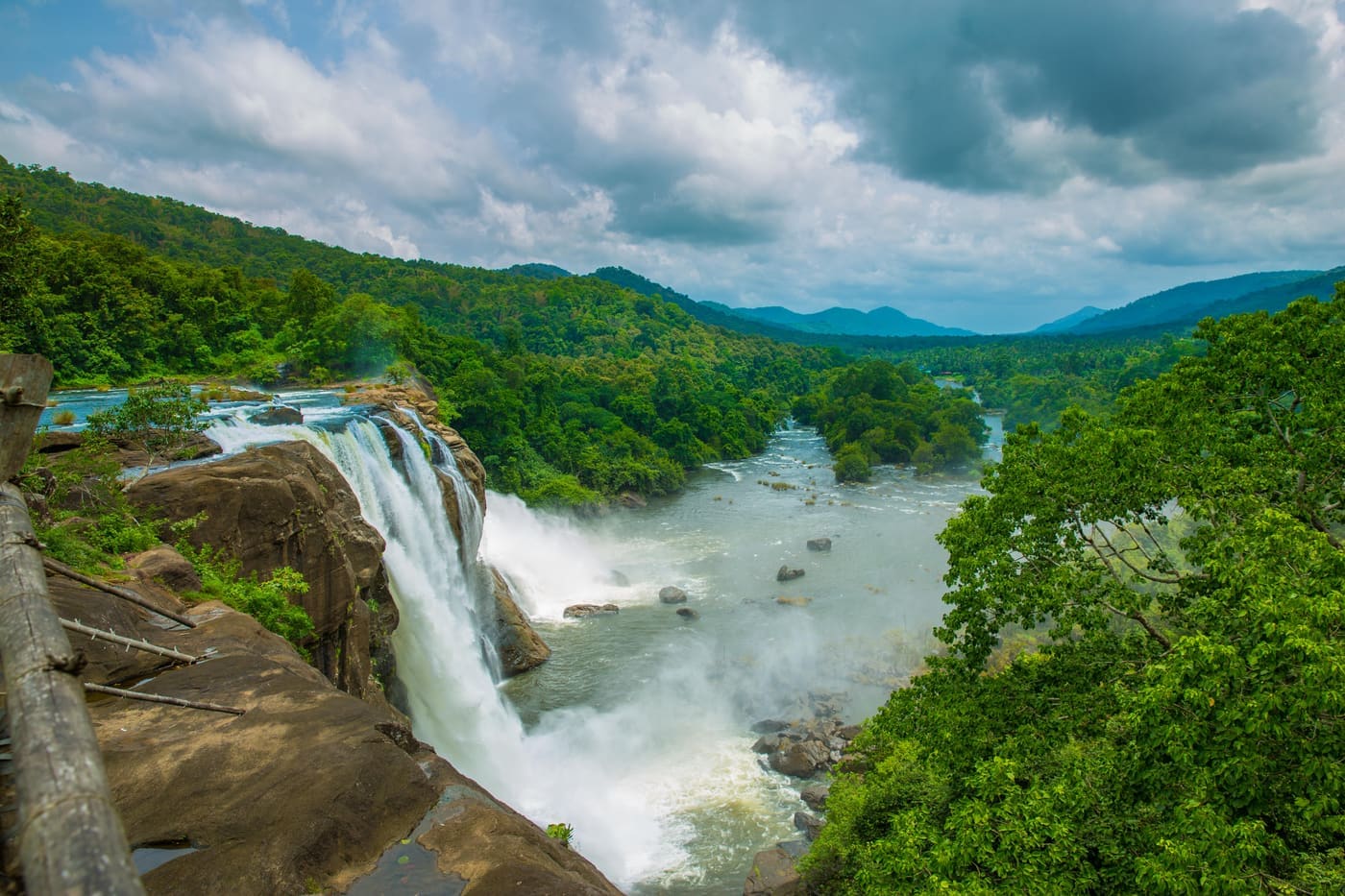
Vazhachal Falls is the quieter, wilder sibling of famous Athirappilly, a broad sweep of the Chalakudy River breaking into white rapids over black rock at the very edge of the Vazhachal Forest Division — one of the last riverine rainforests in the southern Western Ghats, home to all four of India's peninsular hornbills and to the Kadar, an indigenous community whose stewardship has kept this stretch of river alive.
The story of Vazhachal Falls
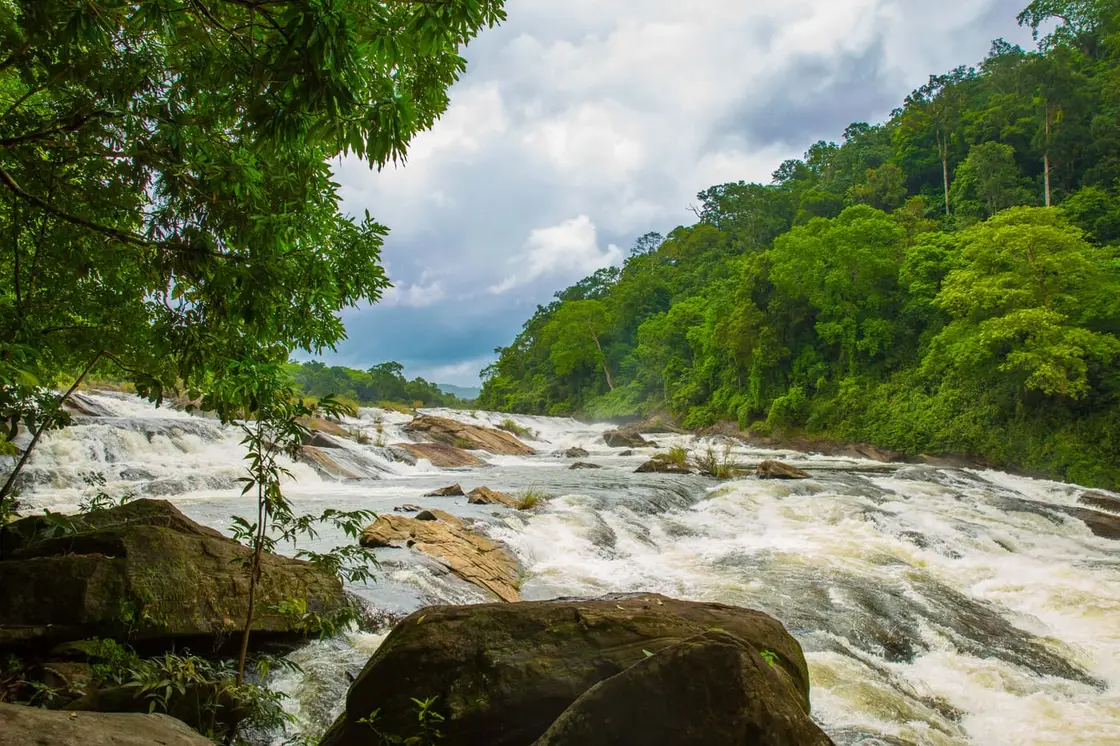
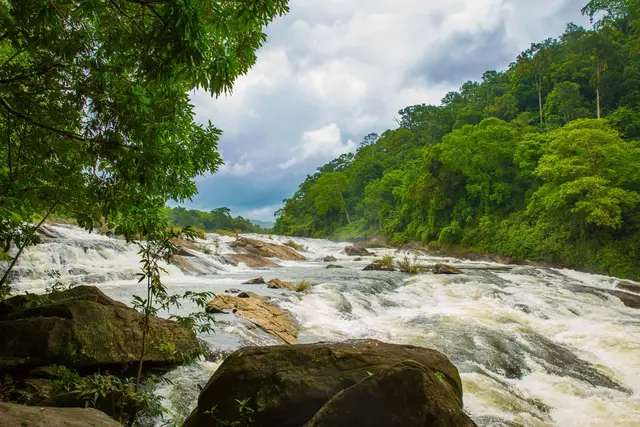
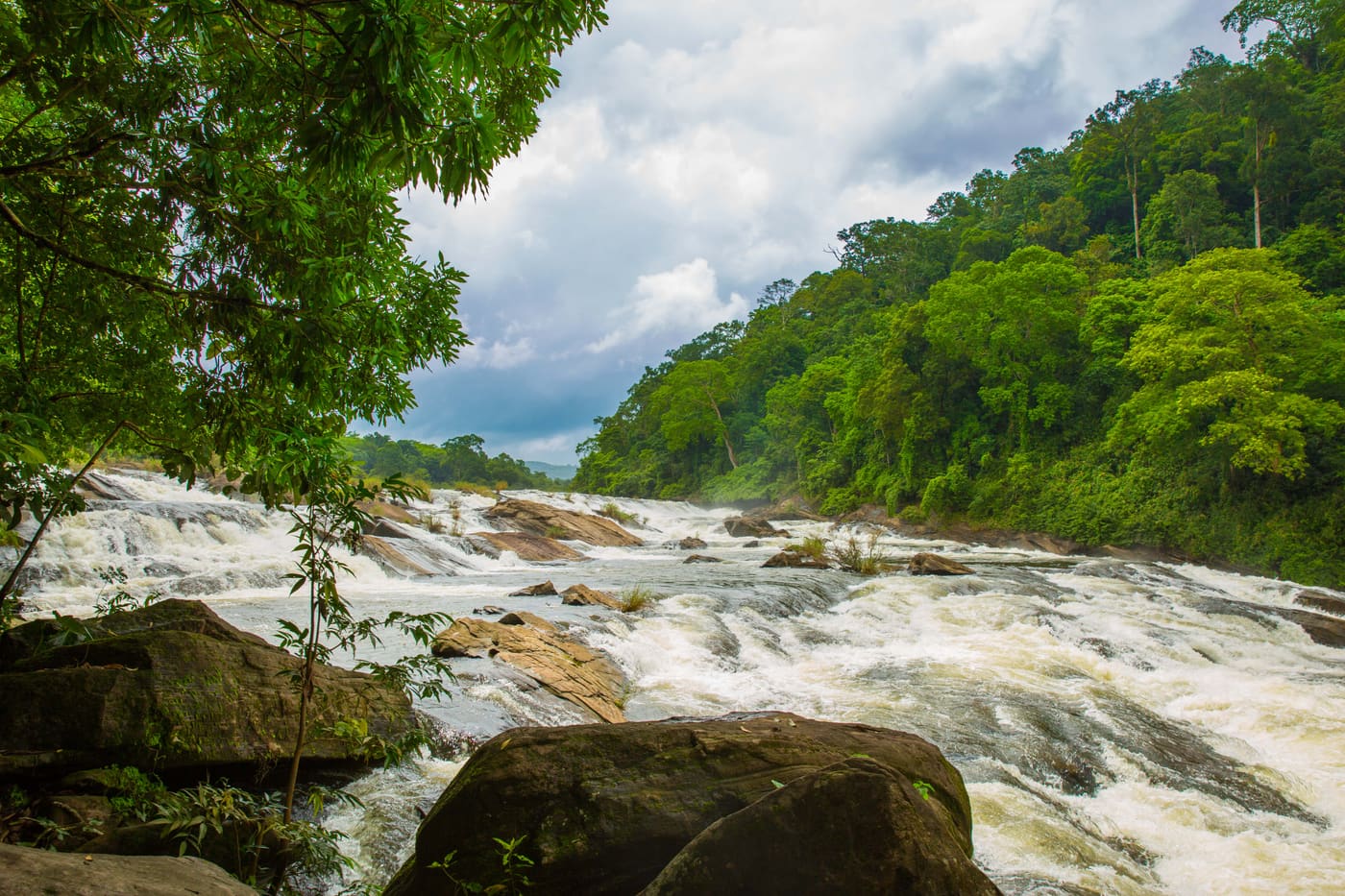
Where Athirappilly drops in one thunderous plunge, Vazhachal spreads out and races. Here the Chalakudy River widens across a long shelf of dark, water-sculpted rock and shatters into a fan of cascading rapids and low cascades rather than a single tall fall. In the monsoon the whole width turns into a roaring sheet of foam; in the drier months it settles into braided channels sliding between smooth boulders, with the forest crowding right down to the water's edge.
The setting is the real spectacle. Vazhachal sits at the threshold of the Vazhachal Forest Division, a rare low-elevation riverine forest that forms part of the Anamalai landscape in the Western Ghats — a UNESCO-recognised global biodiversity hotspot. The Chalakudy is one of the most species-rich rivers in Kerala, and the ribbon of forest along it is a corridor for elephants, a refuge for the endangered lion-tailed macaque and Malabar giant squirrel, and, most famously, a stronghold for hornbills.
This is one of the very few places in the entire Western Ghats where all four of the region's hornbill species are found together: the magnificent great hornbill, the Malabar pied hornbill, the Malabar grey hornbill and the Indian grey hornbill. The great hornbill — locally the Malamuzhakki Vezhambal, roughly the one whose deep call resounds through the mountains — needs tall old riverside trees with natural cavities to nest, which is exactly what this stretch of the Chalakudy still provides (indicative — confirm locally).
The forest here is not empty wilderness; it is the ancestral home of the Kadar, a small indigenous community who have lived along the Chalakudy for generations. Traditionally gatherers of forest honey, medicinal plants, fruit and fish, the Kadar hold an intimate, working knowledge of the river and its trees. In recent decades members of the community have turned that knowledge to conservation — helping monitor and protect hornbill nests, and largely ending the earlier practice of hunting the birds (indicative — confirm locally).
That guardianship has a hard-won political edge. Under India's Forest Rights Act of 2006 the Kadar settlements have secured Community Forest Rights over a long stretch of this landscape, giving them a formal say over what happens on their territory. Figures such as Geetha Vazhachal — described as the first woman moopathi, or chieftain, of the Kadar — have become well-known voices for the community and for the river, linking indigenous rights with the defence of the forest itself (indicative — confirm locally).
For the visitor, all of this gives Vazhachal a different mood from its crowded neighbour. It rewards those who slow down: the shine of spray on rock, the possibility of a hornbill's heavy wingbeats overhead, the sense of standing at the edge of a forest that people have fought, successfully so far, to keep whole.
History
Vazhachal has long been known simply as a beautiful bend of the Chalakudy River on the old route toward the high ranges and the Tamil Nadu border, close enough to Athirappilly that the two are almost always visited together. It lies within the Vazhachal Forest Division, managed by the Kerala Forest Department, which controls access and runs the shared entry-pass system with Athirappilly (indicative — confirm locally).
The stretch's modern reputation is bound up with conservation science. The Chalakudy River basin and the Vazhachal forests have been recognised for exceptional ecological value — the area has been identified as an Important Bird Area for its hornbill populations, and the riverine forest is prized as one of the few of its kind left in Kerala (indicative — confirm locally).
From the mid-1990s onward, Vazhachal became the centre of one of Kerala's longest-running environmental controversies: the proposed Athirappilly hydroelectric project. First put forward by the Kerala State Electricity Board around 1996, the plan envisaged a dam on the Chalakudy in the Vazhachal Forest Division — reported at roughly 23 metres high with a 163-megawatt capacity — to generate power (indicative — confirm locally).
The project drew sustained opposition on two intertwined grounds. Ecologically, critics warned it would submerge biodiverse riverine forest, threaten the hornbills' nesting habitat and disrupt an elephant corridor, and could diminish the flow that makes both Vazhachal and Athirappilly what they are. On rights grounds, the Kadar community opposed it, pointing out that many families would be displaced and that the community had already been pushed downstream by earlier hydro projects; under the Forest Rights Act their Community Forest Rights gave the opposition legal weight (indicative — confirm locally).
After decades of protests, legal challenges and studies, the Kerala government at one point announced it was shelving the project — though proposals to revive it, at times reframed around tourism, have periodically resurfaced. Because the situation has shifted over the years and remains contested, treat any specific status as provisional and confirm the current position locally (indicative — confirm locally).
Why visit
It is a genuine Western Ghats rainforest riverscape without the full crush of Athirappilly — the same magnificent Chalakudy River, but broader, wilder and framed by dense forest that comes right down to the rocks.
It is one of the only spots in the Western Ghats where all four peninsular hornbill species occur, so patient birdwatchers have a real chance of hearing or glimpsing the great hornbill and its relatives around the riverside forest (sightings never guaranteed — indicative, confirm locally).
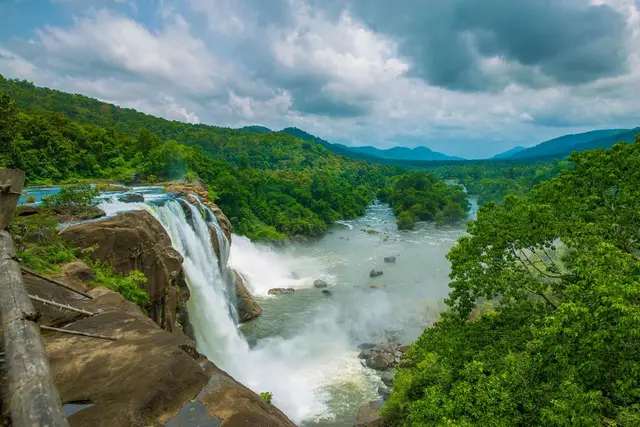
The falls pair naturally with Athirappilly just a few kilometres away, letting you combine the region's dramatic single plunge with Vazhachal's long, cascading rapids in a single outing.
In full monsoon the river is at its most powerful and photogenic, a wide roaring sheet of white water against black rock and green forest — one of the great sights of central Kerala.
It carries a rare and important story: a living indigenous community, the Kadar, whose stewardship and rights struggle to protect this forest and its hornbills make Vazhachal as much a place of conservation history as of scenery.
Because it is less commercialised, it suits travellers who want quiet, nature and a slower pace over selfie-crowds — a place to sit by the water and watch the forest rather than tick a box.