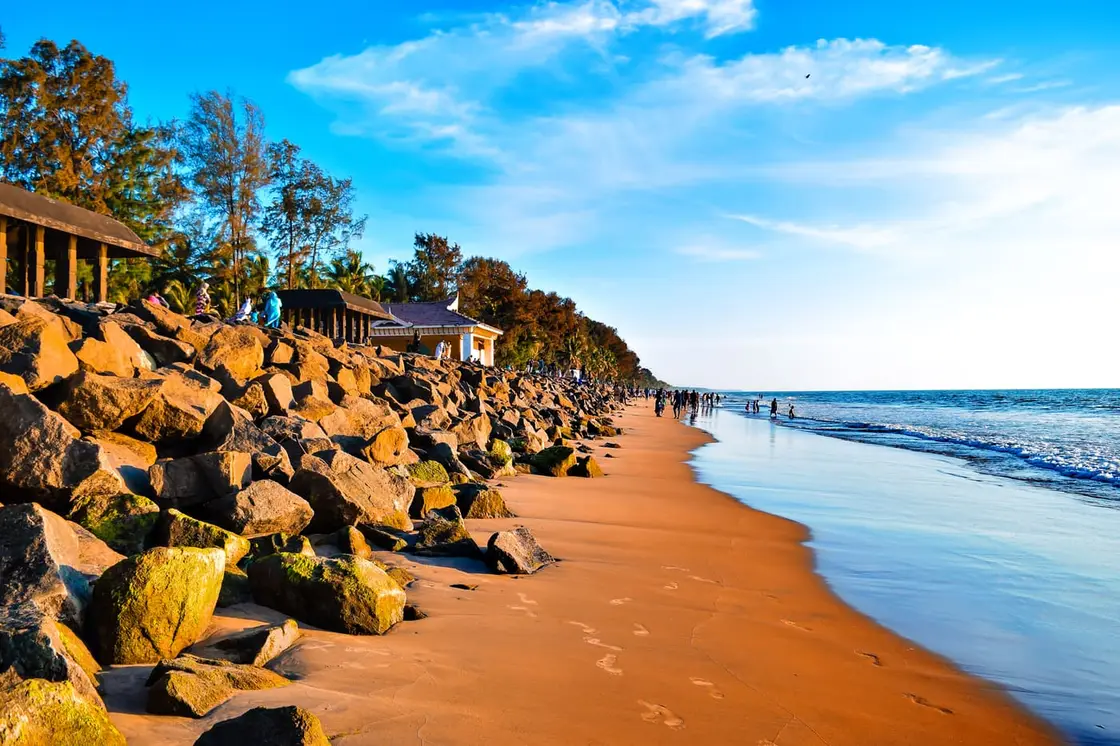
Snehatheeram — the name means “Shore of Love” — is Thrissur’s most-loved family beach, a broad ribbon of golden sand at Thalikulam where casuarina groves lean over a tidy, tree-shaded promenade and the Arabian Sea burns orange, pink and violet at sundown. Clean, landscaped and cared-for, it earned Kerala Tourism’s best-beach honour in 2010 and has drawn Thrissur’s evening crowds ever since.
The story of Snehatheeram Beach
The first thing you notice at Snehatheeram is how gently it welcomes you. The sand runs wide and pale-gold, sloping in an easy, unhurried gradient down to the Arabian Sea, and behind it stands a windbreak of casuarina — the feathery, pine-like trees that hiss softly whenever the sea breeze moves through them. Families spread mats in their shade, children chase one another between the trunks, and couples find quiet corners along the tiled walkway that traces the shoreline. It is a beach designed to be lingered on, not merely glanced at.
The name carries the mood. “Snehatheeram” joins the Malayalam words for love (sneham) and shore (theeram), and the “Love Shore” tag has stuck for good reason — this is a place couples and families come to slow down together. Unlike the working fishing strands up and down this coast, Snehatheeram has been shaped into a landscaped destination: manicured gardens, paved paths, benches facing the water and shaded play zones, all kept notably clean by the district tourism authorities who manage it.
For families with young children the draw is the dedicated children’s park set just back from the sand, with rides, swings and play equipment carrying only a nominal charge (a few rupees each). Alongside it a small marine aquarium adds an educational stop, displaying a variety of aquatic species — a rare touch on a Kerala beach and a reason parents cite for choosing Snehatheeram over the wilder shores nearby. Between the park, the aquarium and the open sands, a family can happily fill a whole evening here.
The casuarinas are more than scenery — planted along many Kerala shores as a natural windbreak and sand-binder, they give Snehatheeram its distinctive filtered light and cool, whispering shade even on warm afternoons. Their long shadows stretch across the beach as the day cools, and the strip of green between the road and the water is what turns an ordinary stretch of coast into a proper picnic ground. Vendors and small seafood shacks cluster near the entrance, so the smell of fish curry and prawn fry drifts along with the sea air.
This remains a living coastline as well as a tourist one. Thalikulam sits within the long fishing belt of central Kerala, and colourful country boats and the day’s catch are part of the everyday backdrop — a reminder that the sea here feeds the villages behind it as much as it entertains the visitors on the sand. Watching the boats come and go is part of the pleasure of an unhurried evening at Snehatheeram.
But the reason most people time their visit for late afternoon is the sunset. With the beach facing due west into the open Arabian Sea, the sky above Snehatheeram runs through a slow blaze of orange, then pink, then deep purple, silhouetting the casuarinas and the fishing boats against the water. It is one of the most photographed sundowns in the Thrissur district, and on clear evenings the crowd along the walkway falls quiet to watch the light go. A note of caution, though: the Arabian Sea along this coast can carry strong currents and sudden undertows, so wade and bathe only in the shallows near the shore, keep children close, and never swim out far — the calm surface can be deceptive.
History
For most of its history Thalikulam was known simply as a fishing settlement on the Thrissur coast rather than a visitor destination — the beach was a working shore, not a landscaped one. Its transformation into “Snehatheeram,” the manicured family beach known today, came through deliberate tourism development by the district authorities, who laid out the gardens, the tiled shoreline walkway, the children’s park and the seating that now define the place (indicative — confirm locally).
The single milestone most often repeated is official: in 2010 Kerala’s Department of Tourism selected Snehatheeram as the best beach tourism destination in the state. That recognition, widely cited by Kerala Tourism and the district tourism promotion council, marked the point at which a quiet local shore became a headline attraction and cemented its reputation across the district.
The beach is maintained as a managed tourism facility rather than left as open coast — a distinction visitors feel immediately in its cleanliness and upkeep. Small paid attractions such as the children’s park and the marine aquarium, together with the food stalls and the Naalukettu-style seafood restaurant near the entrance, were added to give families a full evening out rather than just a patch of sand (indicative — confirm locally).
That family-first design is what sets Snehatheeram apart from neighbouring stretches of the same coastline. Where beaches to the north and south remain largely undeveloped working shores, Snehatheeram’s combination of a dedicated children’s park, an aquarium, landscaped gardens and a safe, walkable promenade turned it into the shore Thrissur families choose by default — and steady word-of-mouth around that reputation, more than any single event, is what has kept it the district’s favourite beach year after year (indicative — confirm locally).
Today Snehatheeram sits within the wider Nattika–Thalikulam coastal tourism circuit of the Thrissur district, drawing domestic visitors throughout the year and busiest on weekend evenings and holidays, when the sunset crowds are at their thickest (indicative — confirm locally).
Why visit
One of Kerala’s cleanest, best-kept family beaches — officially named the state’s best beach destination by Kerala Tourism in 2010.
A rare beach with a dedicated children’s park (rides and swings for a nominal fee) plus an adjoining marine aquarium, making it ideal for families with young children.
Cool, shaded casuarina groves and a landscaped, tiled promenade for unhurried evening strolls, picnics and people-watching.
One of the Thrissur district’s finest sunsets — the west-facing shore blazes orange, pink and purple over the open Arabian Sea, a favourite of photographers.
Fresh-off-the-boat seafood at beachside shacks and a Naalukettu-style restaurant — fish curry, prawn fry and Kerala staples steps from the sand.
A genuine slice of coastal life, with colourful fishing boats and the working rhythm of the Thalikulam fishing belt as a backdrop.