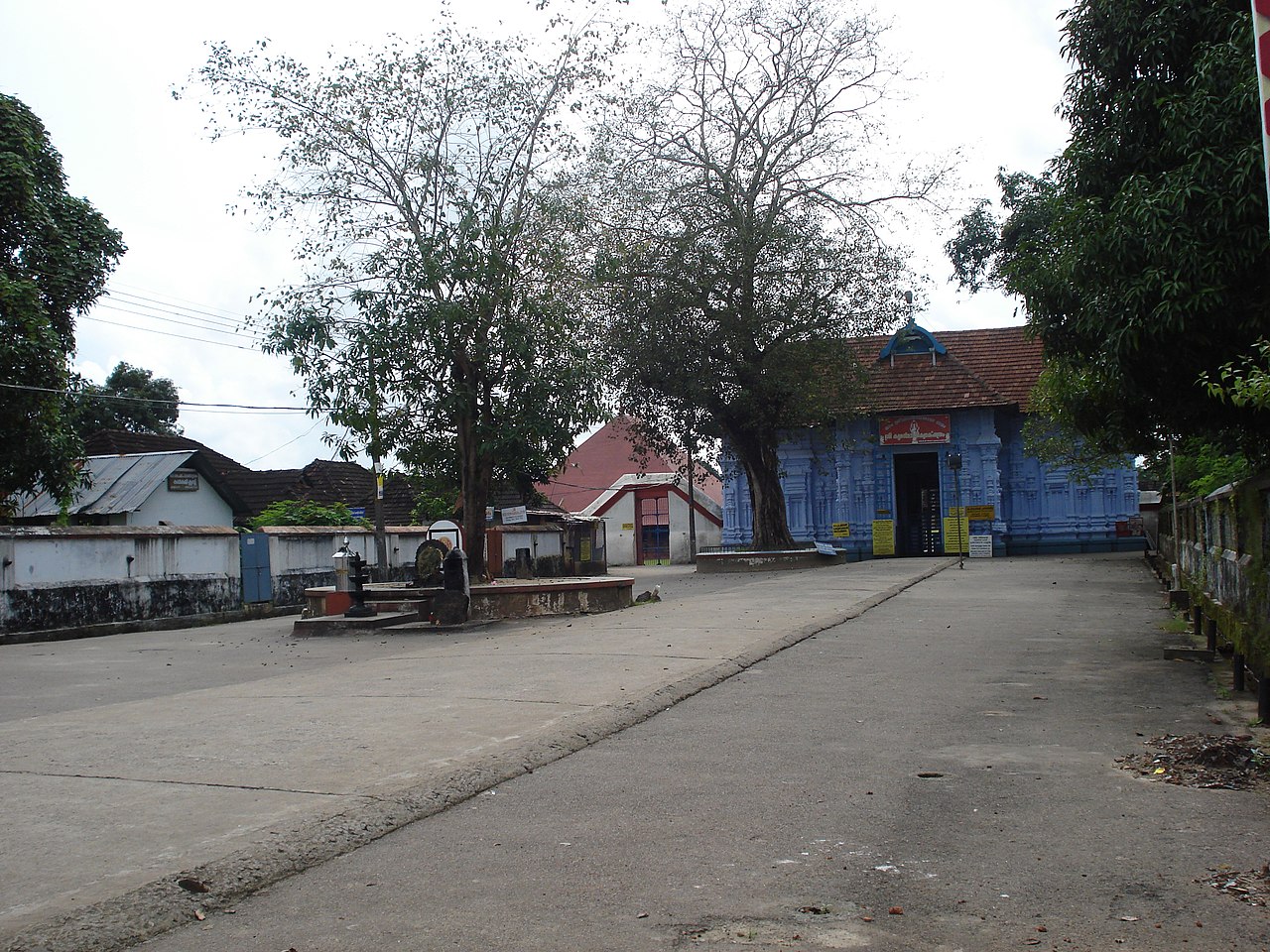
The story
On the quiet banks of the Theevra (Karuvannur) river, a short way inland from the Arabian Sea coast in Thrissur district, the Thriprayar Sree Ramaswamy Temple enshrines one of Kerala’s most beloved images of Sree Rama — worshipped here as Triprayar Thevar. Ancient, art-rich and steeped in the Ramayana, it is the foremost of the four Nalambalam shrines and the presiding deity of the legendary Arattupuzha Pooram.
The story of Thriprayar Temple
Thriprayar sits on the southern bank of the Theevra river, also called the Karuvannur, in the coastal belt of Thrissur district roughly midway between the great pilgrimage centres of Guruvayur and Kodungallur. The temple is dedicated to Sree Rama, the seventh incarnation of Vishnu, but here he is addressed with an intimacy peculiar to Kerala — as Triprayarappan or, more commonly, Triprayar Thevar, “the Lord of Thriprayar.” Devotees often call the shrine the Dakshina Ayodhya, the Ayodhya of the South.
What sets the sanctum apart is the idol itself. Unlike the familiar two-armed archer of the Ramayana, the deity here is a rare chaturbahu — a four-armed form more usually associated with Vishnu. The image bears a conch (shankha) and a discus (chakra) in two of its hands, and, depending on the account you hear, a bow or a mace together with a garland or lotus in the others. To worshippers this is Rama invested with the full majesty of the Godhead, and tradition holds that it depicts him in the moment after the slaying of Ravana, victorious and serene.
That fusion of the warrior-prince and the cosmic Vishnu gives Triprayar Thevar a layered character. Local temple lore also links the form to the killing of the demon Khara, earning the deity the name Khara Samhara Moorthy, and some accounts read the four attributes as uniting the Shaiva and Vaishnava aspects, even hinting at the Trimurti. Whatever the theology, the effect on a visitor standing before the lamplit sanctum is of a Rama who is at once approachable and vast.
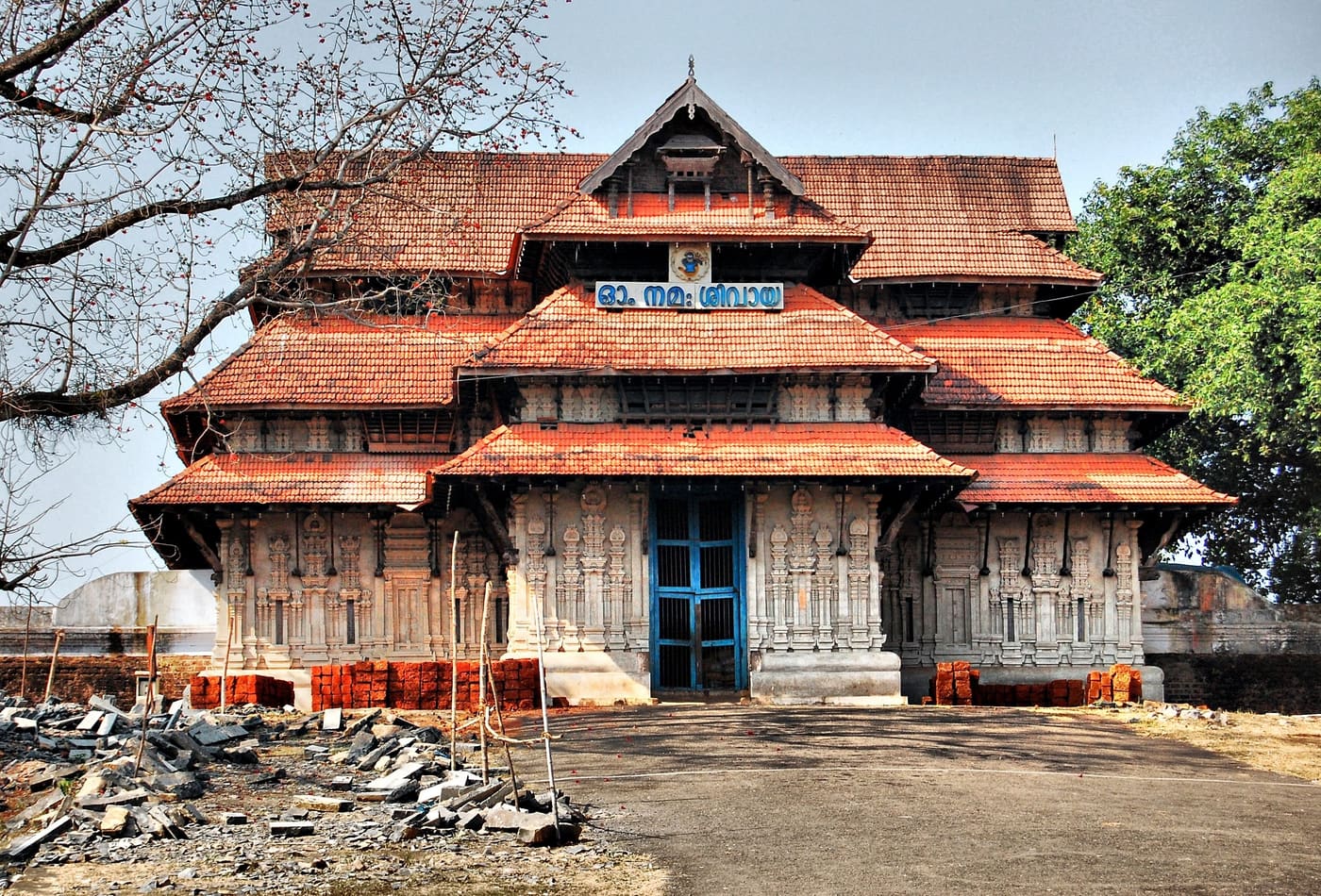
The sreekovil (sanctum) is circular, crowned by a conical copper-sheathed roof, and the temple is renowned across Kerala for the richness of its woodcarving — timber panels and struts alive with figures from the epics. As one of the district’s classic Kerala-style temples, Thriprayar has long been a stage for the ritual arts, and performances such as Kathakali and Chakyar Koothu have traditionally been offered here, especially during festival seasons (worth confirming the current programme locally before you plan around it).
The temple is also famous for its river life. A cherished offering called Meenootu — the feeding of the fish that shelter in the temple tank and the adjoining river — draws devotees who believe the act brings relief from respiratory ailments such as asthma. The sight of shoals gathering to be fed, in waters no one is permitted to harm, is one of the gentler images that stay with pilgrims long after the darshan.
Above all, Thriprayar is a temple of connections. It anchors the one-day Nalambalam circuit of the four sons of Dasharatha, and its deity presides over the Arattupuzha Pooram, spoken of as the “mother of all poorams.” To visit Thriprayar, then, is rarely to visit it alone — it is the head of a family of shrines and the senior partner in one of Kerala’s oldest festival gatherings.
Legend & myth
As legend has it, the four-armed idol of Thriprayar was no ordinary image but one worshipped by Sree Krishna himself at Dwaraka. When Krishna completed his earthly sojourn and ascended (the swargarohana), the story goes, his sacred possessions were given up to the sea, and the idol of Rama was among those lost beneath the waves.
Generations later, so the tradition runs, fishermen casting their nets off the Kerala coast near the Chettuva region drew up something far heavier and stranger than any catch — the lost image of the four-armed Rama. Recognising its sanctity, the local chieftain, remembered as the Vakayil (Vakkayil) Kaimal, is said to have received the idol and installed it on the banks of the Theevra at Thriprayar, and so the temple was born.
These accounts — the Dwaraka worship, the sea-borne idol, the fishermen’s miraculous find — belong to the temple’s devotional legend rather than to documented history, and are cherished as such. They are best received as sacred story: a way the community has long explained why an image of such rare form, and such power, came to rest at this particular bend of a coastal river.
History
Thriprayar is regarded as an ancient foundation, generally spoken of as dating back many centuries, and it stands among the older established Rama temples of the Kerala coast. As with many shrines whose origins are wrapped in legend, precise dates are hard to fix, but its antiquity is not in doubt — it has been a working centre of worship and temple arts for a very long time.
Over the centuries the temple drew the patronage of the region’s ruling powers. Accounts associate it at various times with the Zamorins of Calicut and the rulers of Cochin, among others, whose gifts and protection helped sustain the shrine, its rituals and its considerable festival calendar. Such royal association was typical of a temple of Thriprayar’s standing.
Its most enduring historical role, however, is ceremonial. Triprayar Thevar is the presiding deity of the Arattupuzha Pooram, held at nearby Arattupuzha and reckoned among the most ancient of Kerala’s pooram festivals — so old that it is popularly called the “mother of all poorams,” a forerunner of the grand temple gatherings for which the Thrissur region is famous. Thriprayar’s deity takes the senior place in that assembly of gods.
Equally, Thriprayar heads the Nalambalam — the set of four temples honouring Rama and his three brothers, Bharata, Lakshmana and Shatrughna. The tradition of completing all four in a single day, especially in the monsoon month of Karkidakam, has made Thriprayar the starting point of a pilgrimage undertaken by generations of Malayali families, giving the temple a fixed and honoured place in the devotional geography of central Kerala.
Alongside these grand associations, the temple has preserved a set of distinctive vazhipadus (offerings) that carry their own remembered histories — the Meenootu fish-feeding, the Chathan seva or bhandaram believed to ward off malign influences, and the Kadhina Vedi barrel-cracker offering, popularly linked to the return of Hanuman from his search for Sita. Together these keep the older layers of the temple’s life alive in daily practice.
Why visit
To stand before one of Kerala’s rare four-armed images of Sree Rama — Triprayar Thevar — a form understood as Rama in the full glory of Vishnu, and by tradition depicting him in the aftermath of Ravana’s fall.
To begin (or complete) the Nalambalam circuit at its very head: Thriprayar is the Rama shrine that opens the one-day pilgrimage of the four brothers, a deeply meaningful journey especially in Karkidakam.
To connect with the Arattupuzha Pooram, the “mother of all poorams,” whose presiding deity is the Lord of Thriprayar — a living link to the oldest festival traditions of the Thrissur country.
To take in a temple that is a treasury of Kerala craft and performing art — a circular copper-roofed sanctum, richly carved woodwork, and a long association with Kathakali and other ritual arts during the festival months.
To share in the gentle ritual of Meenootu, feeding the protected fish of the river, and to sit a while on the peaceful banks of the Theevra — a riverside setting that gives the whole visit an unhurried, contemplative air.
To time a trip with the temple’s great occasions — the Vrischikam Ekadasi, with its splendid procession of caparisoned elephants, and the Meenam-month Pooram — when the shrine is at its most alive with lamps, music and crowds.